The fleet has scarcely drawn breath since crossing the finish line.
Leg 2 of the 2026 Doyle Sails Round North Island Two Handed Yacht Race proved to be the kind of passage that crews will be talking about for some time. The 480 nautical mile run from Mangōnui to Queen Charlotte Sound opened as a strategic question and hardened quickly into something far more physical. The first major decision came at the top of the North Island: push west for angle and pressure, or turn south sooner and stay closer to the coast. How each crew answered that question shaped everything that followed.
What came next made the choice even more consequential. Winds climbed above 30 knots, gusts hit 37 knots, and the sea state settled into what crew after crew called lumpy and bumpy. For a two-handed fleet working through the night and into a demanding following day, the conditions asked hard questions. Then, as the weather relented, the leg transformed once more. Survival gave way to boat speed, tactical positioning, and the hunt for pressure at precisely the right moment.
At the sharp end, Explore Racing and Motorboat III turned the line honours fight into something worth watching. Explore Racing crossed first, edging Motorboat III by just 9 minutes 51 seconds on elapsed time. On corrected time, Kick produced the leg's outstanding result, claiming overall PHRF honours and Division 3. Pipi topped Division 2 on PHRF, Carpe Diem took Division 4, and Motorboat III added Division 1 on corrected time to its elapsed podium finish.
Beyond the front of the fleet, corrected time margins stayed tight well into the placings. The racing was not decided only by the leaders. It was contested hard across the full spread of the fleet.
After yesterday's rest day, attention now turns to what lies ahead.
{{TABLE_1}}
Leg 3 departs at 1pm this afternoon from just outside Tory Channel. At 220 nautical miles it is considerably shorter than Leg 2, though shorter should not be read as straightforward. In several respects, this leg may prove to be among the more complex of the race.
The opening task is Cook Strait. Tidal flows, shifting gust patterns, exposed headlands, and a sea state that has a habit of compressing fleets all sit between the start line and the far shore. Boats that find clean air and stay in pressure from the outset are likely to gain ground quickly, while those that drop into holes or get caught on the wrong side of a tidal rip will find the gap hard to recover.
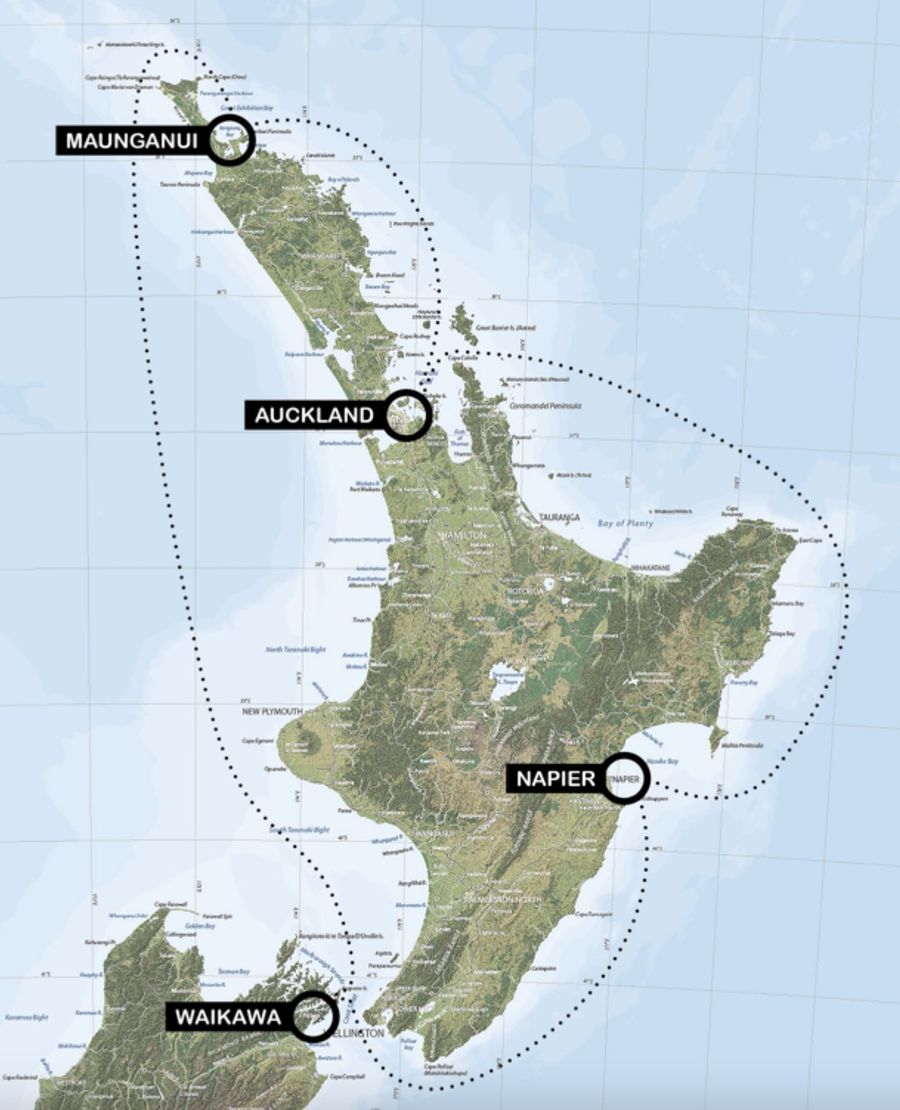
Beyond the strait, the course tracks along what the organisers describe as the notorious Wellington south coast. Crews face a choice that has no easy answer: sail tighter inshore and manage the tidal rips, or stand further offshore to keep away from the worst of the disturbed water. Both options carry a cost. From there, the route heads to Turakirae Head, then across Palliser Bay past Ngawi and around Cape Palliser. It is a section of coastline that consistently feels larger than the chart distance implies. The leg then reaches up the Wairarapa Coast, rounding Castlepoint and Cape Turnagain before bearing into Hawke Bay, past Cape Kidnappers, and on to the finish at Napier Harbour.
The course is full of shape. Corners, transitions, and sustained coastline influence mean there will be few quiet stretches from start to finish.
The forecast for Leg 3 promises an energetic opening. At the 1pm start from Charlotte Sound, crews should expect southeast winds around 19 knots building toward 24 knots, gusting to 31 knots, under cloudy skies with an air temperature of about 15 degrees. Sea state inside the Sound will be short and steep, roughly 0.7 to 1.4 metres at four seconds, giving the fleet a choppy exit as it clears into Cook Strait.
Through the afternoon and into the evening, as boats push along the southwestern corner of the North Island, southerlies of 17 to 21 knots are forecast with gusts into the mid-twenties. Seas are expected to build to around 2.3 metres at seven seconds. Smaller and slower boats may still be working through the toughest conditions while the quicker ones have already pushed clear, making this phase of the leg particularly demanding for the back end of the fleet.
Overnight, the breeze is forecast to ease back to 14 to 18 knots, with seas sitting around 2.2 metres at eight seconds. The motion should become a fraction more manageable, though conditions will remain enough to keep everyone attentive.
Along the Wairarapa Coast by tomorrow morning, the wind is expected to shift west and then southwest, generally in the 11 to 19 knot range, with seas also moderating. The leading boats could find a workable run into Hawke Bay during this window. Tomorrow afternoon brings a fresh complication, with southerlies forecast to build again as the fleet approaches Napier.
The real variable may emerge right near the finish. Closer to Napier, the breeze is expected to ease significantly through tomorrow afternoon and evening, becoming lighter and more variable overnight and into Wednesday. Arrival time will matter enormously. The faster boats may carry stronger pressure all the way in, while those arriving later could face a softer, more tactical finale with very different implications for their corrected time.
Leg 2 was a test of resilience and patience. Leg 3 looks set to reward clean starts, smart transitions, and the capacity to keep adjusting as the wind shifts down the course. The route to Napier has no shortage of places where time can be won or lost in a hurry.
Given what this fleet produced on the last leg, another absorbing afternoon seems almost certain.