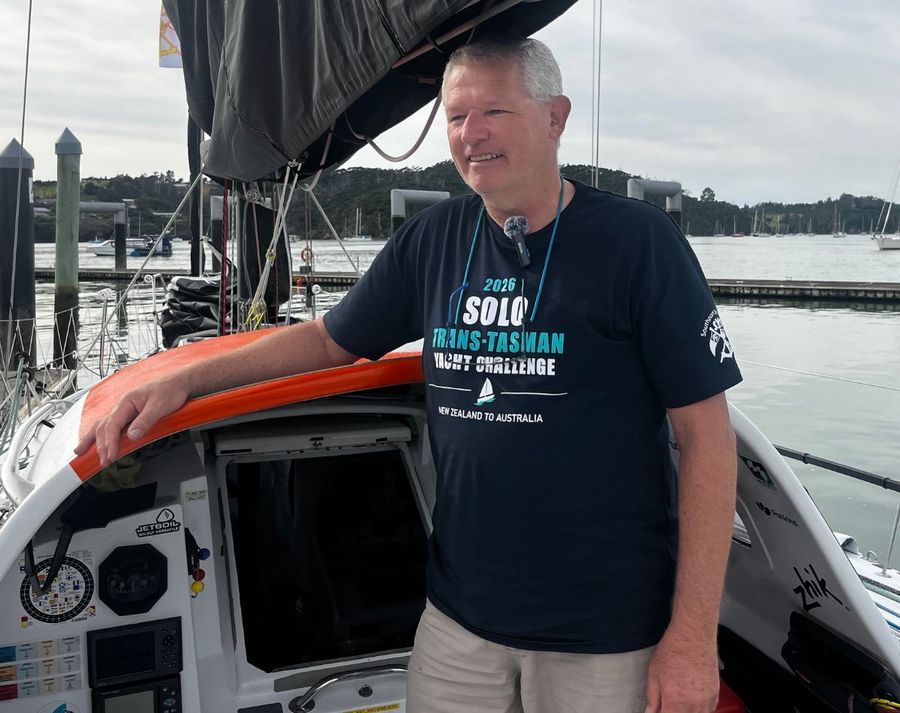
Kevin Le Poidevin came agonisingly close. Somewhere around 120 nautical miles out from Newcastle, with more than 13 days of hard Tasman miles behind him, his third attempt at the Solo Trans-Tasman Yacht Challenge ended without a finish line. The race was already over for him, undone by a single snapped shackle west of Balls Pyramid. What followed across the next several days was, by his own account, the most demanding sailing of his life.
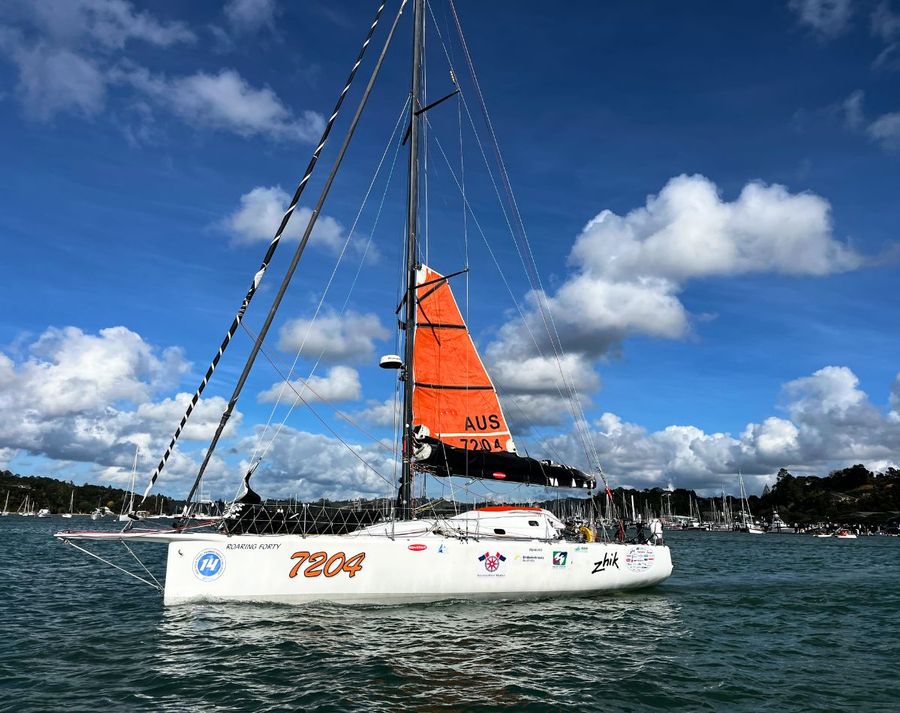
Doug Esterman was the last competitor to cross the finish at Southport, bringing his Cavalier 39 Fair Winds over the line earlier today. Le Poidevin, sailing the Open 40 Roaring Forty, never joined him there. He was still motoring toward Newcastle when the two spoke, beanbag out in the cockpit, J3 flying on a rebuilt forestay, a Volvo diesel humming below. He expected to tie up around nine the following morning, wash the boat down, pack his bags, and fly to Southport in time for the finishers' party on Sunday.
Roaring Forty departed Ōpua on Saturday 30 May with the rest of the 2026 Solo Trans-Tasman Yacht Challenge fleet, leaving a calm harbour with barely a breath of wind. The boats crept northward along the Northland coast and, once around North Cape, sailed straight into conditions that had been well flagged in the forecasts: high winds, hard gusts, and squalls stacked across the Tasman. Most of the fleet altered course to skirt the worst of it, swinging onto a more south-westerly heading. Le Poidevin had intended to hold tight to the rhumb line, but within two days the weather had shut that option down completely. He followed the same arc as the others, sacrificing directness for survivability while working to protect what distance he could make good. There was no clean path regardless. Conditions kept deteriorating.
"That was towards the shit," he said, "and there was no way around it."
Wind and squalls continued building through the crossing. Then, early in the evening of day six, just west of Balls Pyramid, a momentary lull split a squall apart: 45 knots dropping suddenly to 10 or 11. Le Poidevin tacked through onto a north-westerly heading, third reef in the main and the J3 set on the inner forestay, driving through breaking seas at seven to eight knots. Then the speed fell away, and he went forward to find out why.
"I came up on deck, still daylight, about three or four in the afternoon. I looked forward and went, that's not my jib top. I saw this black and white furled sail lying on the deck and thought, oh, my bloody jib top hadn't broken. And then I looked again and went, oh, that's not my jib top. That's my actual structural stay that holds the mast up."
He bore away and dropped the main almost simultaneously. The runner was already on and loaded. The inner forestay was carrying the rig load. The mast stayed in the boat. The forestay itself had come down with something close to orderliness, draping across the stanchions with both the stay and the furler intact. The cause was a snapped eight-ton shackle, found cleanly broken in two. Years of accumulated hard miles, compounded by the relentless gusty punishment of this crossing, had fatigued the metal through. A $150 fitting had ended his race.
Le Poidevin motored through the darkening conditions toward Lord Howe Island, arriving on the more sheltered eastern side roughly five hours later in pitch black. Local authorities strongly advised against attempting to anchor in those conditions. With no better option available, he settled into a continuous loop through the night: motoring up under the shelter of the cliffs, setting his alarm, letting Roaring Forty drift back while he grabbed whatever sleep he could, then waking to the alarm and starting again.
"Motor up, drift back, motor up, drift back. That was the plan for as long as I could manage it."
When conditions eased enough to justify an anchoring attempt, he moved to Ned's Beach. The holding proved poor. At 9pm the anchor alarm dragged him out of sleep. He surfaced from below to a rhythmic thudding and understood immediately that he had drifted too close to shore. The keel was touching the sandy bottom and working against it with each swell. He threw the engine into full reverse with the throttle hard open, using the lift of each passing wave to claw back ground, and worked Roaring Forty's bow around degree by degree until he had a clear bearing to open water. He got off the bottom by executing a three-point turn with a keel dug into sand, and he got out.
Needing rest, he found a second anchoring spot a little further offshore, tucked close to the cliff face. Anchor down, and he lay down too. Then the alarm fired again sometime in the night. The anchor rode had chafed through on reef. Pitch black, cliff on one side, reef on the other, he ran his pre-planned escape heading: forward two minutes, turn right. He came through into clear water with nothing left on the end of the chain. Back to drifting.
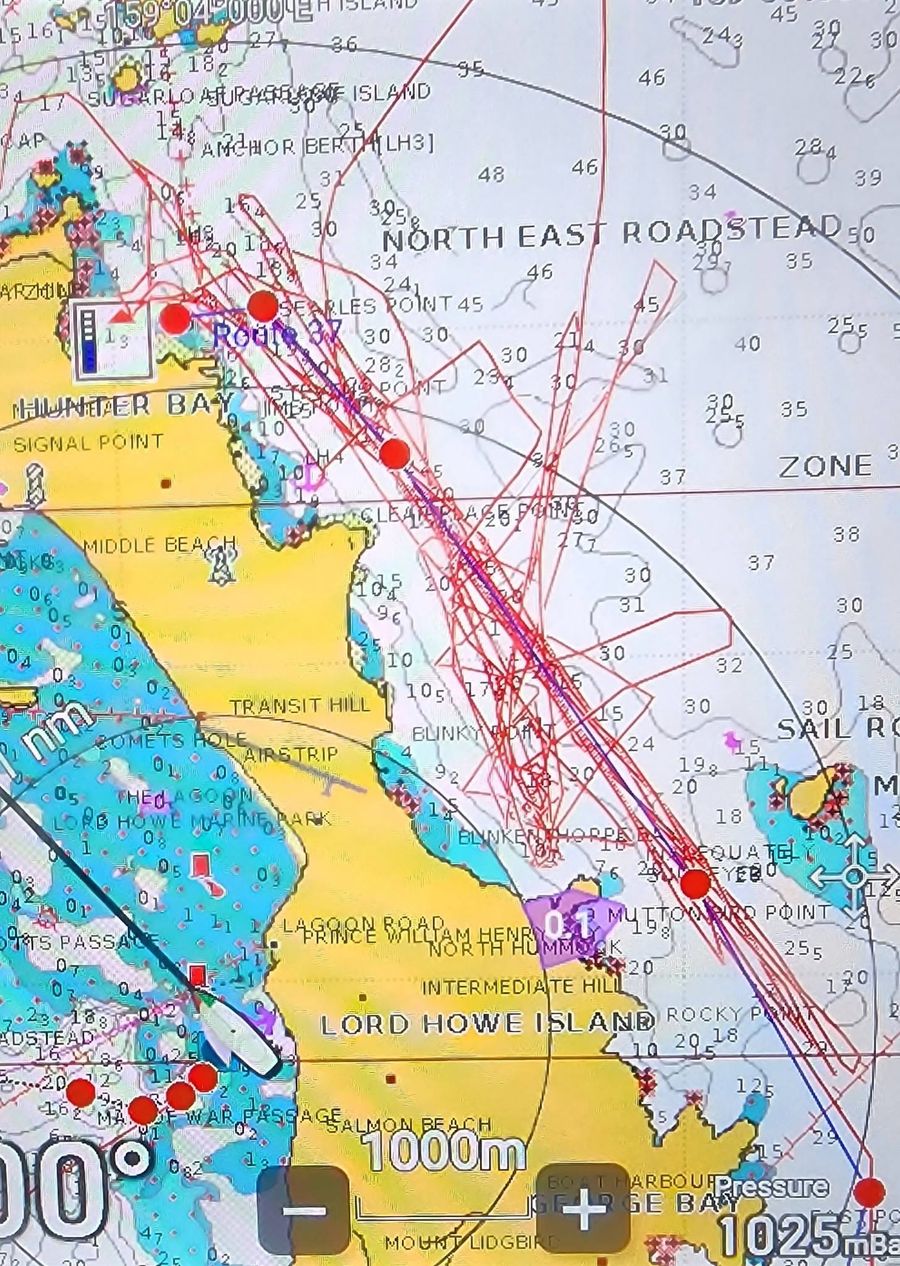
When the wind shifted enough to open a passage to the island's western side, he moved. A mooring had been made available, and Joel, the local marine officer, drove down to the mooring patch and pointed his car headlights at the water to guide Roaring Forty in. Le Poidevin picked up the buoy, ran through his checks, and lay down. Seconds later the alarm sounded again. The buoy had simply come with him, not properly set.
Joel returned. It turned out Le Poidevin had picked up a neighbouring buoy entirely. Joel came back a second time, this time with the rescue crew in a dinghy, located the correct mooring, and made it properly fast. Then Le Poidevin slept.
Rain the following day kept him below. When it cleared, even with the wind still blowing hard, he went aloft. The carbon spar was slippery from the rain, and the work at the masthead was intricate: constructing a substitute forestay from 11mm Dyneema, with a large turnbuckle to be tensioned incrementally against the furler attachment. Up at the top of the rig, the mast was moving two metres side to side. Below the hull, sharks were making slow, unhurried circuits around Roaring Forty.
"I climb the mast myself a lot, so I'm quite comfortable up there. But trying to stabilise yourself to do the job, I put an eye on the stay with some Dyneema, chafe sleeve around it. I was hoping to luggage-tag it through the clevis pin, which was still in there. Because if I dropped it, I was stuffed."
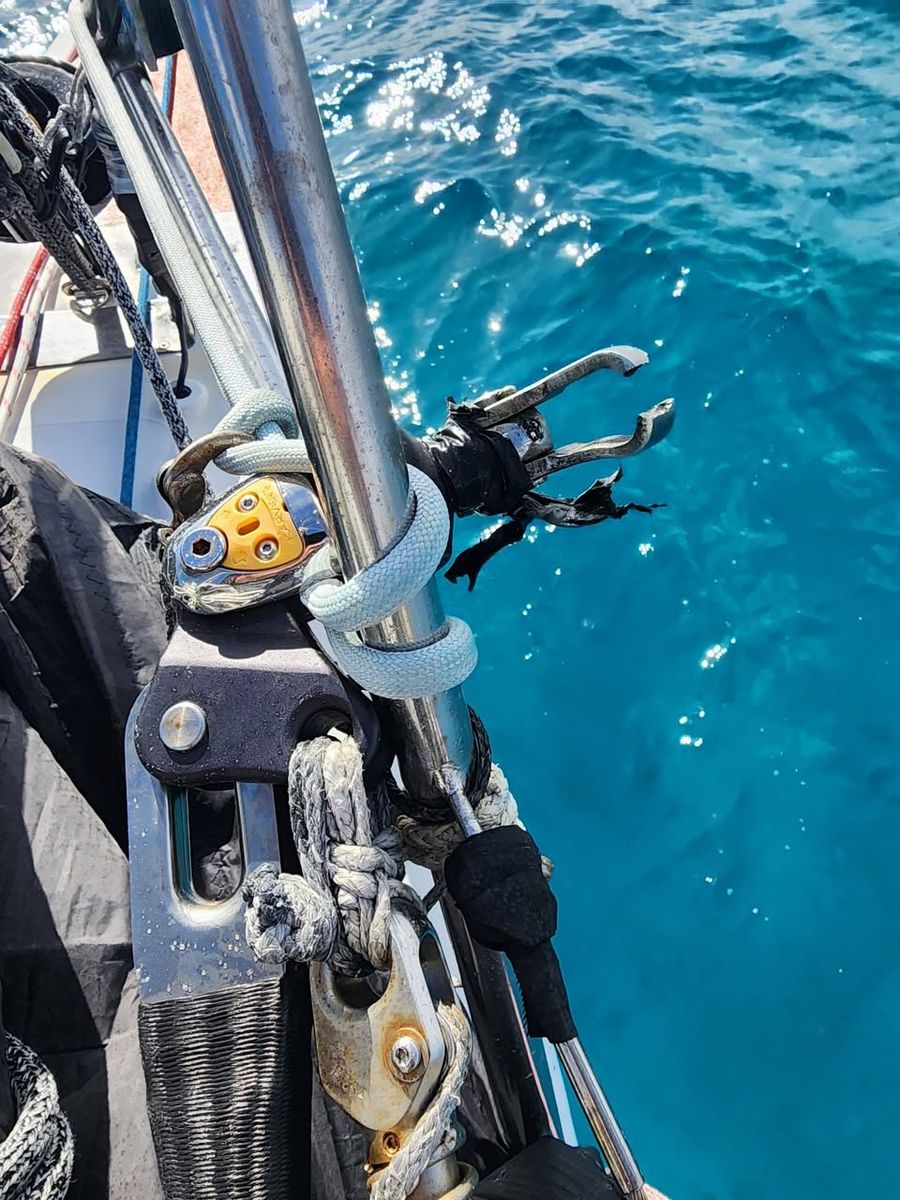
Threading the eye through the clevis proved impossible. Instead he lashed it, wrapping Dyneema five or six times through the eye and around the clevis pin and pulling it snug, then adding leather and zip ties over the damaged bracket to guard against chafe. Working the bottom end of the stay was then a matter of cycling through a sequence: crank on halyards, ease the turnbuckle, shorten the lashing, repeat, until the stay was solid and the rig could be trusted. With that done, he pointed Roaring Forty at the Newcastle Cruising Yacht Club and drew the most direct line he could manage.
Luck had little to do with getting him through, and he had precious little of it on this trip anyway. What he had instead was 15 years as a mechanic, 31 years in the Royal Australian Air Force with cross-training across avionics, radar, instruments and radio, nine years as an Air Sea Rescue skipper working the Gold Coast bar before the seaway was built, three years with the ambulance service, and a career that had taken in project management, aviation maintenance risk assessment, and a deployment to the Middle East in 2003.
"Dealing with stressful situations in a calm, controlled manner, with critical thinking applied to every step. That's where I think all of those things come into play."
Exhaustion came through clearly in the telling. So did frustration. Panic never surfaced. Neither did any thought of giving up.
Roaring Forty came off the beach without damage. An underwater camera inspection the morning after confirmed no harm to the keel, the sandy bottom having cushioned the impact where rock would have caused serious injury. The total structural damage amounted to one failed shackle and a slightly chewed forestay fitting at the masthead, both of which will be replaced. The mast will be pulled for non-destructive testing, though Le Poidevin is relaxed about what that inspection will show. The cap shrouds remained tight throughout. Everything else is planned maintenance already on the list.
None of it has dampened his appetite for a fourth attempt at the Trans-Tasman. He has a solo round-Australia record attempt to reschedule, a double-handed Sydney-Hobart Yacht Race to contest, a Cape Horn rounding ahead of him, and a possible return to the Global Solo Challenge.