Superyacht concepts occupy a space somewhere between imagination and inevitability. The most compelling designs look like science fiction when they first appear on a drawing board, yet something close to them tends to get built eventually. Recent years support that pattern: sustainability has moved from a recurring talking point into a live engineering brief, submersibles have become a genuine product category, and one designer has proposed a 3D-printed yacht with a hydroponic garden growing food inside the hull. Five concepts are worth understanding.
Sustainability is the defining preoccupation of superyacht design right now, and the proposals coming from serious studios are not simply gesturing towards it. They are engineering it in from first principles. Feadship's Concept C, unveiled at the 2024 Monaco Yacht Show, draws 100 per cent of its power from methanol fuel cells and lithium-metal batteries. Following that came BREAKTHROUGH, a 118.8-metre vessel and the first design primarily powered by green hydrogen, running 16 fuel cells with cryogenic storage and an underwater lounge integrated directly into the hull. For a category that spent decades defined almost entirely by diesel engines, these represent a genuine departure.
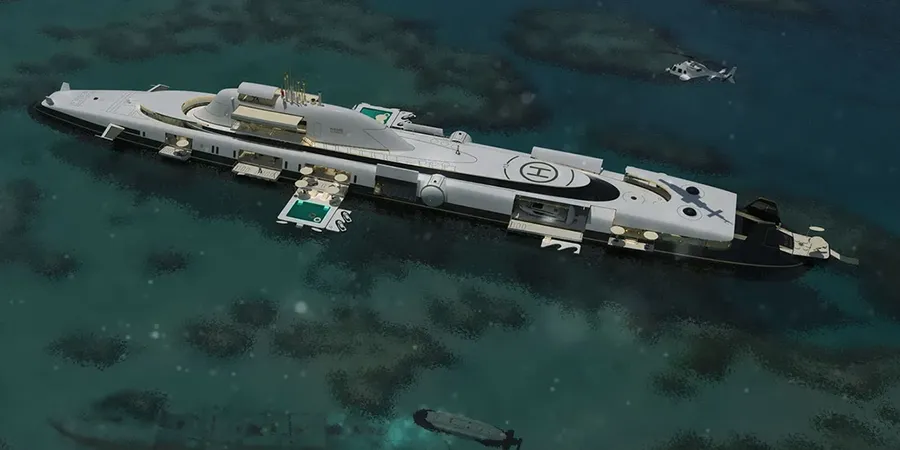
The notion of a fully submersible superyacht was, until recently, the kind of idea designers floated as a thought experiment rather than a credible commercial brief. Migaloo PSY decided to take it seriously. Their Migaloo M5 is a 166-metre concept capable of operating completely underwater for up to four weeks, carrying a 200-square-metre spa, a cinema, a helipad, and two smaller submarines for deep-sea exploration. Migaloo PSY exists specifically to develop private submersibles as a real product category, and the Migaloo M5 is the most ambitious concept the company has produced.
One of the more unexpected directions to emerge from 2024 could be described as the post-industrial category. Anthos is a 150-metre superyacht conceived as a conversion of a 10,630 GT container ship, the first entry in designer Mario Biferali's Nacht® series developed with Oceanco. The original vessel's structure is retained as the backbone of the entire design. What Biferali layers on top is a "Sea Garden" terrace lined with vegetated walls, a multi-level owner's apartment spread across three decks, a helideck, pool, sports courts, and wellness facilities. The silhouette is deliberately unglamorous, industrial in character where conventional superyachts prize sleekness. It makes a strong statement, even if the market for converted cargo ships remains a narrow one.
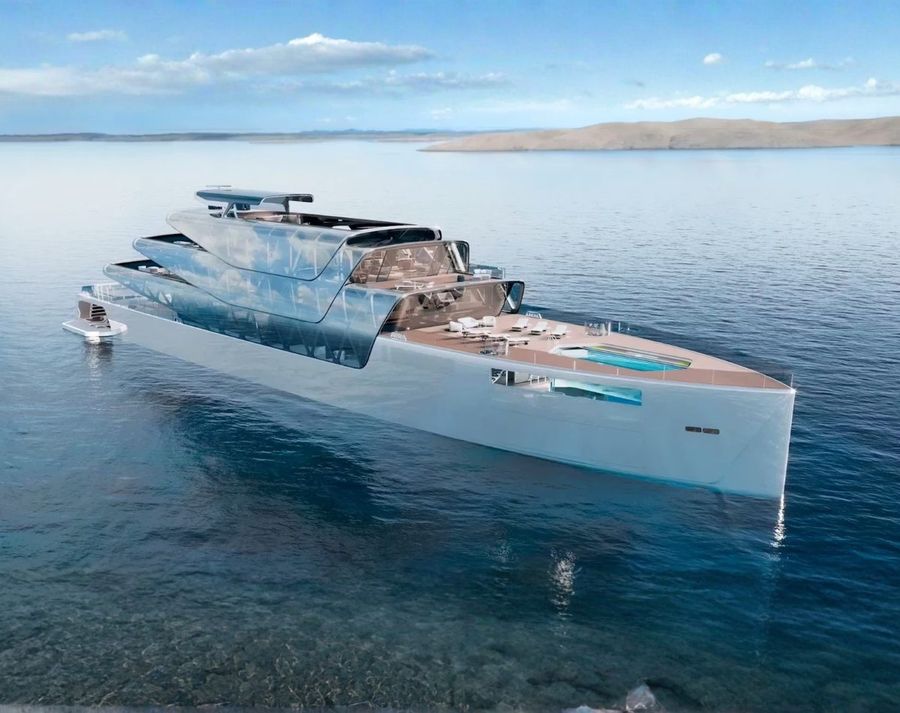
Designer Jozeph Forakis pitched Pegasus as the world's first 3D-printed superyacht. At 290 feet, the vessel would be constructed using robotic printing that forms a mesh framework integrating hull and superstructure in a single continuous build process, consuming less energy and less material while generating less waste than conventional construction methods. The interior incorporates a multi-level hydroponic "tree of life" garden capable of growing fresh produce and purifying air throughout the yacht. The technique draws directly from established vertical farming technology, which places Pegasus firmly in the achievable category rather than the purely speculative one.
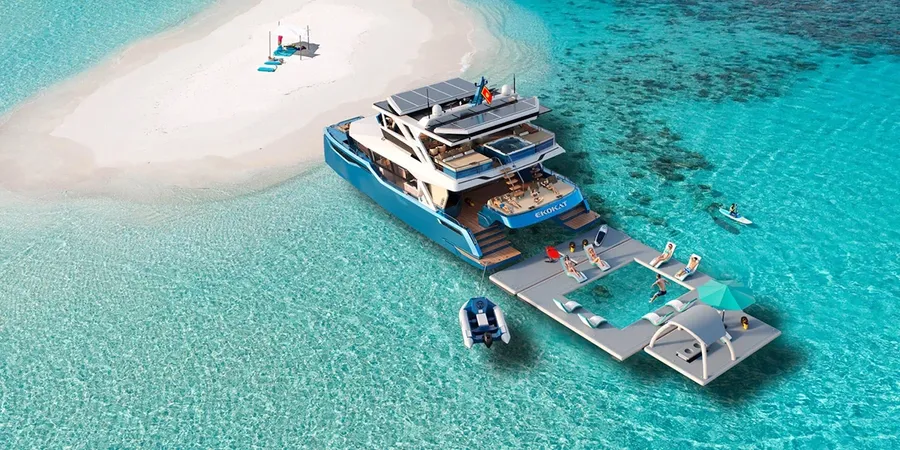
Designer Espen Oeino has argued for years that multihulls represent the future of yachting, with sustainability as the central driver of that argument. The concepts now arriving from across the industry suggest the broader field has caught up with that position. The EkoKat concept, shown at Cannes 2025, delivers interior volumes typical of a 30 to 40-metre yacht within an 18.9-metre catamaran hull, with a solar-powered flybridge feeding 600 kW into onboard battery stacks. At an entirely different scale, Lateral Naval Architects unveiled SPEAR in 2024, a 140-metre trimaran offering 40 per cent more exterior space than a comparable monohull. The multihull argument Oeino has been making for years is now simply the direction a growing share of the industry has chosen to go.