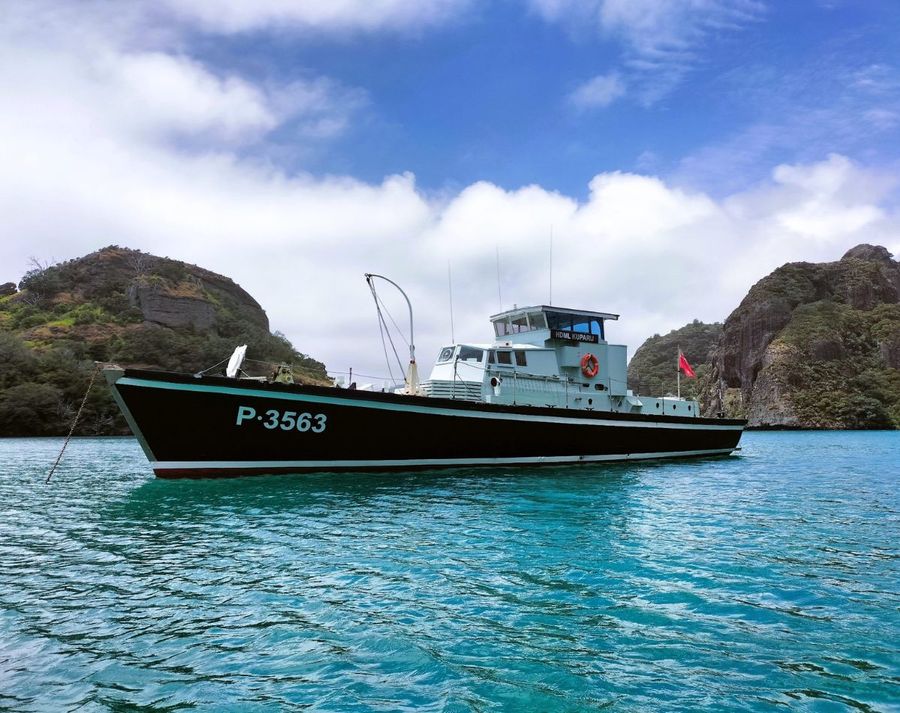
Few vessels carry as much history as Kuparu, a 72-foot wooden launch built in wartime California that once patrolled New Zealand's coastline against enemy submarines. In the early hours of Sunday morning, that history was placed in serious jeopardy when her crew were winched to safety by rescue helicopter and the vessel herself was left drifting in the Tasman Sea.
The distress call came from waters off Ninety Mile Beach. The Northland Rescue Helicopter was tasked by the RCCNZ, with Waikato rescue helicopters also attending. All three crew members were brought ashore safely within a few hours, but Kuparu had to be abandoned to the sea.
Word of the incident spread initially through a post on Reddit before reaching the wider maritime community, where it has since prompted genuine grief. Kuparu is regarded as one of the last operational Harbour Defence Motor Launches anywhere in the world, and the prospect of losing her has resonated deeply with those who followed her long restoration story.
| Attribute | Specification |
|---|---|
| Official Designation | HMNZS Pegasus P3563 → HMNZS Kuparu P3563 (WWII Hull Q1348) |
| Design / Class | W J Holt Admiralty WWII anti-submarine patrol craft |
| Dimensions | 76 ft LOA, 72 ft LWL, 16 ft Beam, 5 ft Draft |
| Displacement | 54-ton gross displacement timber hull |
| Builder | Ackerman Boat Company (Lido Island, California, 1943) |
| Propulsion | Twin Mark 6 two-stroke Foden diesel engines (180-hp each) |
| Home Port | Auckland, New Zealand |
Kuparu's origins lie in 1943, when she was laid down at the Ackerman Boat Company, a wooden shipbuilding yard in Newport Beach, California. The company had been founded by Clarence Ackerman, who began as a recreational boatbuilder before committing entirely to military contract work in 1943 to support the Allied war effort. Under the United States Lend-Lease policy, the yard was contracted to build four Harbour Defence Motor Launches for delivery to the Royal New Zealand Navy. Kuparu, carrying hull designation Q1348, was one of those four anti-submarine patrol craft. She completed the Pacific crossing to New Zealand in late 1943.
Assigned upon arrival to the 126th Motor Launch Flotilla, Q1348 took on the role of patrolling New Zealand's home waters. As the war progressed, her service extended beyond those shores to tropical deployments throughout the Pacific Islands. She remained in commission with the Royal New Zealand Navy until 1989.
The precise sequence of events leading to Sunday's emergency has not yet been confirmed, though it is understood that Kuparu was taking on water in addition to the mechanical and electrical failures that prompted the distress call.
Scott Perry first encountered Kuparu in August 2016, sitting out of the water on an old trailer at a house relocation yard in Helensville. The hull was rotting and had been neglected for somewhere between 16 and 20 years. Perry bought her for $10,000 and threw himself into an intensely personal restoration project. Working with a team of volunteers, he returned Kuparu to her Fishery Protection Service-era appearance, repainting her, improving her seaworthiness, and setting goals that reached well beyond the immediate work: museum status, and eventually a full circumnavigation of New Zealand.
For Kuparu to be lost now, after everything Perry and his volunteers invested in her revival, would be a bitter end for HMNZ Kuparu after all that had been given to bring her back.