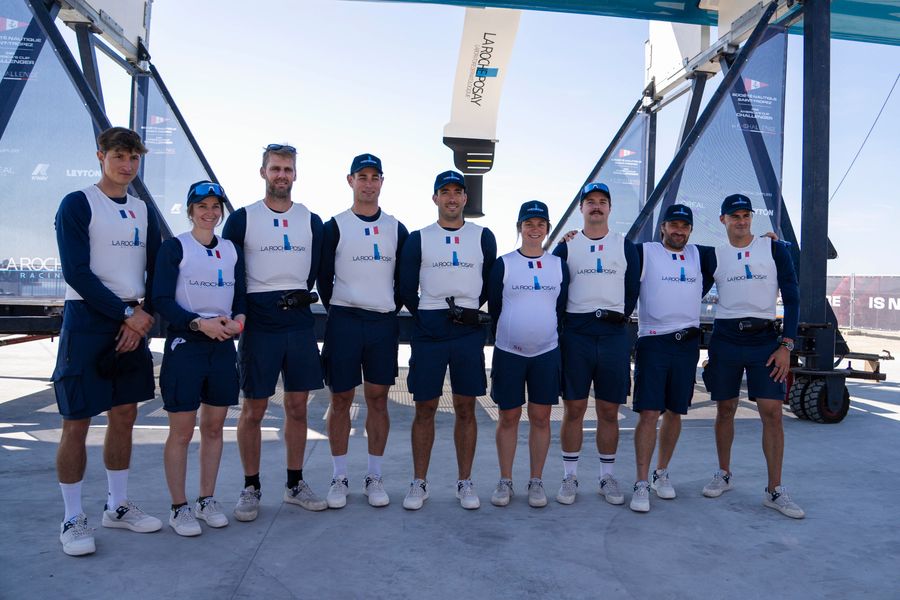
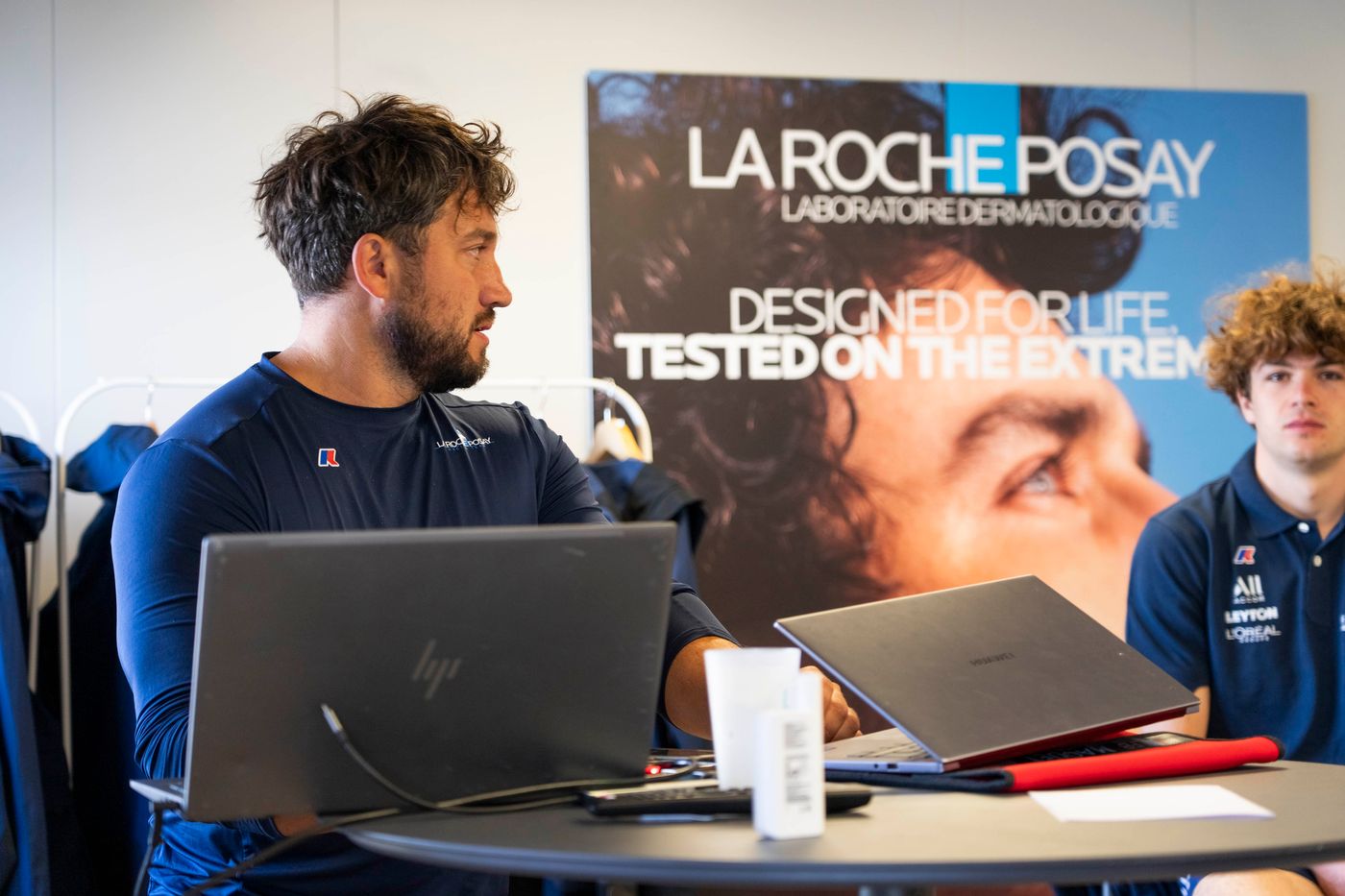
La Roche-Posay Racing Team has built something you don't often see in Cup sailing: a human performance unit that treats the sailor as the primary piece of equipment. Three specialists now cover physical preparation, medical oversight, nutrition, recovery and, increasingly, cognitive load analysis, supporting the team's Challenger, Youth and Women squads through to the 2027 America's Cup in Naples.
Kilian Philippe handles sports science, physiological data and performance coordination. Thomas Cruble, a physiotherapist and osteopath with a micronutrition background, will be based full-time in Naples from autumn. Martin Oudet is the team's emergency physician, responsible for individual medical monitoring, emergency protocols on the water, and anti-doping matters.
The three of them were introduced to the Youth and Women squads during a preparatory camp at Lorient ahead of the ETF26 Series event, held 12 to 15 August.
The unit works in close collaboration with the sporting performance department and coaching staff, data flowing both ways. If coaches notice a drop in performance during a particular manoeuvre or phase of racing, the human performance specialists can cross-reference that observation against physical load, sleep, recovery, stress, nutrition or hydration data. The feedback loop also runs the other direction: unusual fatigue or stress flags go straight back to the coaching team.
Muscle mass and body fat baselines have already been established for the Youth and Women sailors, with regular retesting planned in Naples. The AC40 is less physically demanding than previous Cup generations, and the risk, as the team sees it, is that physical preparation gets quietly deprioritised. That would be a mistake. The shocks and rapid decelerations the boat produces make injury prevention anything but optional.
During intensive periods, Philippe favours short sessions of 20 to 30 minutes, what he calls "microdose" training. Hard physical demands are clustered on the same days where possible, protecting genuine recovery time around them. Sailors who already work with their own physical trainer are welcome to continue that relationship.
Then there is the part that is harder to measure.
On an AC40 or AC75, visible physical effort tells only part of the story. Even when the boat is foiling and physical movement is limited, sustained concentration, constant information processing and rapid decision-making place a real demand on the nervous system. Sensors are being tested on the AC75 to capture not just heart rate but heart rate variability, HRV, which provides a window into how the nervous system is responding to stress. Early observations have already shown that certain manoeuvres produce a sharp stress response in crew members, one that heart rate alone would not reveal.
NeuroTracker, already in use with some Challenger sailors, will also be available for shore-based cognitive training. The system uses three-dimensional visual exercises targeting attention, simultaneous information processing and processing speed. Progress is tracked individually over time rather than used as a comparison between athletes.
Naples will impose its own demands. The heat, the sun exposure, the equipment sailors wear on the water: all of it accelerates dehydration, with direct consequences for concentration and reaction time. Nutrition will be organised around the sailing schedule, with balanced Mediterranean cooking, planned menus and specific attention to foods that affect energy and alertness.
Recovery is treated as part of training rather than an afterthought. After sailing, the priority is straightforward: eat, drink, and leave the base when the programme allows.
The sensors and HRV tools refine the picture over time. They do not replace the basics.