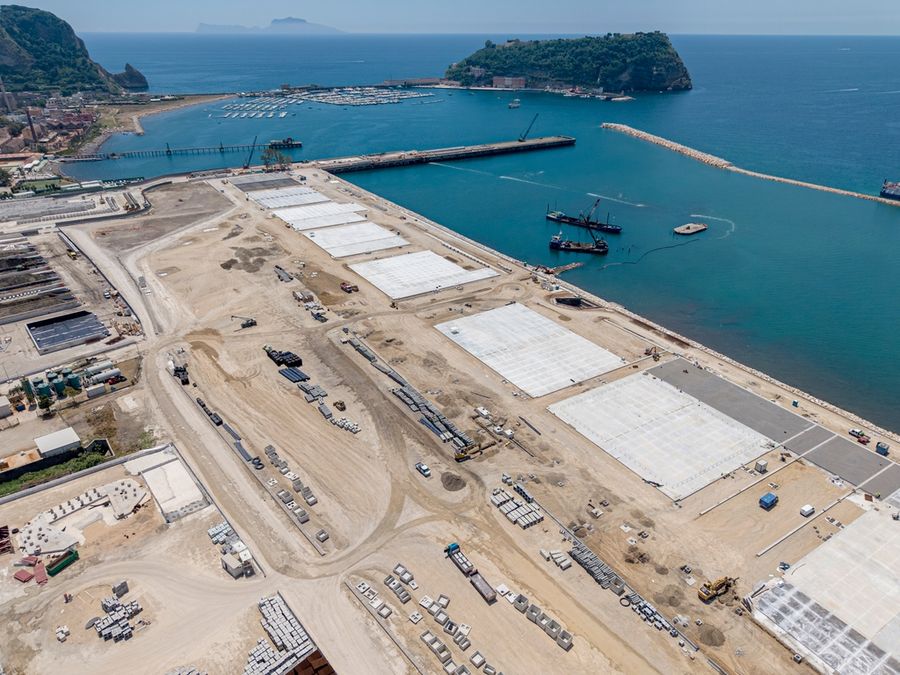
At Bagnoli, the roads are not all finished yet. Construction machinery moves through the dust, cranes share the space, and access routes shift as work progresses. On the edge of the Bay of Naples, with Vesuvius sitting on the horizon like it always has, the future bases for the 38th America's Cup are beginning to take shape.
The La Roche-Posay Racing Team base is still a vast construction puzzle.
Metal frameworks, facade elements, flooring and containers wait to be positioned according to plan. Within a few weeks they will form a 1,320 square metre technical building, a 440 square metre team living area and a 330 square metre hospitality space facing the water.
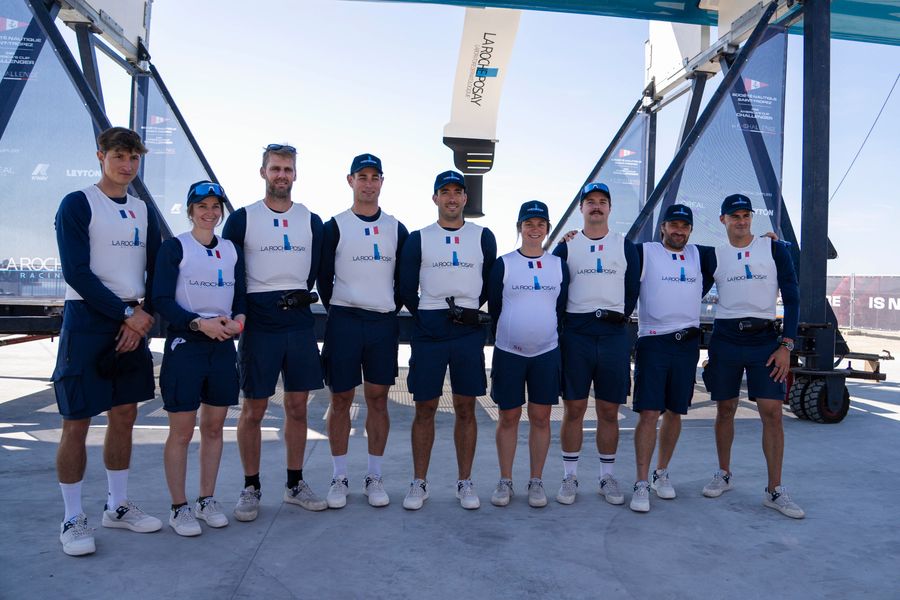
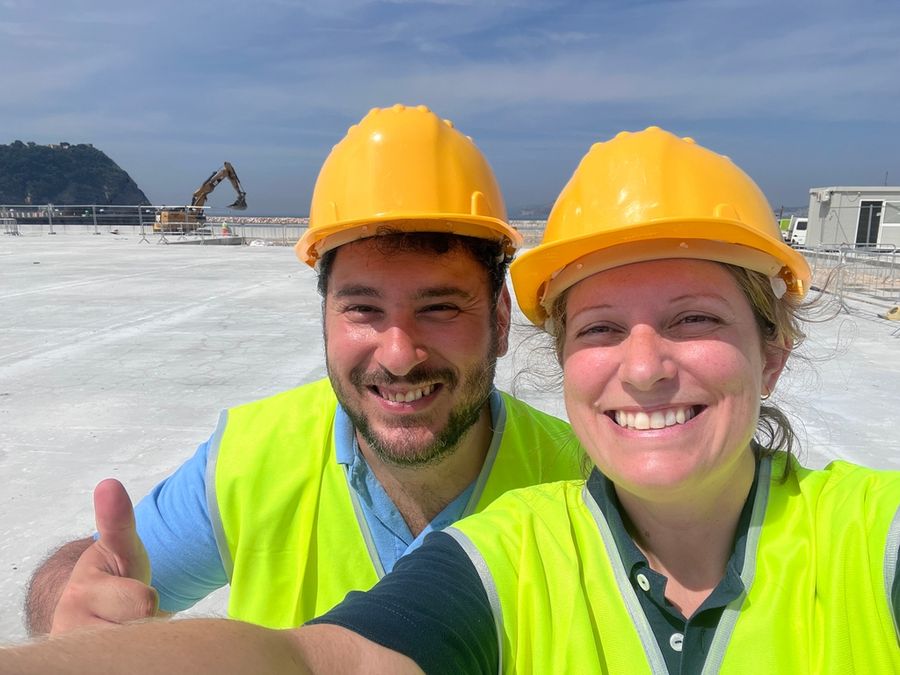
Overseeing deliveries, site access, connections and the sequencing of contractors is Émilie Llorens, operations and logistics manager at K-Challenge, running the move alongside Léo Chapalain, who is responsible for technical operations. Together they are managing one of the least visible but equally critical operations of the French campaign: shifting an America's Cup team from Lorient to Naples without breaking stride.
"For the sailors, the competition will take place in 2027. For us, it's happening now," she says.
Nearly 2,000 kilometres away in Lorient, around 80 people are still working daily around the AC75: sailors, engineers, technicians, designers, performance specialists and support staff. The boat must keep sailing, being maintained and developed right up until its departure for Italy.
The difficulty is keeping both operations alive at once.
"A lot of the equipment needed for the Naples build was stored in containers also used by the technical teams," Llorens explains. "We worked with each department to determine what could leave and what absolutely had to stay available to keep the boat sailing."
Crates have been opened, equipment sorted, priorities reassessed. Some items have already left Lorient; others will wait until the final sailing sessions are done. The mast, sails, electronics, rigging equipment, tools and chase boats will travel with the AC75 on a carefully established sequence.
The schedule leaves little room for improvisation. Send something too early and operations in Brittany slow down. Leave it too late and the restart of sailing in Naples is delayed.
During the most intense phases, up to two trucks will depart Lorient each day. Around 30 containers must transit to Italy, and when the exceptional transport requirements for the AC75 and three semi-rigid chase boats are added, close to 40 separate movements will be needed, with loads ranging between 10 and 25 tonnes. The transfer will continue across several weeks through to mid-September.
Naples is a building site inside a building site.
The French base is being constructed alongside those of rival teams, all within the broader construction zone of the future America's Cup village. A crane blocked on a shared access road, an open trench or the delivery of a structural element can disrupt multiple teams at once.
"Our building site is in the middle of an enormous building site," Llorens says. "That requires a lot of coordination. Every week, the managers of the different bases meet with the organisation to anticipate movements, access and the use of heavy equipment."
Bagnoli is a former industrial area that sat largely abandoned for years. Water and electrical networks are being extended progressively to each plot. Roads are taking shape. Safety rules and traffic arrangements change as the work advances, sometimes overnight.
The French team remains responsible for its own installation but depends on the broader schedule. Flexibility is not optional.
"Not everything depends on us. We might have planned an intervention, but if the road isn't accessible or a connection isn't finished, we have to be able to reorganise the programme immediately."
Three people are on site at Bagnoli right now. They will be joined progressively by a team that should not exceed around ten people, supported by three specialist contractors.
"We have a small team of genuine all-rounders," Llorens continues. "Everyone has their specialty, but everyone is capable of working across several subjects and helping each other. Without that versatility, it would be difficult to run this many projects in parallel."
Much of the structure at Bagnoli is not entirely new. The buildings were used during the previous America's Cup in Barcelona, then dismantled, stored and adapted to the Naples configuration. Pillars, floors, walls and facades come apart, travel and go back together differently.
"We are reusing practically everything. That gives us an advantage because we already know the buildings, their uses and how they function. We need to adapt them to a more compact site, but we are not starting from a blank page."
The largest volume will house the technical core: the AC75, workshops, the mast and a sail loft installed on a mezzanine level. Sixteen containers will be converted into specialised work spaces. The team base alongside will bring together offices, a kitchen, a canteen and communal areas. The hospitality space will have its own kitchen and will receive partners and guests at the water's edge.
Reusing the Barcelona structures also reduces the project's environmental footprint. Where significant concrete foundations were required in Spain, K-Challenge has opted for demountable metal foundations that can be relocated when the event is over. When the team leaves Naples, most of its base goes with it.
The containers and boats are only part of what needs to move.
From September, the majority of K-Challenge staff working on the 38th Cup will leave Lorient in two main waves: shore-based technical teams first, then sailors and those directly involved in on-water operations. Some will arrive alone; others will come with partners or children. Most will remain in Italy until the end of July 2027.
Between 75 and 80 apartments, covering 90 to 100 rooms, are being sought across four areas: Bagnoli, Pozzuoli, Posillipo and Vomero. Eight local real estate agencies are working simultaneously for K-Challenge. The goal is to keep everyone within twenty minutes of the base while accounting for individual circumstances.
Single staff members tend to prioritise proximity. Families want more space and easy access to schools. Five families are affected, along with around 17 partners and fewer than ten children, seven of whom will need to be enrolled in schools in Naples.
"For an event lasting a few weeks, it is possible to assign housing to each person without leaving much choice," Llorens explains. "Here, people are going to live in Naples for several months. We want them to be able to picture themselves there, for their families to feel comfortable and for the accommodation to genuinely suit their needs."
A digital platform brings available properties together so staff can browse apartments, submit preferences and liaise with the logistics team before signing. The support extends beyond housing. K-Challenge has been in contact with the French school, the consulate and local services. A list of French and English-speaking doctors, paediatricians and dentists is being compiled, along with options for childcare and daily life.
A slow internet connection or an unsuitable apartment can become a performance problem quickly.
The decision has been made: accommodation must be ready before anyone arrives. No hotel nights are planned during the transition. From September, each person collects their keys and moves straight in. Behind that apparent simplicity sits a long checklist covering water, electricity, internet, furniture, contracts, condition reports and access.
Lorient still needs attention in the meantime. With the sporting programme having evolved, 31 temporary apartments had to be found during the summer of 2026 for international staff and team members who had already given up their previous accommodation ahead of the move.
"Sometimes these are small issues, but they all arrive at the same moment. You can't decide to handle housing for one month and then transport the next. Everything moves forward at the same time."
Visa requirements add another layer. Five non-European team members required documentation allowing them to work and reside in Italy for more than 90 days. The others will complete residency formalities once on the ground. Preparation for all of this began in April and is being managed entirely in-house.
In a few months, between 60 and 100 meals will be served daily at the Naples base. Across the full campaign, around 19,250 meals are planned. By then, offices must be running, workshops equipped, apartments occupied and the AC75 ready to sail.
For Llorens, that moment will already feel like a win.
"When everyone is settled, when the base is functioning and when the sailors can go out on the water normally, our biggest challenge will be behind us."
Until then, she moves from one task to the next: a transport to confirm, an apartment to sign off, a connection to reroute, a contractor to follow up, a road temporarily closed. The logistics of an America's Cup campaign are not simply about moving objects. They are about making the necessary work invisible so that everyone else can do theirs.