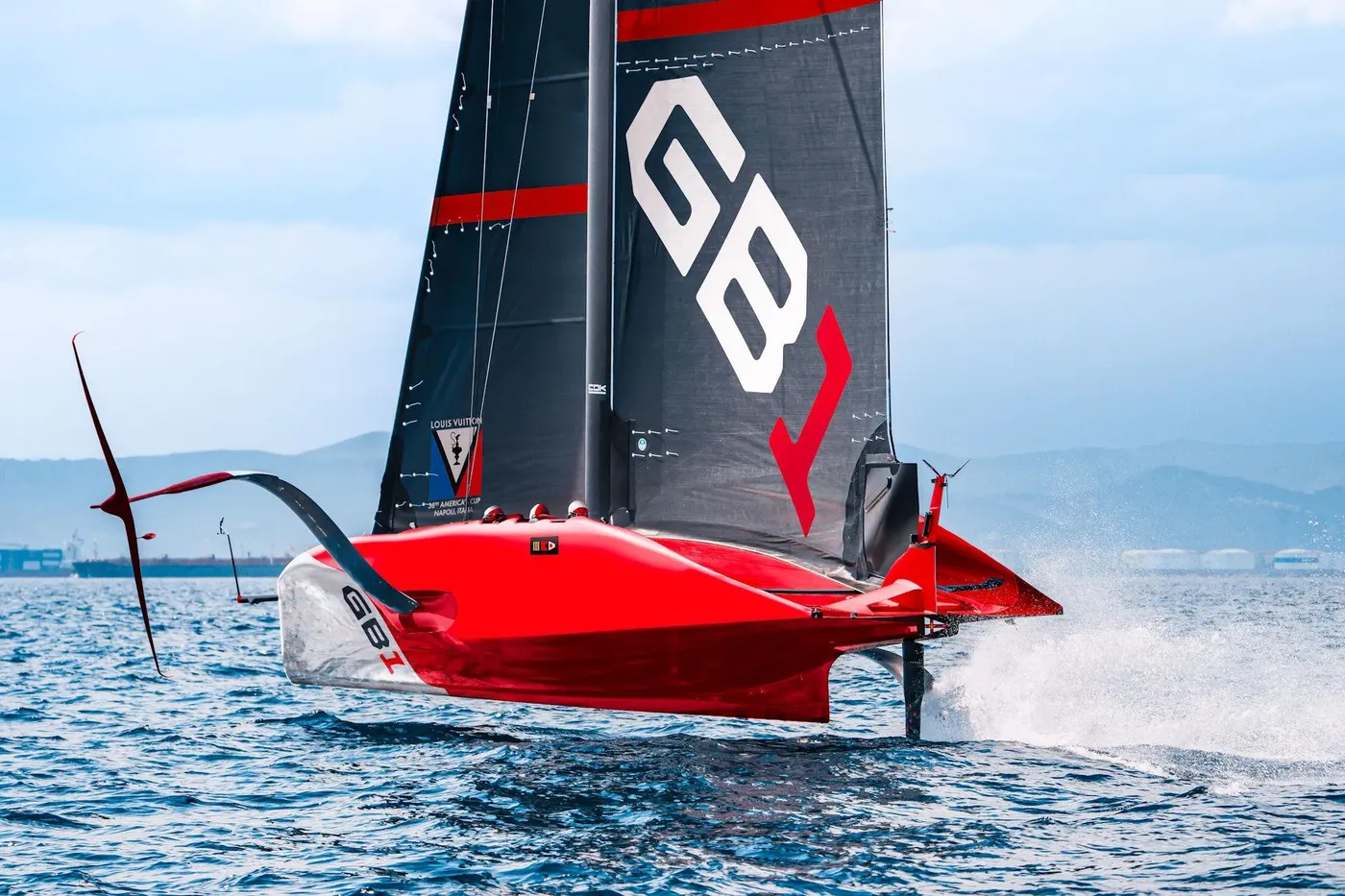
The future of Britain's America's Cup challenge hangs in the balance following a £180 million legal dispute centred on the AC75 Britannia, with INEOS owner Sir Jim Ratcliffe challenging Ben Ainslie's control of the yacht ahead of a potential 2027 campaign.
Some corners of the British press have cast the conflict as a personal showdown between two of the nation's most celebrated sporting figures, but the underlying stakes are considerably more complex than any rivalry narrative suggests.
Britannia delivered Britain's strongest America's Cup result of the modern era in 2024 and now carries an estimated valuation of around £180 million. The vessel, along with everything engineered into it across two campaign cycles, sits at the heart of Ratcliffe's legal challenge. INEOS is reported to be pursuing ownership of the yacht on the grounds that it funded and drove the programme's development, and therefore retains ownership.
The timing of this dispute could scarcely be more consequential. Current America's Cup regulations require competing teams to carry over and modify their existing AC75s rather than commission an entirely new build. That single rule transforms Britannia from a symbolic marker of past achievement into something far more fundamental. For any credible British entry in 2027, it is the competitive foundation on which everything else must be built.
The legal conflict emerged following the breakdown of the Ratcliffe and Ainslie partnership in early 2025. Ainslie has since moved to establish a new campaign structure under the GB1 banner, securing fresh investment and operating entirely independently of INEOS. The position advanced by his team is that Britannia falls within the control of Athena Racing, the entity underpinning his campaign.
Two directly competing claims over the same programme now stand before the courts. One rests on who provided the financial backing; the other on who held operational control. Neither argument is straightforward, and a resolution through legal channels is unlikely to arrive quickly.
{{TABLE_1}}
What gives this dispute its sharpest edge is that the physical boat accounts for only a portion of what is genuinely at stake. Two Cup cycles have allowed the Britannia programme to accumulate layers of performance data, design refinements, and technical systems that could not be replicated quickly or cheaply. In a class where the smallest gains in speed and setup consistently separate the fleet, that body of knowledge carries competitive value well beyond what any appraisal of the hull alone could capture. The yacht itself is tangible and quantifiable. The intellectual capital built around it is less visible, but arguably the more decisive asset.
Framing the dispute purely as Ratcliffe against Ainslie, as some coverage has chosen to do, risks obscuring what the outcome could genuinely mean for British sailing at the highest level. Should the legal challenge succeed and ownership transfer back to INEOS, Ainslie's GB1 campaign would face the prospect of starting over without the accumulated advantages of a two-cycle programme. Should Athena Racing's position be upheld instead, the campaign retains its continuity, though the dispute has already consumed time and attention that could have gone elsewhere.
However the courts ultimately rule, the 38th America's Cup may prove to be determined as much by what unfolds in boardrooms and legal chambers as by anything contested on the water. In the modern Cup, the most consequential battles are often the ones that never reach a start line.