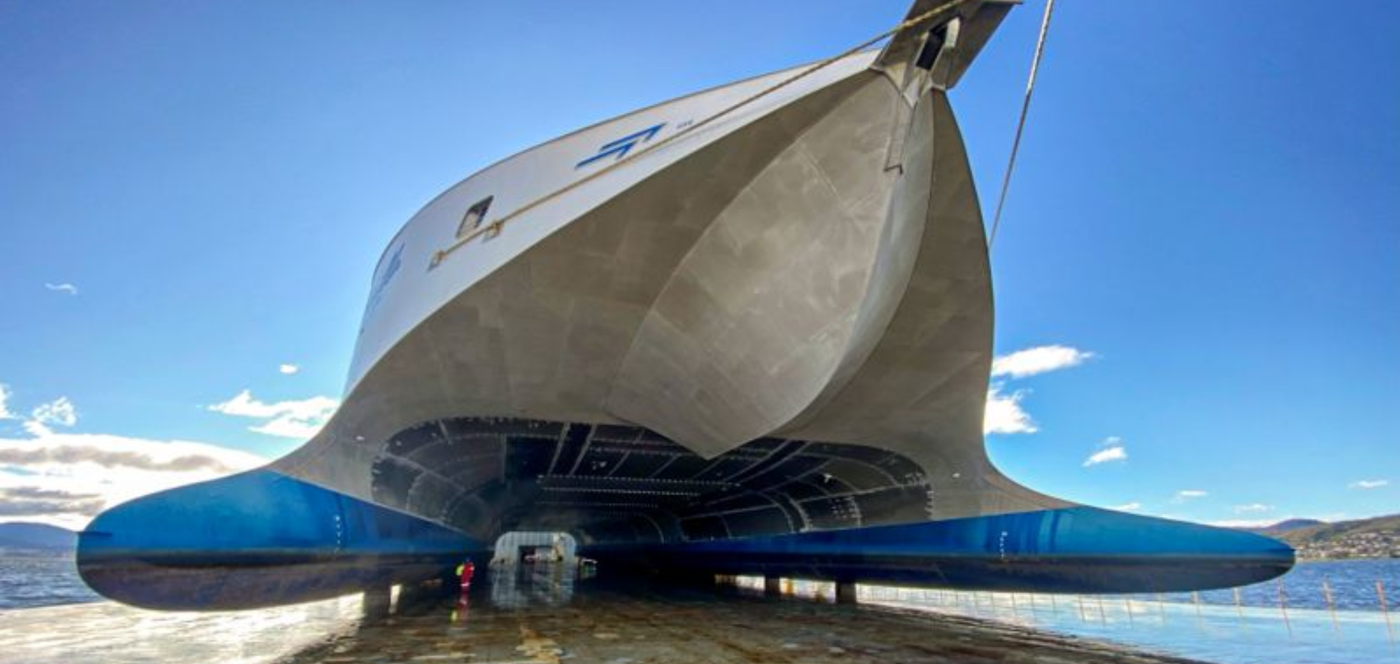
A 130-metre ship needed a bigger ship to get it to work. That's the scene that played out on the River Derwent on 5 August, when Incat's Hull 096, the largest battery-electric vessel ever built, was floated onto the deck of the heavy lift ship Black Marlin and carried out of Hobart, bound for South America.
The logistics alone are worth pausing on. Black Marlin is a semi-submersible, one of the largest of its kind, and getting a finished 130-metre catamaran aboard it means the transport ship has to sink itself first. It takes on ballast until its cargo deck is underwater, waits for Hull 096 to be manoeuvred into position above it, then pumps the ballast back out so both vessels rise clear of the waterline together. It's not a subtle operation, and this one very nearly didn't happen on schedule. Black Marlin was meant to arrive in Tasmania back in March, but the transport ship got caught up for months in the Strait of Hormuz crisis before finally reaching Hobart in late July.
Hull 096 itself will carry the name China Zorrilla once it's in service, honouring the Uruguayan actress who died in 2014. Built for operator Buquebus, it's rated for 2,100 passengers and 225 vehicles across a short, high-frequency crossing between Buenos Aires and Colonia. It wasn't always meant to be electric. Buquebus originally ordered it in 2019 as a dual-fuel LNG ferry; in January 2023, with construction already underway, the two companies tore up that plan and reworked the ship around batteries instead.
What replaced the diesel and cryogenic tanks is genuinely startling in scale. More than 40 megawatt-hours of battery capacity, over 250 tonnes of it, split across four separate battery rooms holding just over five thousand individual cells. Incat says the system is four times bigger than any maritime battery installation that's come before it, and IEEE Spectrum's reporting on the build notes that each module is individually cooled and isolated, so a single cell failure can't cascade through the rest of the pack. Eight electric waterjets do the propulsion work, and in trials the ship touched 29 knots carrying 600 tonnes of cargo, well above the roughly 25-knot cruise it's designed to hold in service.
"Hull 096 has been the biggest and most ambitious project in our company's history," said Incat Chairman Robert Clifford as the ship left Hobart, "and its departure is a testament to the skill, dedication and innovation of our entire workforce." It's the ninth vessel Incat has built for Buquebus, a partnership stretching back to HSC Francisco, an LNG-powered catamaran delivered in 2013 that briefly held the title of fastest turbine ship afloat. This one will hold a very different record for a while yet.
There's a commercial logic sitting underneath the engineering, too. The middle deck houses a 2,300 square metre duty-free shop, reportedly the largest retail space on any ferry anywhere, and the ship's cruising speed has been kept moderate partly to give passengers more time to spend money and partly because slower speeds mean less drag and a smaller, lighter battery pack. Once it arrives in South America, after around 40 days at sea, Hull 096 will be unloaded, commissioned, and prepared for regular service.
Behind the ferry, a bigger bet. Incat isn't treating this as a one-off. With Hull 096 handed over to Black Marlin, the yard's attention shifts to a five-vessel aluminium electric shipbuilding programme announced late last year, including battery-electric ferries under construction for Danish operator Molslinjen destined for the Kattegat crossing between Jutland and Zealand. If Hull 096 proves the concept at sea, that programme is where the industry finds out whether it scales.
Learn more from INCAT Tasmania about the World’s Largest Battery-Electric Ship Loaded for Journey to South America and Incat Hull 096 Begins Journey to South America.