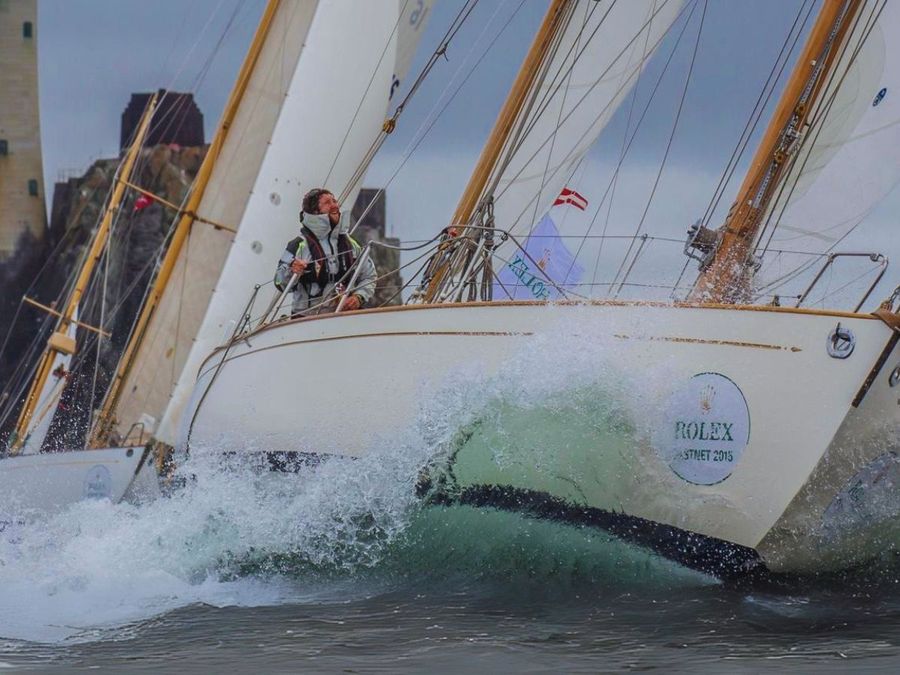
One hundred years of offshore racing finds its focal point this weekend, when more than 460 yachts leave Cowes bound for the Fastnet Rock and a finish line in Cherbourg. What began as a fringe idea in 1925, when Weston Martyr's ambition and a postwar hunger for adventure sent seven boats into open water, has become the largest offshore sailing event in the world.
At the time, the concept was treated with open scepticism. Racing converted cruisers and pilot boats across the open sea struck many as reckless. Yet those seven starters seeded something lasting. The Royal Ocean Racing Club was founded in the race's wake, and offshore sailing found the event that would define it.
From seven boats to hundreds – how the race grew
Growth in the early decades was cautious. Fewer than 30 boats entered before the Second World War. After it, momentum built steadily. New boat designs pushed performance forward, and the arrival of the Admiral's Cup in 1957 sharpened international competition considerably. Through the 1970s, entire nations invested in campaigns aimed specifically at Fastnet glory. Prime Minister Edward Heath steered the UK team to victory in 1971.
Then 1979 arrived, and with it a catastrophe that changed the event permanently. A violent, unforecast storm tore through the fleet. Fifteen sailors lost their lives. Twenty-three boats were abandoned. The rescue operation became the largest peacetime effort of its kind in British history.
Out of that tragedy came reform. Safety standards were overhauled, weather forecasting improved, boat design philosophy shifted, and crew preparation protocols were tightened. The race did not become easier, but it became more rigorous in every way that mattered.
Recovery in entry numbers was gradual. It was not until 2011 that the fleet surpassed the 303 boats that had started in 1979. Rolex's arrival as title sponsor in 2001 gave the event's international standing another significant lift, drawing attention and competitors from well beyond traditional offshore sailing circles.
Now in 2025, it's a pilgrimage
This Saturday, 26 July, the fleet assembles at Cowes for a 695-nautical-mile passage that takes in tidal traps, fog-prone headlands, and the unpredictable weather systems of the Celtic Sea. The numbers alone speak for themselves: 464 boats have entered, crews represent 41 nations, more than 19 countries appear in the start list, and the age range stretches from a 14-year-old to an 81-year-old.
The variety within the fleet is equally striking. Ultim 32s, IMOCAs, Class40s, and doublehanded entries line up alongside family-crewed classics. History is afloat in the form of Dorade, Stormy Weather, Crusade, and Bloodhound, vessels that connect the centenary edition to the race's earlier chapters. New Zealand's Caro, a modern performance machine and the 2023 winner, returns to defend her title.
The Admiral's Cup raises the stakes
Adding another layer of significance to this year's race is the return of the Admiral's Cup, absent from the calendar for more than two decades. The series, once the most prestigious international competition in offshore yacht racing, culminates with the Fastnet Race, and 15 yacht clubs have entered two-boat teams to contest it. The Royal New Zealand Yacht Squadron is among them.
These are serious campaigns. Olympians, America's Cup veterans, and offshore specialists fill the crew lists. The competitive pressure runs throughout the fleet, including among the military teams who have their own long association with the race.
The Royal Engineer Yacht Club has sailed every Fastnet since 1925. This year they return with the J/109 Trojan, well aware of what the centenary means. "There's a lot of pressure because of the centenary," says REYC skipper Andrew Motion. "Whatever happens, hell or high water, we'll be on that start line."
Records, rivals, and reasons to watch
The 2025 entry list has already set a benchmark, with 407 IRC-rated boats registered, a new record for that category. The Fastnet Challenge Cup goes to the best-performing IRC yacht on corrected time, meaning the biggest boats carry no automatic advantage. Past winners on IRC include the Nicholson 33 Iromiguy and the VO70 Wizard, a spread that demonstrates how effectively the rating system compresses the performance gap between large and small hulls.
At the scratch end of the fleet, Black Jack 100 and SHK Scallywag headline. The Admiral's Cup entries Callisto and Beau Ideal are also worth watching closely. Outside the Admiral's Cup, the Ultim 32s are running fast and look genuinely threatening, with Kiwi sailing star Peter Burling among those aboard one of them.
The fleet's sub-divisions tell their own story. Eighteen JPK 1010s, 17 First 40s, and 16 Sun Fast 3200s are all entered, alongside schoolboats such as Fulmar Fever from Ireland. Armel le Cléac'h on Banque Populaire represents one end of the experience spectrum; at the other are crews completing their first Fastnet aboard a 40-year-old Contessa.
All eyes on Cowes this weekend
With Saturday's start now days away, Cowes carries a noticeable charge. The Admiral's Cup teams are using the remaining inshore races as preparation, squeezing every useful data point from the racing before the offshore passage begins. The atmosphere holds both tension and celebration, a fitting combination for a milestone that belongs to the whole sport.
A century on from seven yachts crossing an open sea on an uncertain course, the Fastnet Race continues to grow, to evolve, and to demand the best of every sailor who enters it. The seamanship, the strategy, and the endurance required have not diminished. Neither has the ambition that sets each fleet in motion.
This Saturday, the fleet will slice through the Solent, pass The Needles, and push out into open water. The same wind that filled those original seven sails in 1925 waits for them offshore.