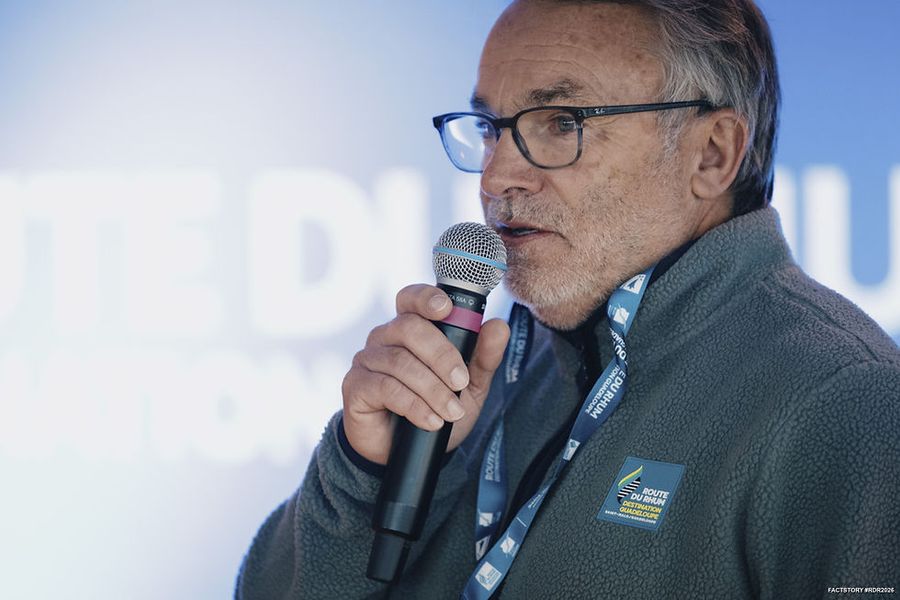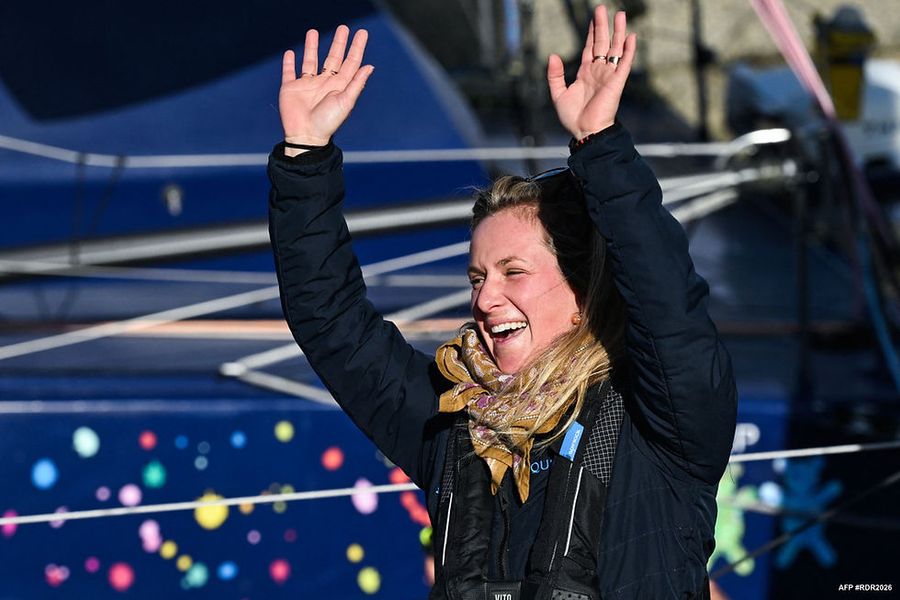
Saint-Malo woke to brilliant sunshine on Saturday as the IMOCA fleet and part of the Vintage Multi class left the pontoons, a day after the Ultims had departed. The crowds were back in force, the mood lighter than the emotional send-off of the day before. Skippers used the morning to recharge ahead of Sunday's 1302 start and the serious business that follows.
The party atmosphere of the previous evening had already faded. Faces were tired after days in the village, but something had shifted, especially among the sailors. Everyone had moved into a new phase: leaving the pontoons, passing through the locks, sharing one last moment with the crowd before the real contest begins.
Technical teams trickled in first, then the public followed, and soon the walkways were as packed as the day before. Singer Vianney boarded Café Joyeux and said he would be following Nico d'Estais "at 2000%". Nearby, actor François Damiens turned out to support Violette Dorange on Initiatives Cœur, while ultra-trail runner Mathieu Blanchard studied the boats. Catherine Chabaud, France's Secretary of State for the Sea and a former well-known racing sailor herself, was also there. "There's always as much pleasure, emotion and surprise, because the boats keep improving and a new generation of sailors keeps coming through," she said.

Every skipper carries their own story down that pontoon. Fabrice Amedeo, racing FDJ United, spoke of "a bit of revenge to take", having been forced to retire after a fire aboard his IMOCA off the Azores last edition. Maxime Sorel, on Vaincre la Mucoviscidose, said he had "already won just by being at the start line" after the effort it took to get there. "I'm thinking of all our mates who couldn't be here because of budget," added Manu Cousin of Coup de Pouce. For those setting off tomorrow, there was real happiness in the air. "Honestly, I'm thrilled to be heading to sea," smiled Sébastien Marsset of Foussier. "You spend years, months, working towards getting out on the water, so it's a huge privilege."
Minds were already turning to the fight ahead. "The start takes some of the pressure off," said Corentin Horeau of MACSF. "There's potentially a sail change off Cap Fréhel, then another at Bréhat. It'll be full-on, but everything is planned like clockwork." Sam Goodchild, on MACIF Santé Prévoyance, agreed the opening stretch wouldn't be straightforward. "Even if the start looks easy, it's not simple in terms of sail changes, or strategy."

Ambrogio Beccaria, sailing Allagrande Mapei, made the same point. "There's wind, it'll be quick going in fast conditions. It might look simple, but it's going to take a lot of intensity." The fleet faces an unusually northerly route this year. Francesca Clapcich, the Italian-American skipper of 11th Hour Racing, called it "an unusual route". "Since the trade winds aren't established in the south, there's no other option," she said. "We're going to have to deal with the low-pressure systems coming through. Either way, it should be a fast crossing." Élodie Bonafous, racing for Association Petits Princes Queguiner, expects the race to hinge on stamina. "It'll come down to endurance, managing the rhythm, and being able to absorb the boat's high speeds. You need to pace your physical effort to have energy left at the end."
Earlier that morning, five Vintage Multi boats were the first through the locks. Quayside, near their berths, a mother lifted her small son onto her shoulders and pointed something out: "look, those are grandad's handprints." Set into the pavement were the two handprints of Francis Joyon, winner of the Route du Rhum Destination Guadeloupe in 2018. The man himself was busy preparing his multihull Océans, about to start his ninth Route du Rhum.
Alongside him, Gilles Lamiré arrived without his red suit, keen to get Groupe CGA through the locks. "It's a bit like our Stade de France," he joked. "It's the last moment we get this closeness with the public, and it means a lot to me." Tomorrow it would be back into the bubble of race preparation. "We're lucky, we can get out of the Channel quickly with the wind behind us," Lamiré continued.

"We'll get to the Azores fast. After that, the weather gets more complicated. There are lows to the north-west, even lows to the south. We'll have to thread our way through." The route looks close to the direct line this year, further north than usual, with the trade winds refusing to cooperate. "We'll put the shorts on a bit later than usual," joked Damien Seguin of Arkéa, Handicap International, in front of supporters who had come to cheer him off. "It should be quick to Guadeloupe, the first routing gives us somewhere between 10 and 11 days at sea."
A serious spectacle awaits, starting tomorrow at 1302.