Corentin Horeau continues to stretch his lead at the front of the IMOCA fleet in the Route du Rhum, holding more than 270 miles over nearest rival Boris Herrmann on Malizia 4. Behind the leader, though, the chase is brutal.
Sam Goodchild, racing MACIF Santé Prévoyance, is closing hard on second place. Further back, the battle for the top ten has turned into a genuine scrap, and the daggerboard boats are fighting it out mile for mile. Ambrogio Beccaria's troubles on Allagrande Mapei haven't dampened the intensity elsewhere in the fleet.
The spread across the IMOCA fleet is now extraordinary. More than 900 miles separate Horeau at the front from Nicolas Rouger, last of those still racing at sea on Demain c'est loin, in 19th. With a gap that size, conditions vary wildly from boat to boat. Horeau fought through a powerful storm in the last stretch, while the bulk of the fleet skirts south of the great circle route to avoid a deep depression blocking much of the track, and others remain caught right in its centre.
Out there, nothing is easy. "I had to run off to furl my headsail," Horeau said this morning. "Luckily I managed the manoeuvre and broke nothing, so that's good news." Maxime Sorel, on Vaincre la Mucoviscidose, was blunter in a video update: "With the state of the sea, I feel like we're going to smash everything up. I'll clearly have to put my race on hold."
Those positioned furthest north, where the depression deepened, have paid for it. Beccaria suffered a heavy fall in his cockpit and is now in serious back pain. After consulting race doctors, he opted to divert towards the Azores. Further north still, Sébastien Simon on Groupe Dubreuil – Air Caraïbes reported the wind "swinging constantly" in unstable conditions. The sailor from the Vendée admitted he got "trapped in the centre of the depression" and now sits almost 700 miles off the lead.

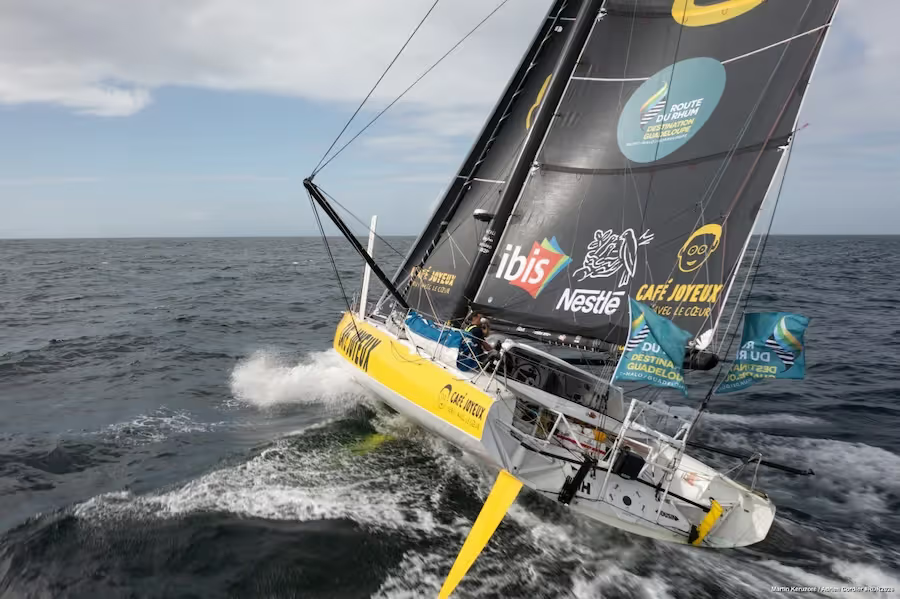
Much of the fleet is pushing south of the great circle route, with the Azores now behind them. "It didn't feel realistic to go round the depression to the north in seas that rough," said Sébastien Marsset on Foussier. It's no easy ride even there. "Conditions have been pretty rough so far and I'm naturally a bit tense," admitted Nicolas d'Estais on Café Joyeux. Fear can strike without warning, as Manu Cousin found overnight on Coup de pouce: "I'd got through the front but within a few seconds the wind jumped to 40 knots and the boat was knocked flat. It's genuinely intense and unstable out here."
Offshore, the Atlantic crossing has become a test of physical, technical and mental endurance. The skippers are using every lull to recover. "We're in a little transition zone before the depression hits," smiled Davy Beaudart on Bureau Vallée. "There's some sun, I've checked the boat, cooked a proper meal. A small break that really helps." He wasn't getting carried away, though: "With the new tropical depression coming, there's still plenty of work ahead."
Companionship is helping crews push through. Beaudart and Sorel are sailing barely 30 miles apart. "We were next to each other on the dock, and now we're barely apart, almost sailing the same course," Beaudart said. The daggerboard boats, led by d'Estais, are locked in their own tight contest, six boats within a 150-mile radius. "The battle with my mates is the first thing I check when I update the charts," said d'Estais. "Our group is really tight, it's fascinating to follow." Marsset is part of that pack too. "There's real competition between us, the intensity is incredible," he said, recalling that four of them, Kojiro Shiraishi on his foiler, Violette Dorange, Louis Duc and himself, crossed the Vendée Globe finish line on the same day after 90 days at sea.
The weather won't let up. Marsset warned "the situation is going to stay complex right to the end," with more wind and another depression still to navigate before what he called "an extremely uncertain finish." Cousin, like everyone else out there, is holding onto optimism: "Since this crossing began, everything's been difficult. But we're not giving up, we'll get there." He finished simply: "At some point, we're bound to get some sun and some warmth."