Swedish marine technology company Humphree has a product success story that stretches back further than most: its Electric Stabilising Fin & Interceptor System, which took joint overall honours at the 2015 DAME Design Awards, remains in production today.
The company's origins go back to 1994, when co-founder Niclas Olofsson solved a performance problem on a high-speed ferry by mounting a vertical plate on the transom that protruded into the water flow off the hull's lower surfaces. The plate created a high-pressure zone that generated lift at the stern, and counter-intuitively produced less drag than a conventional trim tab. Humphree was launched in 2002 to commercialise the concept, with controllable blades that could be retracted or inserted into the flow to manage roll and pitch.
Convincing the market wasn't straightforward. As Humphree's Henrik Ragnmark explains: "By the time we won the DAME Design Awards in 2015 we had been producing interceptors for more than 10 years and were still educating the market about their benefits – most obviously for trimming and saving fuel in a wide variety of situations. But quite early on we also understood that the rapid actuation of these devices made them equally suitable for automated stabilisation of the boat when it was underway. What we needed though was a development that made these capabilities more obvious to the market."
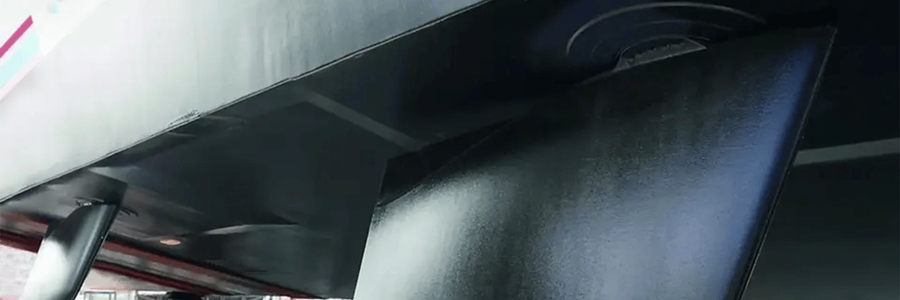
The breakthrough came from integrating fins with interceptors, and choosing electric rather than hydraulic actuation. Ragnmark continues: "We realised that by integrating fins with interceptors, we could add stabilisation of the boat at rest and improve overall system performance. We had a strong background in electric actuation for our interceptors, so that led to us deciding to power the fins electrically. Removing the rotational limitations of hydraulic rams meant we could operate the fins through 360 degrees, enabling them to prevent anchor walking (where the thrust of the fin on a boat at rest might otherwise drive the boat over its anchor rode)."
The 2015 win was notable in its own right. It fell in the 25th anniversary year of the DAME Design Awards and marked the first, and so far only, time two joint overall winners were named. Humphree shared the honour with Spinlock's Lume-On lifejacket light.
The DAME Jury commented at the time: "Good design in marine equipment needs to drive better experiences for people afloat as the whole industry seeks to attract new generations. The growing market for stabilisers is clearly an area to watch in this regard and Humphree has introduced a series of valuable improvements with its Electric Stabilising Fin & Interceptor System. The stabiliser's 24V DC servo, its 360-degree rotating fin (to combat anchor walking), its failsafe fin attachment (design to preserve hull integrity in case of a strike) and its full integration with interceptor trim devices would each be worthy of consideration on their own. Taken as a package this is a very impressive piece of technology, involving many design disciplines, that promises a step forward again in comfort afloat. Fully co-ordinating the effort of pitch and trim is a particularly welcome development and expected to lead to much better handling and reduced fuel consumption."
Much of Humphree's design capability comes from its location in Gothenburg. Product Owner Sven Dahlberg describes the approach: "We try to combine people who understand hydrodynamics with those who can design hardware and electronics. In Gothenburg there are a lot of vehicle engineers and they have the experience of creating robust systems, but they don't know about the marine sector. Many of the design choices we make come the automotive industry and we combine that with the knowledge that we have created here at Humphree about the needs of a boat and how to make it perform better. We also collaborate a sister company, Profjord, also based here in Gothenburg, that specialises in naval architecture and computational fluid dynamics (CFD)."
Dahlberg also points to the computing demands behind the control systems. "The boat needs to be trimmed and stabilised for different power, sea and wind states as well as for uneven loads. The system needs to understand and evaluate what situation the boat is in, anticipate its movement before it occurs and decide what control inputs to send to the fins and interceptors."
Humphree used an approximately 50:50 blend of computer simulation and on-water testing to develop the award-winning system, a ratio that remains largely unchanged today with only a minor skew towards more virtual modelling.
The award opened doors quickly. Ragnmark recalls: "All the shipyards were lined up and very curious about our new system after the announcement and it was very easy for me to arrange customer visits." Early adopters included Amer Yachts in Italy and Van der Valk in the Netherlands.
A year after the win, Volvo Penta acquired a majority shareholding in Humphree, providing global distribution and access to Volvo Penta's Krossholmen Test Center on the Gothenburg archipelago. The acquisition also positioned Humphree's portfolio within Volvo Penta's growing line-up of Electronic Vessel Control (EVC) systems. The company had a turnover of around €5m at the time of the award; it now reports annual revenue of more than €25m.
Subsequent years brought refinements. Optional fin design variations to suit different hull forms were introduced in 2017, larger-boat versions followed, and software updates allowed finer tuning of fin response rates.
Ragnmark credits the company's culture for sustaining that momentum: "My feeling is over the years that we dare to do things. We are open-minded, with a lot of courage. We have had a couple of products that we thought worth developing but they did not find a market – we are prepared to fail to find what is right. Our success comes from being creative and finding the combinations that would be right for a particular boat model. We also listen to our customers a lot. A lot of our incremental development is driven by their feedback. We want to improve our products all the time."