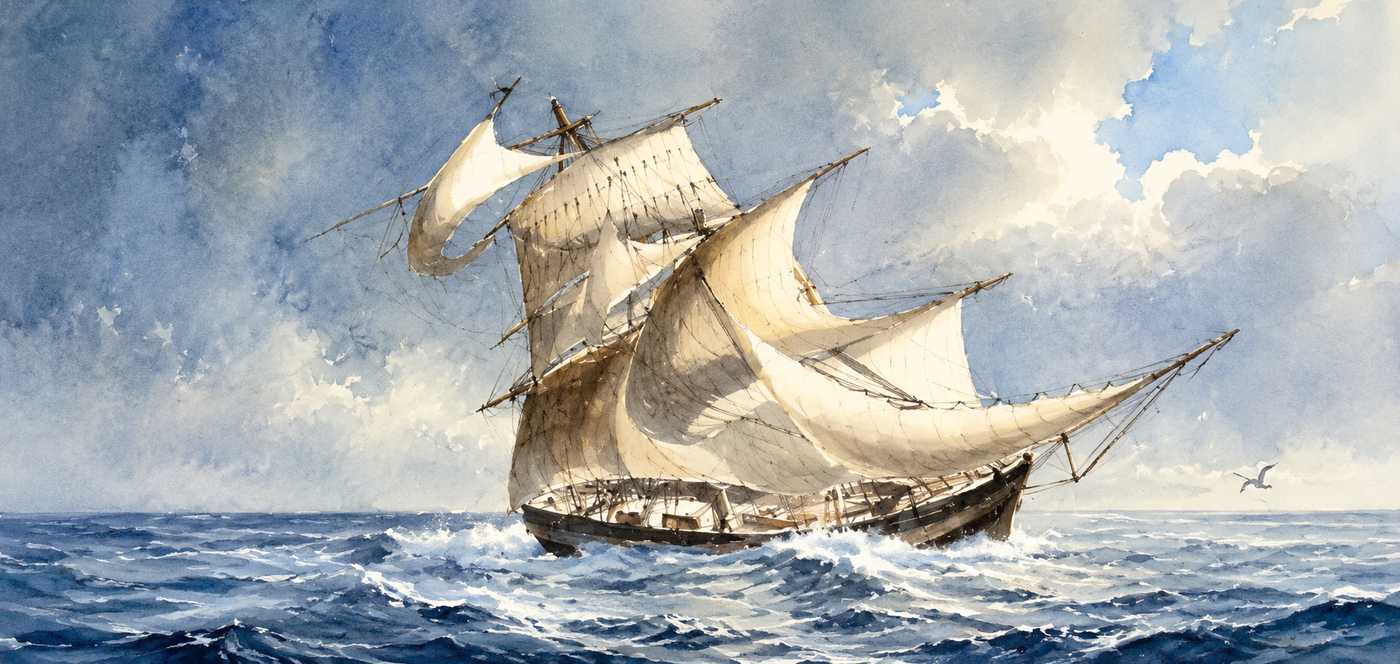
To understand the sheer scale of the maritime sprint that decided the geopolitical shape of New Zealand’s South Island, you have to understand the vessel Captain Owen Stanley was driving. When HMS Britomart slipped out of the Bay of Islands under the cover of night on 23 July 1840, she was not a spacious, comfortable cruiser. She was a Cherokee-class brig-sloop – a design so notoriously wet, cramped, and unstable in heavy weather that contemporary Royal Navy sailors dubbed them "coffin brigs".
To drive a flush-decked, heavily rigged square-rigger down the exposed east coast of New Zealand in the dead of winter meant signing up for a masterclass in extreme seamanship. For over two weeks, Stanley’s crew battled relentless winter gales, freezing sea spray, and shredded canvas. They forced a temperamental naval workhorse to claw her way south with nothing but dead reckoning and raw nerve to guide them, all to drop anchor before a rival French expedition could claim the harbour.
The starting line: driving a Coffin Brig
The Cherokee-class brig-sloop was designed by Sir Henry Peake in 1807 to serve as a cheap, mass-produced naval workhorse. Measuring just 90 feet along the deck with a beam of 24 feet and six inches, the Britomart was a tiny platform for the open Pacific Ocean. Because she was flush-decked – lacking a raised forecastle or quarterdeck – any substantial wave boarding the ship washed cleanly over the entire main deck, keeping the crew perpetually soaked and freezing.
Worse still for winter sailing, Cherokee-class brigs were heavily rigged relative to their small, 237-ton hulls. Carrying two square-rigged masts, they were blindingly fast downwind but highly vulnerable to broaching and capsizing if caught unawares by a sudden shift in wind.
When Governor William Hobson received intelligence that the French corvette Aube was heading south to oversee a French settlement at Akaroa, he knew he could not send a slow transport. He needed speed. He ordered Captain Stanley to take the Britomart, slip out under absolute secrecy, and establish an active British legal presence on the beach before the French arrived.
The winter delivery: clawing to windward
The passage south along the east coast of New Zealand in late July and early August means facing the brunt of the Southern Ocean’s winter cycles. For the crew of the Britomart, the journey was a relentless battle against severe southerly gales and massive head seas.
Square-rigged vessels are fundamentally unsuited for sailing close to the wind. To make headway against a southerly, the Britomart had to brace her yards hard up and tack back and forth across the coast, a gruelling process that required the entire 75-man crew on deck in freezing conditions. Handling hemp running rigging that had stiffened with freezing spray, the sailors had to repeatedly climb into the high rigging to reef down the heavy canvas sails as the wind screamed through the shrouds.
Navigational technology of the era offered no safety net. Without modern lighthouses, coastal charts, or GPS, navigation relied strictly on dead reckoning – calculating position based on estimated speed and compass headings – and throwing a lead line to check the depth when closing with the shore. The coast was a jagged lee shore; a single failure of a spar or a missed tack could see the under-powered brig blown straight into the rocks. Despite the storm splitting their sails and fracturing spars, Stanley pushed the vessel to her absolute structural limit.
Entering the crater: the pilotage of Akaroa
On the afternoon of 10 August 1840, the Britomart finally closed on the towering, dark volcanic headlands of Banks Peninsula. Having out-sailed the storm, Stanley faced a new challenge: bringing a square-rigger into Akaroa Harbour without auxiliary power.
From a skipper's perspective, Akaroa is a flooded volcanic caldera, creating a unique set of aerodynamic and hydrographic hazards:
The Wind Shadow: The sheer cliffs at the entrance, rising over 200 metres, completely block the coastal breeze. As the Britomart entered the mouth, her sails would have suddenly gone slack, leaving the ship to wallow dangerously in the heavy ocean roll rolling into the channel.
The Katabatic Squalls: Once inside the deep, narrow channel, the towering crater walls acted as funnels. Cold air from the high mountain ridges rushed down the valleys in violent, unpredictable squalls known as williwaws. These sudden shifts in wind speed and direction could easily catch a square-rigger flat aback, risking structural damage or a sudden knockdown.
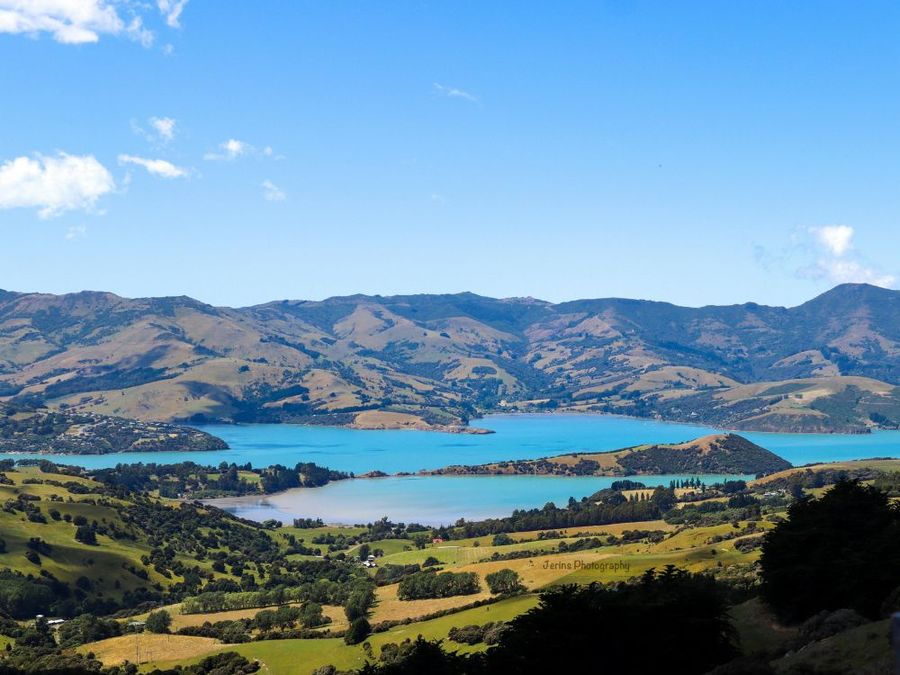
Stanley kept his crew stationed at the sheets and halyards, ready to drop canvas in an instant. Standing deep into the harbour, he bypassed the exposed outer bays and sought out a secure berth. He found it in the lee of Green Point, where the water shoaled from the deep 20-fathom center channel to a manageable 5 to 6 fathoms. The seabed here consisted of thick volcanic mud and clay – excellent holding ground for the brig’s heavy iron bower anchors.
Dropping anchor at the finish line
In the late afternoon of 10 August, the Britomart swung head-to-wind. The order was given, the anchor was let go, and the heavy hemp cable roared through the hawseholes, burying the fluke deep into the mud. The winter sprint was over.
The next morning, 11 August, Stanley and two newly appointed magistrates went ashore at Green Point. They raised the Union Jack and held a brief civil court session on the beach, establishing the formal "active British administration" required by international law to secure a territorial claim.
The extreme seamanship displayed by Stanley's crew proved decisive by a matter of days. The French transport ship Comte de Paris, carrying 57 immigrants, had actually sighted the peninsula on 9 August but was forced by the same brutal weather to seek shelter around the corner in Pigeon Bay. By the time the French warship Aube finally sailed into Akaroa Harbour on 15 August, her captain, Charles Lavaud, looked through his glass only to see the British brig safely riding her anchors, sails furled, and a legal presence firmly established on the shore.
Out-sailed and out-manoeuvred in the final miles, the French choices were limited to conflict or compromise. Lavaud chose the latter, allowing the French settlers to land peacefully under British administration – a move that left Akaroa with its distinct French architecture and street names, all anchored by a two-week winter race against the elements.