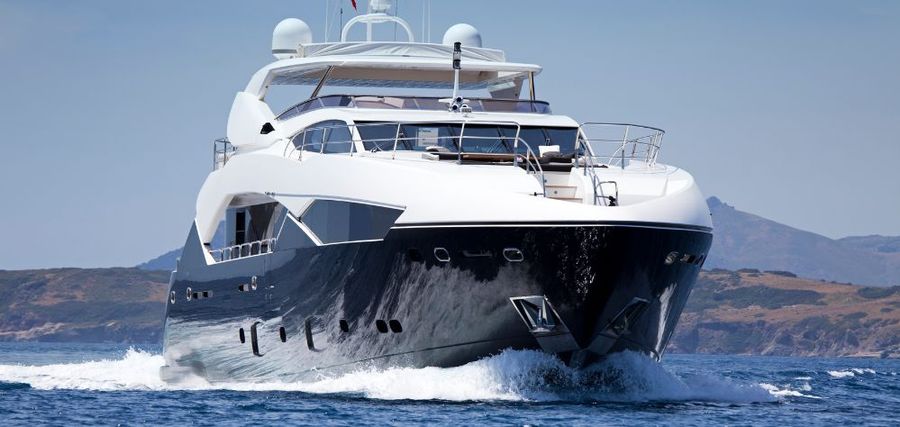
A yacht anchored off the coast at 2am used to mean a generator running until morning. On a growing number of new builds, it doesn't anymore.
Volvo Penta, Azimut, Benetti and Fountaine Pajot are among the builders and suppliers pushing integrated hybrid systems into production yachts, bringing propulsion, batteries, generation and energy management together so the owner has fewer separate systems to manage.
The engineering itself is getting more complicated, not less. Cars went through the same thing. Nobody adjusts their own ignition timing anymore, and most drivers have no idea what their car is doing with regenerative braking at any given moment. The machine deals with it. Boats are catching up.
Traditionally, on a cruising yacht, separate systems handle separate jobs. Propulsion diesels move the boat. A generator covers hotel loads once you're at anchor, air conditioning, fridges, pumps, cooking. Battery chargers keep the house bank topped up. Shorepower runs its own circuit. The crew's job is knowing which of those needs to be running, and when. The hybrid proposition strips that out: stop thinking about which machine should be on, and tell the boat what you're asking it to do instead.
One system, from helm to propeller
Volvo Penta's new D13 IPS Hybrid, due to market later this year, bundles diesel propulsion, a 160kW electric motor, batteries (147kWh or 221kWh options), charging and vessel control into one system rather than parts sourced from separate suppliers. The electric motor sits on the same driveline as the diesel, which means the system can run on diesel alone, electric alone, or blend the two depending on what's needed. In crossover mode, one diesel engine can effectively power both drives, with the electric machines transferring energy between the two sides. That can improve efficiency at lower cruising loads and extend the time between engine maintenance.
160kW works out to roughly 214hp, though electric and diesel outputs don't translate directly into equivalent boat performance, they're doing different jobs at different points in the cruise. As an illustrative comparison, the smaller 147kWh battery option stores somewhere around fifteen times the energy of a modest 10kWh house bank, though cruising boats vary enormously in what they actually carry. It isn't simply a bigger house battery, either. It also has to support propulsion and heavy AC loads, which is why the packaging and cooling requirements are considerably more serious than anything in a conventional yacht's battery locker. Those batteries can be topped up from shorepower or from the diesels themselves, including up to 250kW while running in generator mode. Volvo Penta calls it a helm-to-propeller solution and talks about simplifying service responsibility: one supplier, one point of contact, rather than a boat builder dealing with a collection of separate systems.
The 2am test
Azimut's Seadeck 7 became the first yacht to combine hybrid power with Volvo Penta IPS, using the pilot technology that preceded this new production system. At anchor, its batteries could run all onboard services for up to 12 hours. No generator. Air conditioning, lights, the lot, off battery alone.
On a conventional yacht, the propulsion diesels are already off once you're anchored. What kicks in instead is the generator, running hotel loads through the night. That's the piece Azimut's system removes. The system also allows pure electric manoeuvring and cruising at up to 11 knots, useful for slipping out of a marina without waking every boat around you.
Nobody's arguing the diesel is obsolete here. It simply doesn't need to run unless there's an actual job for it to do.
Sanlorenzo's 25.5 metre SHE runs the same underlying architecture, styling deliberately borrowed from a 1960s Italian motor yacht, 20 knots on conventional power or a quiet 7 knots on electric. Nothing about it needs to look futuristic.
Standard, not optional
Benetti went further with the 40 metre B.Neos. Rather than offering hybrid propulsion as an option, they built it in as standard. The setup, supplied by MAN, pairs two 662kW V8 diesels with two 200kW electric motors, and meets IMO Tier III emissions rules through its own exhaust treatment. Benetti calls it the first displacement yacht under 300GT to ship that way.
The operating modes show why it's worth doing. Battery electric mode handles quiet running at anchor and low speed manoeuvring. Diesel Electric mode suits steady loads where direct mechanical propulsion isn't needed, slow running, harbour operation, or supplying the hotel network while the batteries charge. Crossover gives the system another way to balance propulsion, generation and hotel loads. Boost combines diesel and electric power when maximum performance and acceleration are wanted. Making hybrid standard rather than optional changes the buying conversation. There's no "should I option the hybrid pack." It's just how the boat's built.
Sailing gets the same treatment
Fountaine Pajot's ODSea+ system does something similar on sailing catamarans, solar panels producing up to 2,000W, one console managing where every watt is coming from and going, and hydrogeneration through the propellers themselves, roughly 1kW per propeller at 8 knots.
The propeller trick is worth explaining properly. Under power, electricity drives the propeller. Under sail, water flowing past the propeller spins the the electric motor as a generator, feeding electricity back into the batteries. There is a price: extracting energy from the boat's movement adds hydrodynamic resistance. For a cruising catamaran, the trade can still make sense when replenishing the batteries matters more than squeezing out every fraction of a knot.
What's happening underneath
The reason all of this needs new electrical architecture, not just bigger batteries, comes down to current. A 10kW load at 24V demands somewhere around 417 amps before losses. The same 10kW load at 400V only needs around 25 amps. At those currents, controlling voltage drop and resistive losses requires very substantial cabling, which is why high power electric propulsion generally needs a dedicated higher voltage architecture rather than simply being added to an existing 24V house system. The trade-off is that higher voltage brings its own safety, isolation, installation and servicing requirements that a conventional 12V or 24V system doesn't have to deal with. Plenty of yachts still mix 12V or 24V house systems with a separate high voltage propulsion circuit, there's no single new wiring standard replacing everything. What's changed is that these systems now talk to each other, rather than sitting in isolation.
The catch
None of this comes free, and the costs are worth being upfront about. Batteries of this size are heavy, and weight matters enormously on a boat. They're expensive to buy and eventually to replace. Installation is more complex than a conventional diesel and genset setup, and servicing needs technicians trained specifically on high voltage marine systems, not every yard has that yet. Hybridisation can also mean carrying diesel propulsion alongside electric motors, batteries, power electronics and cooling systems, although some installations offset that complexity by reducing or eliminating separate generator machinery. And to say it plainly: a hybrid system doesn't create energy. It changes where the energy comes from, when the engines actually need to run, and how efficiently the energy already available gets used.
What about my boat?
A ten-year-old cruiser isn't getting electric IPS propulsion by swapping a few boxes. But a lot of the same thinking is already available off the shelf. Victron's PowerAssist function is a good example of what that actually looks like in practice. Say you're on a modest marina connection, the air conditioning is running, and someone puts the kettle on. Instead of overloading the shorepower supply and tripping the pedestal, the inverter charger can temporarily draw on battery power to cover the gap, then let charging resume once demand drops. Its Cerbo GX can start and stop a generator on its own once it hits programmed conditions, so nobody's watching a battery gauge deciding when to fire it up. In both cases, the owner didn't manage the energy source. The system did. Lithium storage, solar, smarter charging. None of it turns an old boat into a hybrid yacht, but it takes a surprising amount of the thinking off the owner's plate.
The bigger picture
For generations, running a yacht meant running its machinery. Increasingly, the skipper tells the boat what they want it to do, and the boat works out which machinery it needs. The engineering gets harder. Living with it gets easier.