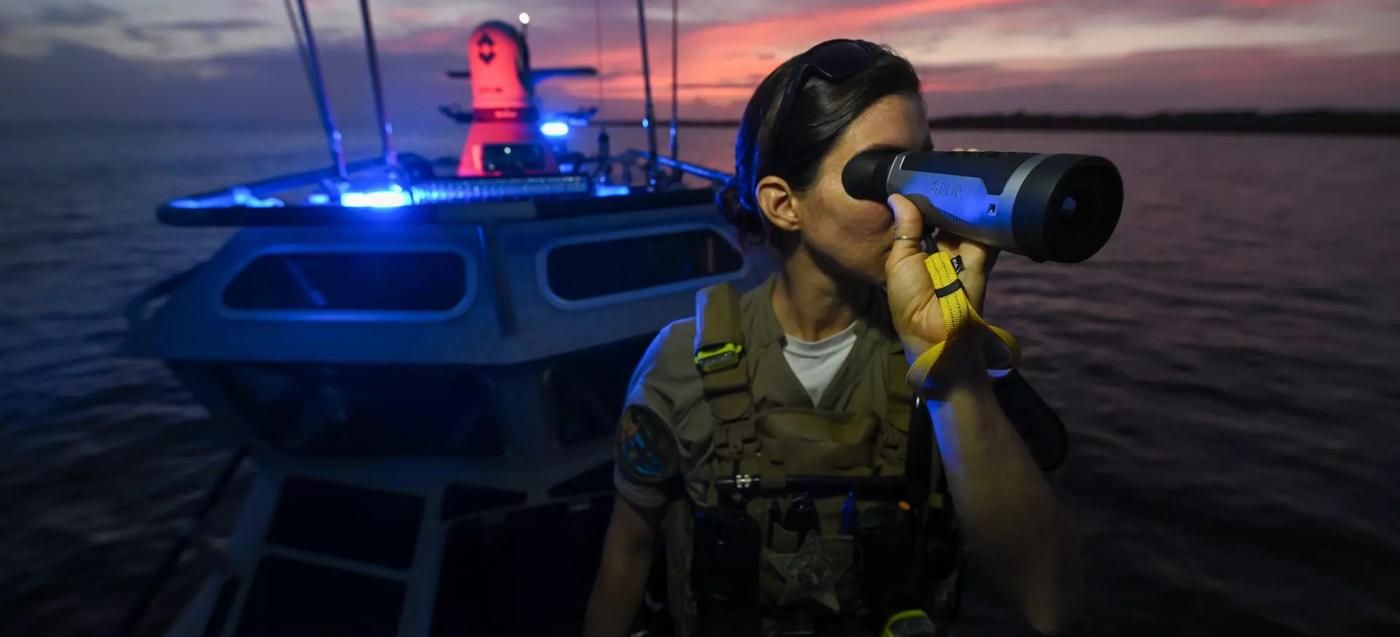
A person adrift at night rarely shows more than a head above the surface. To a spotlight, that's next to nothing. To a thermal camera, it's a bright shape sitting against a cooler, darker sea, because a body radiates heat the water around it doesn't. FLIR calls this a force multiplier for search and rescue crews. It's really just physics doing the work light can't.
That same trick works both ways. In total darkness, in smoke, in haze, in light fog, a thermal sensor keeps reading the heat signatures of other vessels, docks, pilings and anchored boats long after a windscreen has gone black. For a skipper picking a line through a crowded harbour after dark, that's the margin between guessing and knowing.
New Zealand had a front row seat to this technology arriving. When FLIR's long range Voyager camera first went on sale outside the United States, the earliest buyers were New Zealand boat owners, according to Absolute Marine, the brand's exclusive local distributor since 2006. Nearly two decades on, Absolute Marine still supplies FLIR gear to Coastguard NZ, and Nelson's volunteer rescue vessel now carries a FLIR infrared camera purely for night searching, run alongside its onboard navigation system.
The current range shows how far the tech has travelled from that first Voyager. At the entry point sits the Ocean Scout Pro, a handheld thermal monocular for quick situational awareness. Fixed units step up from there: the compact M232, the ultra low-light M300C with 2-axis gyro stabilisation, and the M364C, which pairs a high resolution thermal sensor with its own low-light camera and gyro stabilisation for a steady image in a chop. Absolute Marine also points to a commercial case, the New Zealand coastal freighter M.V. Golden Bay, whose captain has credited the cameras with helping his crew catch small craft that might otherwise slip past unnoticed entering harbour.
It's a long way from novelty to infrastructure in nineteen years. What started as a handful of early adopters testing an American import on New Zealand waters is now sitting on volunteer rescue boats as standard fit, doing its quietest, most important work at 2am when nobody's watching.
Find out more about FLIR Marine cameras from Teledyne and Absolute Marine.