Northland Regional Council's warning about high-powered lightbars wasn't only about your own lights, it explained how a glaring light stops other skippers seeing and reading yours. Getting navigation lights wrong works both ways, and it's one of several things, alongside speed and keeping a proper lookout, that can lead to a collision in the dark.
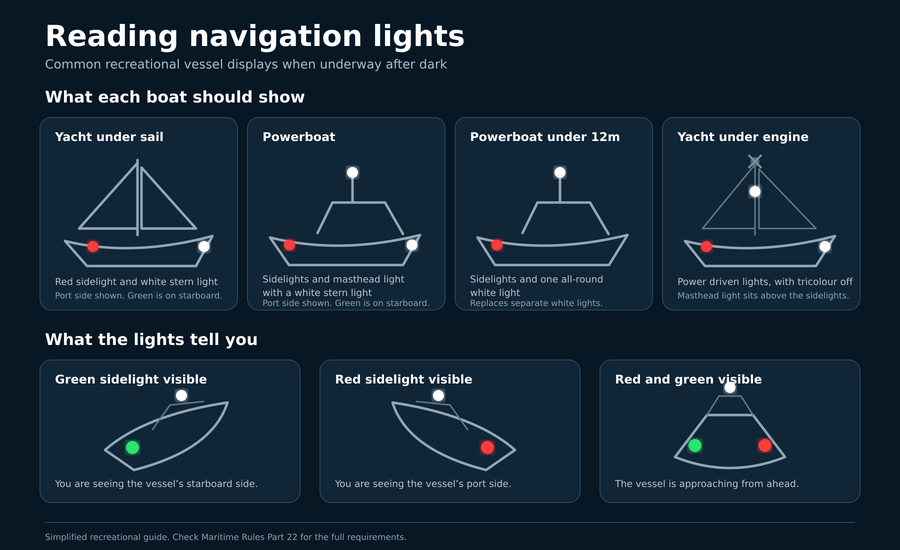
A sailing vessel underway normally displays red and green sidelights plus a stern light. A power-driven vessel normally displays those same sidelights and stern light, plus a masthead light, a white light showing over the forward sector rather than necessarily one mounted at the top of the mast. The moment a sailing vessel starts using its engine, it has to switch over and show power-driven vessel lights, sails up or not.
These are the combinations most recreational boaties, underway, will encounter. It isn't a complete guide to Maritime Rules Part 22, and larger or commercial vessels carry additional requirements. Anchored vessels show a different pattern again.
| Vessel type (underway) | Lights required |
|---|---|
| Vessel under sail | Red and green sidelights, plus stern light |
| Power-driven vessel | Sidelights, stern light, white masthead light |
| Power-driven vessel under 12m | May show sidelights plus a single all-round white light, instead of separate masthead and stern lights |
| Power-driven vessel under 7m, 7 knots or less | May show a single all-round white light, and must also show sidelights where practicable |
Small sailing and rowing vessels sit under separate provisions of their own, distinct from this power-driven concession.
What you can see of another vessel's lights indicates its aspect, in other words, roughly which part of the boat is facing you. A stern light suggests you're viewing the vessel from behind, which often means you're overtaking, though whether you count as the overtaking vessel under the rules depends on your relative position and how you're approaching. A single red or green sidelight tells you which side of the vessel is visible and gives a general sense of its heading relative to you, rather than an exact course. Seeing both sidelights together means you're viewing the vessel from ahead or close to it. That's your cue to slow down. Whether it's genuinely a collision course, and who has to give way, still depends on the wider picture rather than the lights alone. Light patterns can also hint at vessel type, but recreational skippers generally can't judge another boat's precise size from its lights alone.
On sailing vessels under 20 metres, the sidelights and stern light can be combined into a single tricolour lantern, an allowed alternative carried at or near the top of the mast, and it's only used while sailing, not under engine. When a yacht switches to motoring, the tricolour needs to go off, and the vessel must instead show sidelights, a stern light, and a masthead light, a white light over the forward sector, positioned above the sidelights.
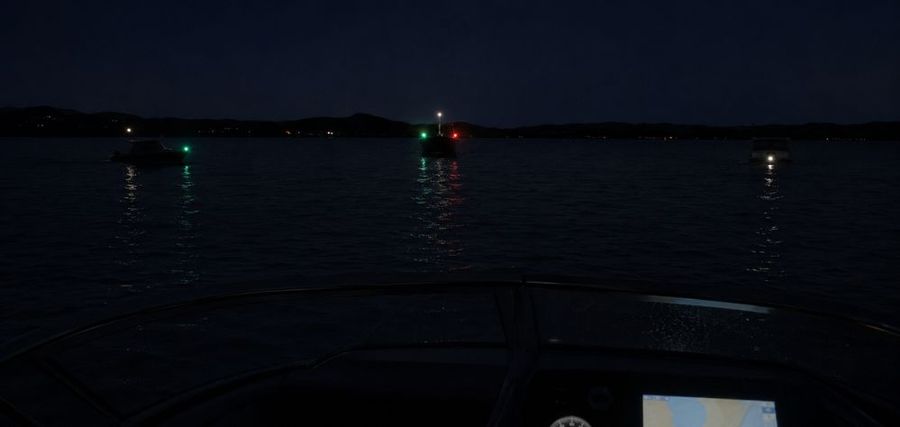
Busy harbours make all of this harder to judge, since shore lighting competes with what's actually out on the water. A flashing light could be a navigation mark or a fast ferry, though other vessels, shore installations and special signals can flash too. A fixed light is often another vessel, but shore lights can appear fixed as well. Coastguard's advice is to treat any single light with care, and weigh up a vessel's aspect, its distance and the surrounding traffic before deciding whether there's a risk of collision and who has to give way.
Coastguard cites an earlier Auckland case where a boatie was fined after colliding with a moored vessel while travelling at excessive speed through a designated mooring area, an impact that damaged both boats and injured several people. Maritime NZ's North Regional Compliance Manager, Neil Rowarth, said the case was a reminder to keep a proper lookout and slow down after dark.
Slow down at night, give yourself more room than you think you need, and check your own lights are correct before you leave the ramp.