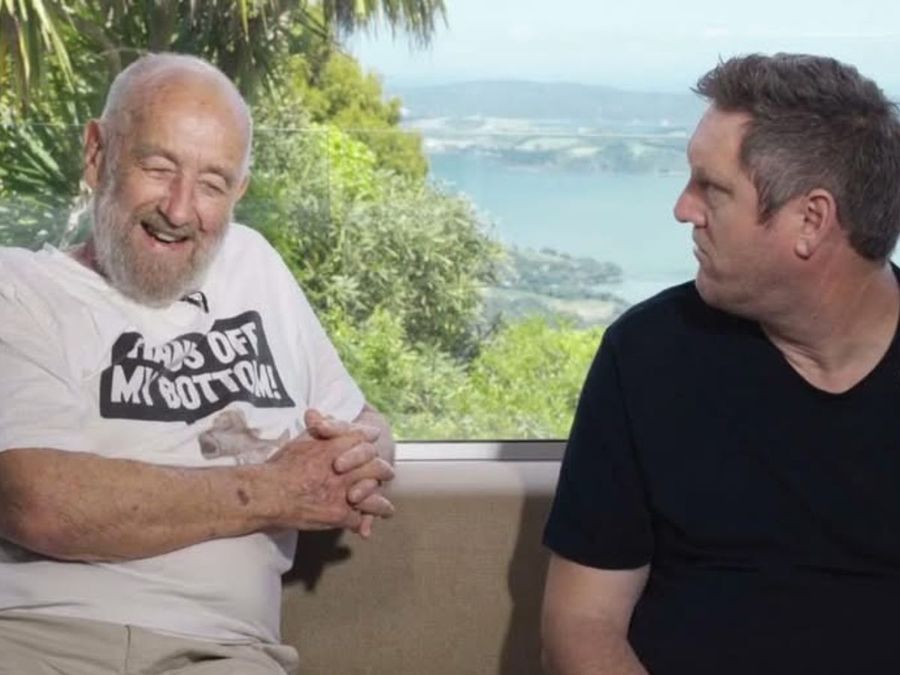
Barry Torkington has been watching the Hauraki Gulf hollow out for more than fifty years. While many New Zealanders treat the Gulf's decline as a relatively recent development, for Barry it has been a steady, lifelong accumulation of losses, beginning when he was a child growing up at Ti Point, overlooking Omaha Bay, in waters that bore almost no resemblance to what exists today.
The Gulf he knew as a boy was teeming. Crayfish were abundant along the coastline, snapper and kahawai moved through in numbers, trevally, parore and gurnard were common, and shellfish beds were rich and widespread. What troubles him most is not simply that those species have diminished, but that each successive generation accepts a poorer baseline as normal. Expectations drift downward, and what would once have looked like collapse begins to pass for the natural state of things.
Barry is not simply a keen observer with a long memory. He is among New Zealand's most experienced practitioners in fisheries management, with a career spanning commercial fishing, aquaculture and policy. He served as Chairman of the New Zealand Fisheries Symposium in 2016, spent many years as a director with Leigh Fisheries Ltd focusing on quality assurance and innovation, and has been actively involved in fisheries management for more than 30 years. That involvement has included contributing to two management plans for the country's largest snapper fishery in Area 1, which refers to the Auckland (East) and Kermadec marine area and covers the east coast of the North Island from North Cape to Cape Runaway, extending to the 200 nautical mile limit of the Exclusive Economic Zone. He now works as an advisor to both the New Zealand Sport Fishing Council and LegaSea, bringing a science-based, experience-grounded perspective that bridges the divide between commercial and recreational fishing interests. That depth of background is what lends his assessment of the Gulf its particular weight.
On the question of what went wrong, Barry is direct. The arrival of industrial trawling, seining and dredging in shallow inshore waters was the turning point. These methods did not simply harvest fish. They stripped habitat, disturbed sediment across the seafloor, removed juvenile fish before they could contribute to the population, and eliminated benthic life that had taken decades or longer to establish. The damage unfolded quickly. Small-scale inshore fishers, working lower-impact methods, were pushed aside as large vessels moved through the same grounds at high volume.
The economic structure behind this has never required those responsible to bear the true cost. Habitat destruction and biomass loss are absorbed by the public rather than by the operators who cause them. When pressure depletes one area, the industrial fleet shifts to the next. Quota owners continue to receive returns while the underlying fishery weakens, and the cycle continues without any mechanism compelling operators to account for what is lost.
Barry argues that the Quota Management System, rather than reversing this decline, has helped to entrench it. Independent fishers must lease quota at significant cost before they leave the dock, carrying the full burden of fuel, wages, maintenance and compliance while quota owners collect rent without setting foot on a vessel. The system was built around commercial interests rather than ecological outcomes, and it shows. For all the pressure it places on inshore species, inshore fishing contributes less than one percent of GDP, making the trade-off increasingly hard to justify.
He supports the use of marine reserves and High Protection Areas, but cautions against treating them as the primary solution. Goat Island has been protected for fifty years and is measurably healthier than surrounding waters, yet it remains well below anything resembling its original state. Reserves cannot rebuild a system that continues to deteriorate beyond their boundaries. Without genuine reform in the broader management framework, protected areas risk becoming isolated pockets of relative health rather than engines of ecosystem recovery.
One of the more striking insights Barry points to came from an unexpected source. During the COVID lockdowns, fish returned to harbours. The reason was not simply that fishing had paused. Boat traffic had ceased, and with it the noise. The response of inshore species to that reduction in disturbance was rapid and visible, demonstrating how sensitive fish populations are to pressures that go well beyond the act of catching them, and how quickly they can begin to recover when that pressure is lifted.
His recommendations for genuine recovery draw on that same breadth of experience. He calls for a rewrite of the Fisheries Act with biomass targets set at levels that actually allow stocks to rebuild. He argues for separating the management of inshore and deepwater fisheries, which currently operate under frameworks that do not reflect their very different ecologies. Industrial harvest methods should be removed from inshore waters entirely. Shellfish beds, reefs and soft sediment habitats need active restoration. Sedimentation must be addressed through meaningful land management enforcement. Small-scale, low-impact commercial fishers deserve support rather than being squeezed out by a system that favours volume and ownership. Stocks should be rebuilt before catch levels are increased, not the other way around. And communities should have a genuine voice in the decisions that shape the fisheries they depend on.
Barry's message is not complicated. The Hauraki Gulf did not arrive at its current state through bad luck or misfortune. The causes are understood, the damage can be measured, and the tools for recovery exist. What has been absent is the structural will to use them. Closures and symbolic protections will not be sufficient. What the Gulf requires is reform that reaches into how fishing rights are held, how habitats are managed, and how the costs of depletion are shared. Without that, future generations may only ever know the Gulf through the accounts of those who remember it as it was.
This article is written with permission of Legasea, based on their podcast with Barry.