Fisheries New Zealand is seeking public feedback on draft fisheries plans for two rock lobster stocks: the Hauraki Gulf and Bay of Plenty fishery (CRA 2) and the Wellington and Wairarapa fishery (CRA 4). Both consultations centre on the same question: where should the biomass target be set for each stock, and what thresholds should prompt a management review if abundance drops?
The current default target is BMSY, the biomass level associated with maximum sustainable yield. FNZ is examining whether higher targets would better reflect ecosystem health, customary values, and broader stakeholder goals. The chosen target will be incorporated into a formal plan for each stock, and FNZ is collecting feedback before making its recommendation to the Minister.
Both stocks have the same four options: BMSY, 1.75 times BMSY, 2.5 times BMSY, or 3.5 times BMSY. FNZ is also consulting on threshold levels, either BMSY or half the chosen target, that would trigger a formal fishery review.
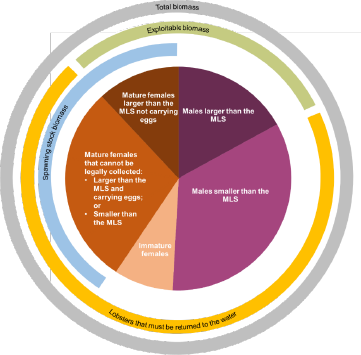
Put plainly, a higher target means more crayfish left in the water. Catches may need to tighten for a period to build numbers up, but the projected returns include more large lobsters, improved catch rates over time, and a fishery better able to absorb poor recruitment seasons or environmental shocks.
The argument for lifting targets is most pressing in the Hauraki Gulf and Bay of Plenty, where urchin barrens have spread considerably over decades. Large crayfish help keep kina populations in check, and restoring their numbers and size is one lever among several, alongside snapper recovery and localised habitat work. FNZ is candid that no single biomass number will reliably convert urchin barrens back to kelp forest, and stock-wide targets cannot resolve individual reef problems on their own. Even so, a greater abundance of large kōura should contribute meaningfully.
FNZ's modelling for CRA 2 shows that managing toward the highest target option would produce substantially more large lobsters over time. That matters because only large animals are capable of preying effectively on large kina. Comparable projections apply to CRA 4, though urchin barrens are less extensively documented in that region.
For CRA 2, the stock was estimated at around twenty percent of unfished exploitable biomass in 2024, which sits above the current default target. In early 2025 the Minister left catch settings unchanged, signalled a rebuild path toward twice BMSY as an interim goal, and closed the inner Hauraki Gulf to lobster fishing between Cape Rodney and Port Jackson. That package provides the backdrop against which FNZ is now seeking a formal long-term target.
The situation for CRA 4 is different. The stock currently sits well above the default target and is projected to hold or grow under existing catch levels. If the final target is set higher, catch reductions may be required to reach it within the agreed timeframe, though that determination will come through later processes.
FNZ has also outlined the likely on-water benefits if targets are lifted. Once a new target is reached, the commercial fleet can expect improved catch per unit effort, while divers and potters should encounter more legal-sized lobsters and a higher proportion of large animals. These figures represent long-run averages rather than any guarantee for the coming season.
Both CRA 2 and CRA 4 are shared fisheries. Customary, recreational, and commercial interests all factor into management, and any short-term catch adjustments will be weighed against each sector's needs and the timeline required to reach the new target.
Consultation is open until 5pm on Monday 8 September 2025. Submissions can be emailed to FMSubmissions@mpi.govt.nz, and the Ministry for Primary Industries page lists the relevant documents and submission form. FNZ is asking three core questions: which target you support for each stock, which threshold you prefer, and how the plan and its target would affect you. There is also scope to comment on plan objectives and the proposed ten-year review period.
For those who fish, dive, or spend time at anchor in these waters, a submission is a chance to be specific and concrete. A few approaches are worth considering.
If you know anchorages and dive sites across a range of exposures and currents, describe where you have noticed crayfish abundance shifting and where kina-dominated ground has expanded. That kind of local knowledge carries real weight.
If you work pots, detail soak times, bait use, bycatch trends, and any changes in gear loss. Those specifics help decision-makers understand how catch rate shifts play out on a small vessel.
If you free-dive or spearfish, note the depth bands you work, the swell and visibility windows that give you access, and how often you now find legal-sized crayfish compared with five or ten years ago.
Consider the time path as well as the target itself. A higher target phased in gradually may suit mixed-use interests better than a rapid transition, and it is worth stating that view clearly if you hold it.
If you are involved in or supportive of local reef-scale restoration work, include that perspective too. Stock-wide targets do not resolve every reef problem, and the role of localised efforts alongside broader management is a legitimate part of the conversation.
As Emma Taylor of Fisheries New Zealand noted when the consultation opened, "Consultation starts today and runs until 5pm on Monday 8 September 2025."
Once submissions close, FNZ will collate responses and put a recommended target and plan for each stock to the Minister for approval. If approved, the plans will guide catch decisions from 1 April 2026 and remain in place for ten years before being reviewed. For anyone who uses these waters, the outcome will shape how abundant crayfish are across key North Island reefs, and how the balance between rebuilding stocks, maintaining access, and supporting healthy habitats is managed over the decade ahead.