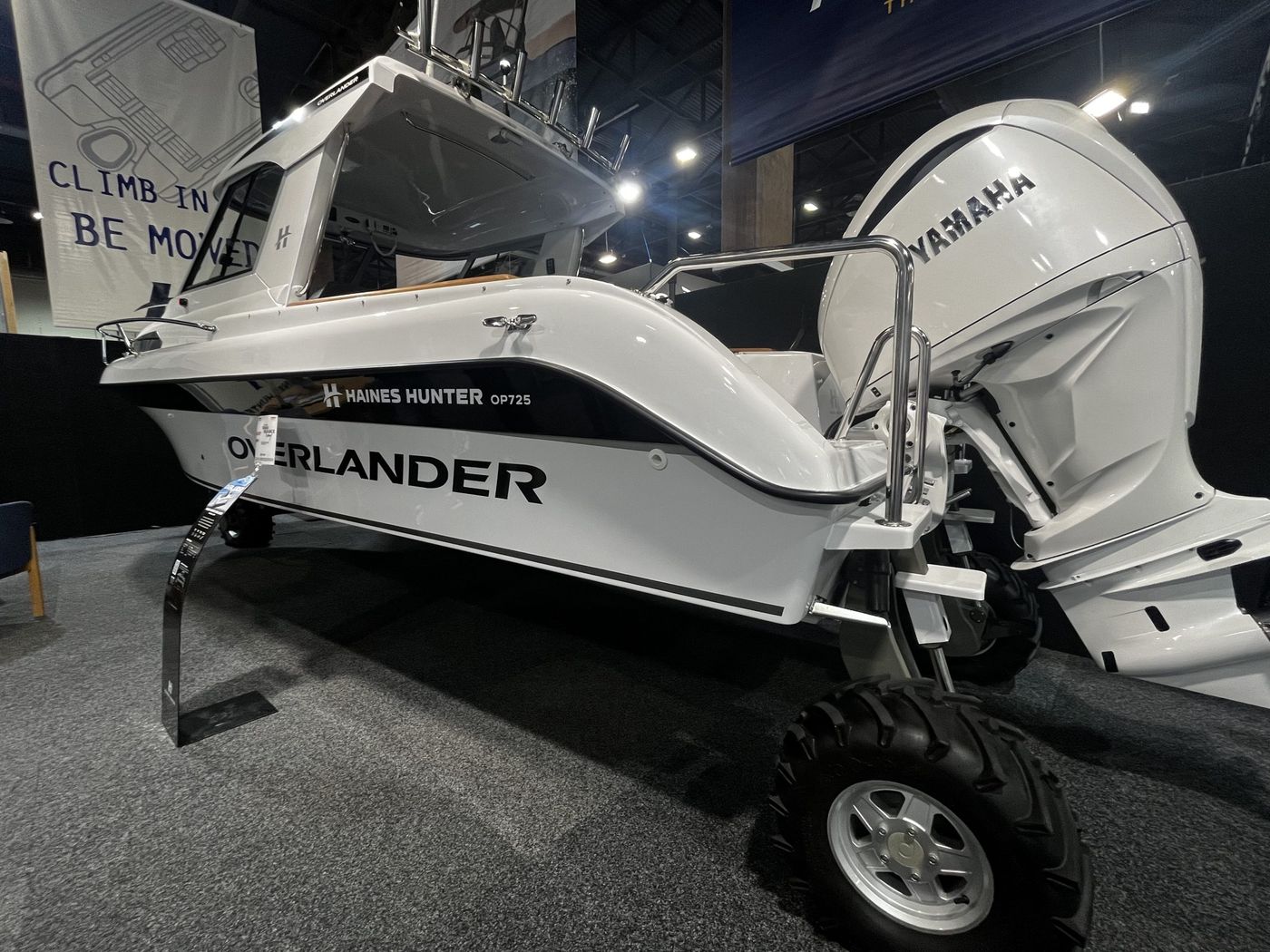
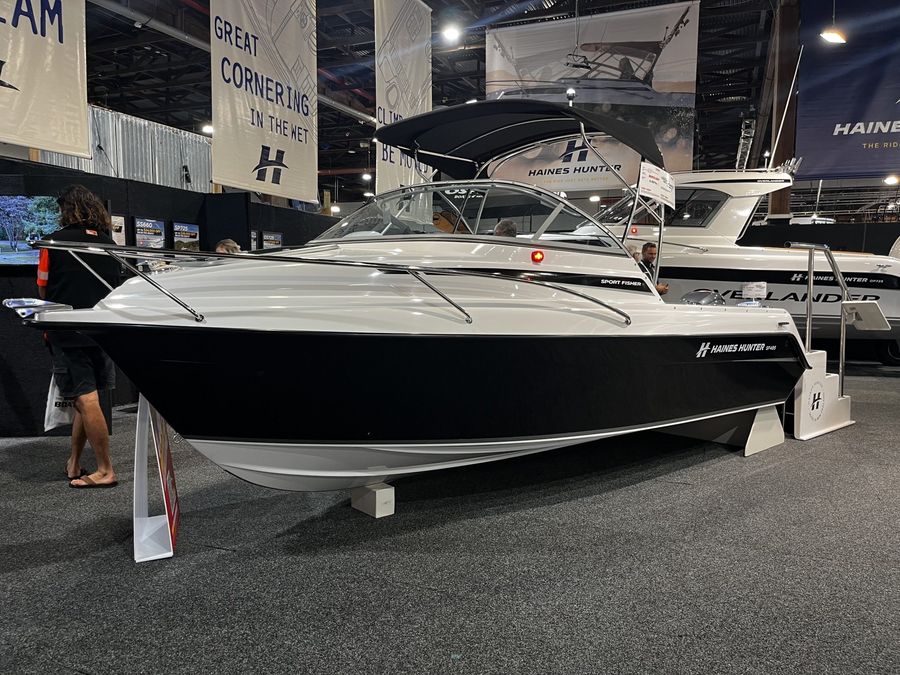
Three boats occupy the Haines Hunter stand at this year's Hutchwilco Boat Show: the SF485 Sport Fisher, the SP635 Sport Pursuit, and the OP725 Overlander Pursuit. Of the three, it is the Overlander that draws the crowds and holds them longest.
Luke, one of the boat builders from the Haines Hunter factory in Ellerslie, takes on the dual role of craftsman and salesman at the show, walking visitors through the OP725 in careful detail. The flush-mounted 16-inch Simrad NSS evo3, the full C-Zone switching system, the dash layout, and the upholstery all receive their moment. The amphibious fibreglass construction and the quality of finish sit in clear contrast to the aluminium vessels surrounding it on the show floor. Teak capping runs along the gunwales as a standard fitting across most of the range, a deliberate nod to earlier Haines Hunter designs rather than a custom upgrade. The SF485 is the sole exception.
The Overlander has been in the lineup for around three years. It generated strong interest at launch, went through a quieter phase, and has been drawing growing attention again. The OP725 carries 500 kilos more than a standard 725, a trade-off directly related to the scale of the wheels the design demands. On the water, performance holds up well against its lighter counterpart, and in certain conditions the extra mass becomes an advantage, lending stability when the boat sits at rest. The one honest concession is spray off the front wheel in a heavy swell. The boat can also be rigged for water skiing, with a ski hook mounting point on the hardtop, and demisters built into the upholstered dash take care of a fogged screen on a cold winter morning.
The V17L: where the modern Haines Hunter began
A short distance from the Haines Hunter pavilion, a separate stand marking 70 years of the Hutchwilco Boat Show brings together some of the most significant boats to have passed through it. A Haines Hunter V17L Cabin Runabout from 1983 is among them.
Sea Craft Ltd, operating out of Ellerslie in Auckland, built the V17 in two versions, the V17L Low Line Cabin and the V17R runabout, turning out 50 to 60 boats per year across roughly six years and completing more than 300 hulls in total. The cabin version accounted for the greater share of that production. Haines Hunter credits the V17L as the model that "helped shape the modern Haines Hunter experience we know today," citing its cleaner inner liner, its more considered layout, and its continued use of the deep-V hull that had already built the brand's reputation for handling New Zealand's unpredictable coastal conditions.
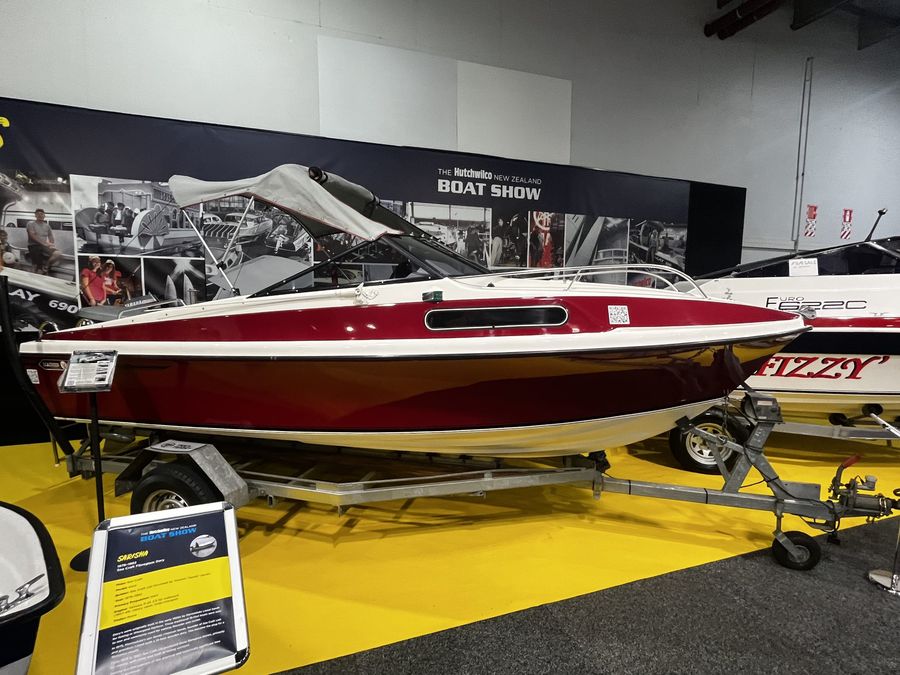
| Make | Haines Hunter |
| Model | V17L (Low Line Cabin) |
| Builder | Sea Craft Ltd, Ellerslie, Auckland |
| Year | 1983 |
| Engine | Yamaha 140 hp AETO 2-stroke (152 hours) |
| Trailer | Home-built |
The V17L was also the direct predecessor to the Haines Hunter 535, a model that went on to see more than 2,000 hulls completed. The boat on display was commissioned in 1983 for Trevor Geldard, former Chairman of Epiglass NZ and the New Zealand International Yachting Trust, and finished in his own distinctive Epiglass gelcoat colour.
Four decades on, the V17 remains a regular sight at boat ramps and marinas around the country. Its deep-V lines and the ride quality they deliver have not dated, and for a generation of New Zealand boaties it was the first serious boat they ever owned.
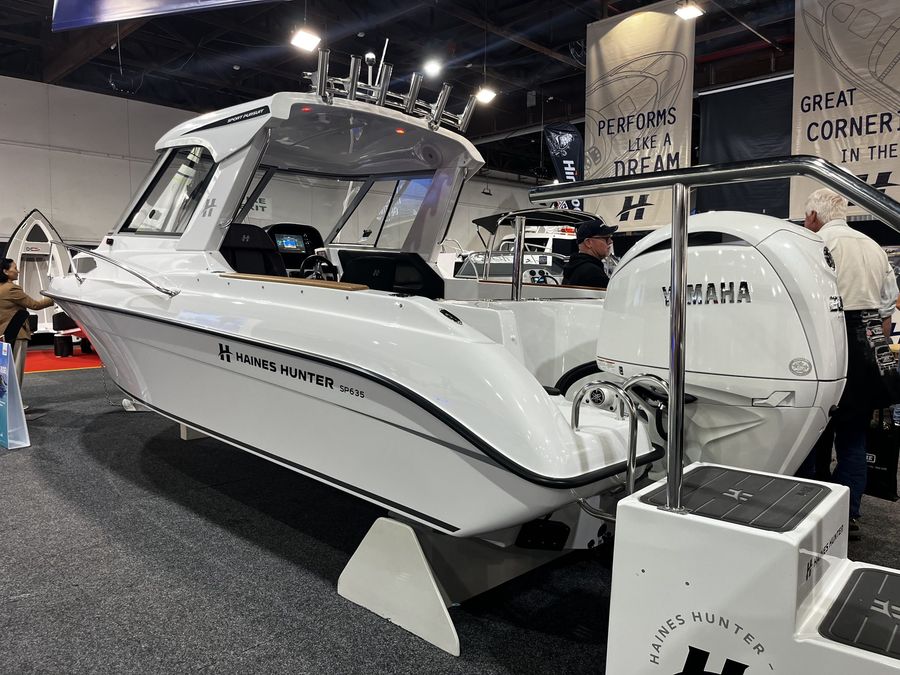
Back on the Haines Hunter stand, the SP635 Sport Pursuit is finished in full white, carrying a 12-inch Simrad NSS evo3, a full C-Zone system, an upholstered crash pad, and a dash cover. It is Luke's personal pick for looks.
At the other end of the stand, the SF485 Sport Fisher is the smallest boat Haines Hunter makes. The cockpit space and fishing room it offers for its size has drawn consistent comment from visitors on the stand.
All three boats are fibreglass and hand-laminated. Every boat leaving Haines Hunter HQ is fitted with Yamaha power, though dealers around the country fit what they prefer.