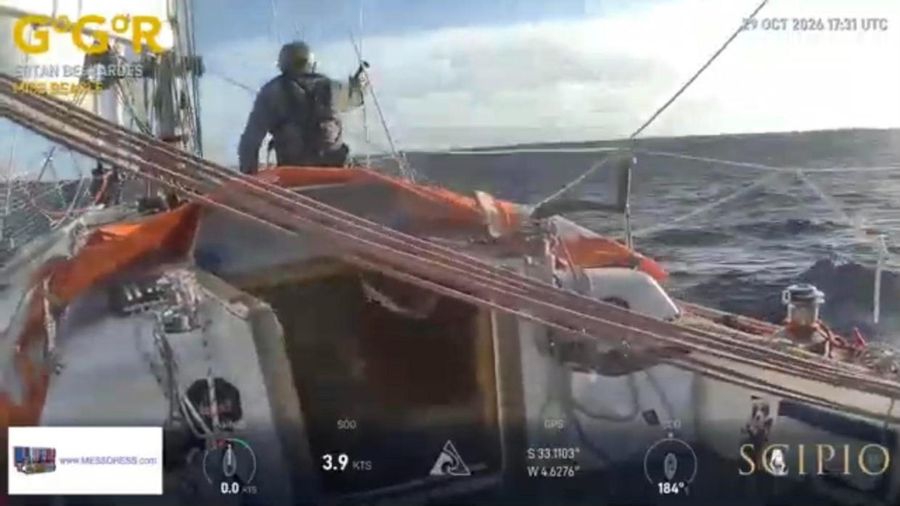
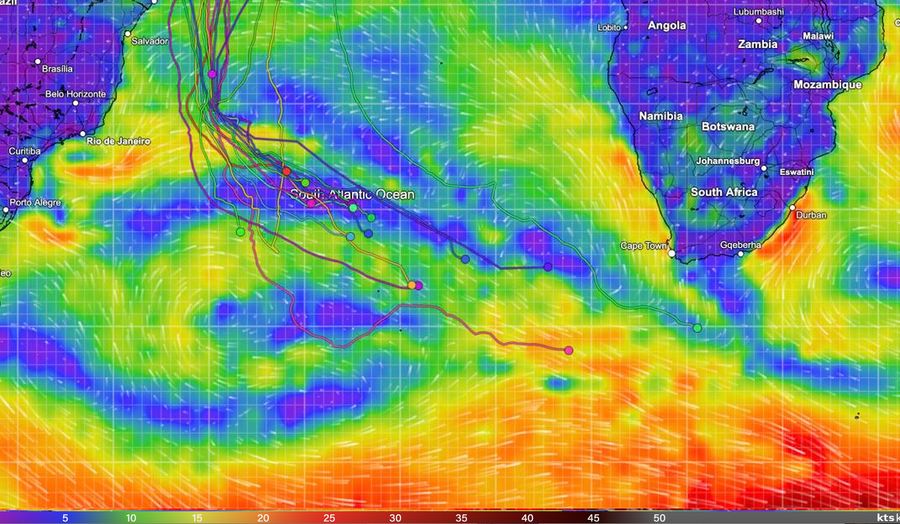
Damien Guillou kept his foot down while most of the Golden Globe Race fleet drifted. At 20:00 UTC on Friday 30 October Solarem had 19,555 nautical miles to the finish at Les Sables d'Olonne, after a 161-mile day that was the best on the board by 45 miles. That stretches his lead over second-placed Ertan Beskardes to 656 miles, 49 more than a day earlier. Behind them the middle of the fleet is crawling under a South Atlantic high. Pär Nyman made 16 miles, Isa Rosli 31 and Mara Kveseth 40. Positions and distances are from the 20:00 UTC tracker unless stated.
Golden Globe Race 2026: distance sailed
Tracker snapshots, start to Day 54
Source: Golden Globe Race live tracker (Yellow Brick)
Guillou shoots the sun at 42 south
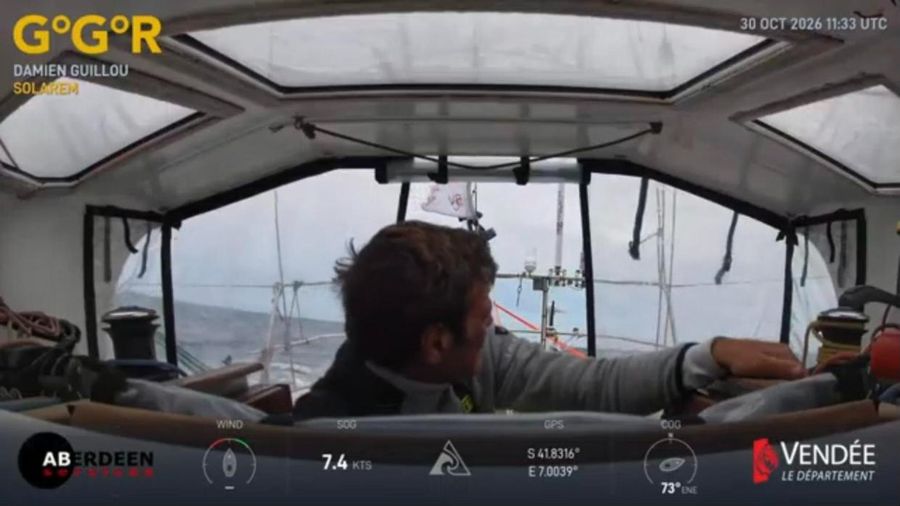
The leader was at 41.8 degrees south and 7.0 degrees east at 11:33 UTC on Friday, making 7.4 knots in a lumpy grey sea, and he chose that moment to check exactly where he was. In a recording from the saloon of Solarem he talked through his noon sight. He takes a reading of the sun about three quarters of an hour before it peaks, and again half an hour before. Once it has passed the top and started to fall he repeats both on the same settings, then averages the times to find the instant of local noon. He admits the method is not very precise. When the sky allows he uses a quicker version, watching the sun climb, catching it just before the top and again as it drops, which makes the arithmetic much simpler. A grey cloud sat over the sun at the start of the clip, with blue sky close behind it.
Through the next half hour the overlay shows his speed swinging between 5.6 and 8.5 knots as the swell lifted and dropped the boat. That pace has taken him to 7,548 miles sailed, 1,168 more than Beskardes.
Beskardes passes Cape Town's latitude
Ertan Beskardes in Miss Beagle had the better of the breeze on Friday afternoon UTC. By the overlay he was at 34.4 degrees south and 3.3 degrees west, making 6.8 knots in what he called a lovely sea state and watching his first albatross of the day. He wanted more south in it. He said he was desperate to see 35 degrees south on Friday and could not say why, only that the number mattered to him. By his own count he had about 300 miles to go to reach 40 south, and about 1,000 to the longitude of South Africa, so he has room to give away some easting if the wind refuses to back.
Over the hour the wind started to move towards the west, and the heading he could hold slipped from about 140 degrees to between 120 and 130. He spoke of gybing or heading south overnight if it carried on. He still hopes for 140 to 150 mile days and was pleased with the breeze he has had since mid-morning.
The boom vang he repaired on Thursday night is now stronger, with the boom held at two points instead of one, though the vang is still the main anchor. He then realised he had forgotten to tension the preventer, which takes some of the load.
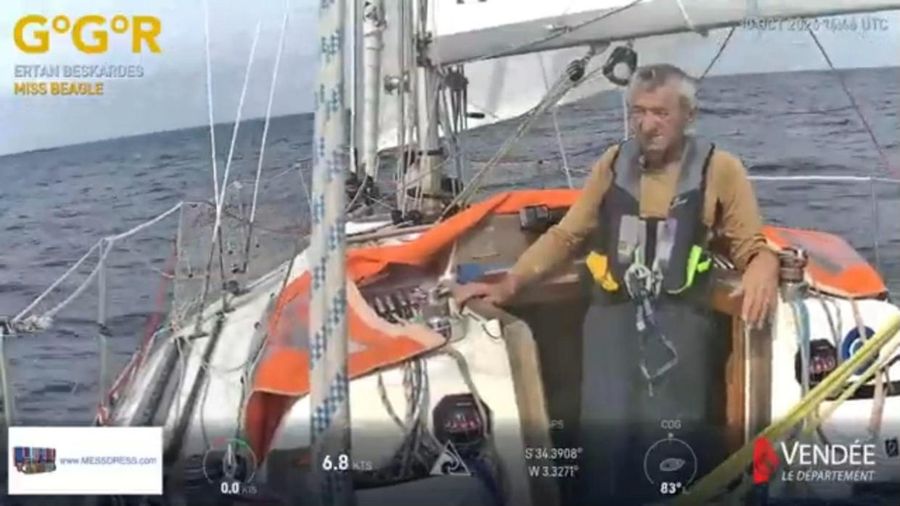
Down below he made a hot chocolate and gave it ten out of ten, though the fresh milk is nearly gone and he expects to be on powdered milk by Monday. He is keeping the ship's 200-litre water tank full until after Cape Horn. He knows he has plenty to get home, and a part-empty tank sloshes loudly. In the meantime he is working through boxes of bottled water. He also had a word of praise for Matt Woodside, who he said sailed some 23,000 miles to reach the start line, by way of Cape Horn.
Calm for Christensen, dolphins for Kveseth
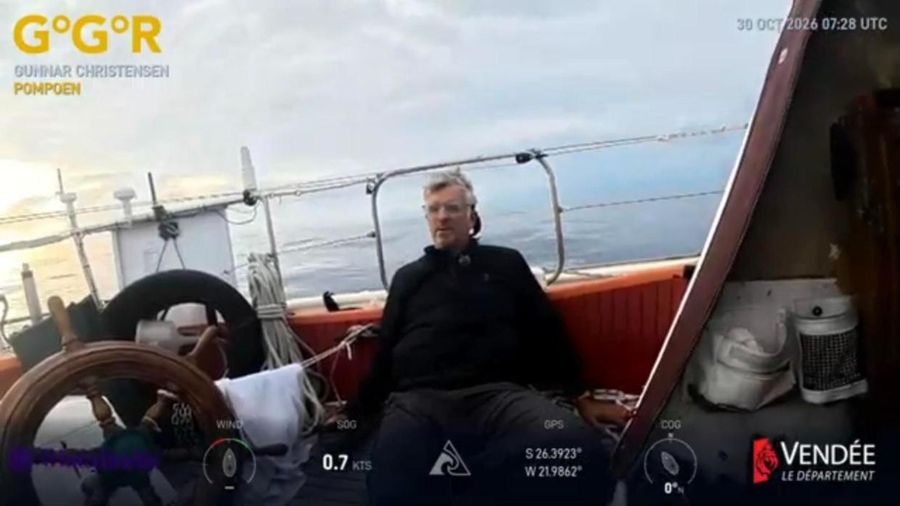
Gunnar Christensen in Pompoen spent Friday morning UTC in a flat calm. The overlay at 07:28 UTC shows 0.7 knots at 26.4 degrees south and 22.0 degrees west, with the sun low and golden behind the wheel. The past few days had brought two lows in quick succession, on Monday night and Tuesday night. He put the worst at 30 to 40 knots with gusts to 50, under triple-reefed main and storm jib, though he noted that Daniel Pinsky had reported more. The seas were big enough that he had to run with them, which kept him north when others further south had a more helpful westerly. The wind then went to the south-east, where he wants to go, and he gave back much of what he had gained.
He now sits just ahead of Woodside, and the tracker agrees, by three miles. What he cares about, he said, is feeling part of the race, and the daily weather chat with Pinsky, Woodside, Henry Wootton and Kveseth helps. He and Wootton have both noticed this is not much of a downwind race.
In the calm he got to work. He serviced the taffrail log and showed how to slide the weight on the torpedo so it does not wear on the same spot, then melt the ends of the line and tie a figure-of-eight knot. He also checked the main halyard and found almost no chafe. A couple of nights earlier a ship on its way to Brazil had called him on the radio just to check in, having passed three of the leaders days before. Batteries were the bigger concern. After days of overcast his hydro generator was not putting in what he expected, and the voltage sagged to 12.5. A 100-watt portable solar panel brought it back to 12.8, and he is thinking about switching the cameras off at night.
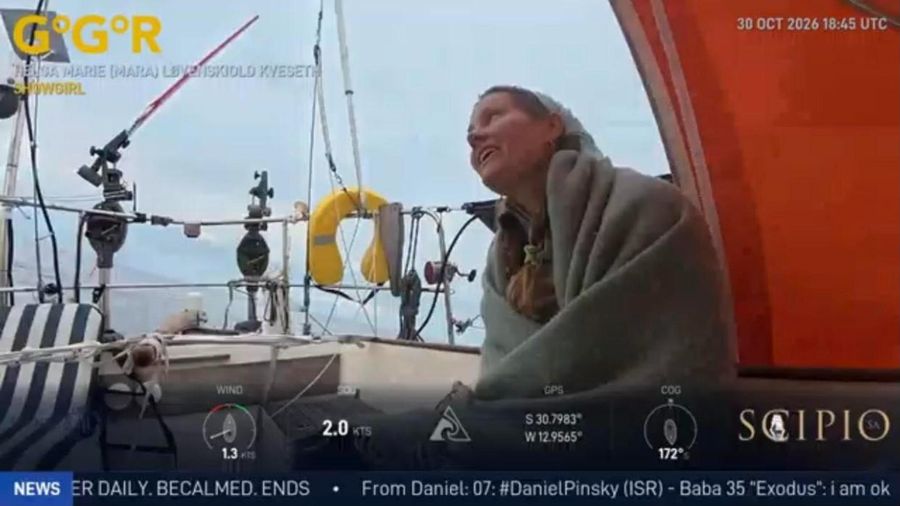
Kveseth in Showgirl had better luck. At 18:45 UTC on Friday she was moving at two knots in 1.3 knots of true wind at 30.8 degrees south and 13.0 degrees west, wrapped in a blanket in the cockpit. She was about to call it a no-win day when dolphins turned up. She loves the old rule that dolphins bless a passage. She had them at the start of her Atlantic crossing and a safe trip, then none on the way back and a wretched one, so she is counting on her blessing lasting until Australia.
She has other reasons to feel lucky. She, Pinsky and Etienne Messikommer are within a day or two of each other and chat daily. Messikommer has the best radio of the three and has become the relay when signals are poor. They pass on advice without rank, she said. When Wootton needed a copy of an equipment manual, Kveseth had it and read it down the radio. She plans to climb the mast, seven metres up, with silicone spray to ease the main halyard, but only in calm water. Her Yankee halyard protection had chafed, and she moved the knot to shift the wear.
Across the fleet
Andrea Lodolo in BiBi is third with 20,395 to go after 93 miles. Messikommer in Bernard has moved past Kveseth into fourth on 20,715, after 106 miles, with Kveseth fifth on 20,760. Pinsky in Exodus made 116 miles, the second-best day on the board, and is sixth on 20,788, just 28 behind Kveseth.
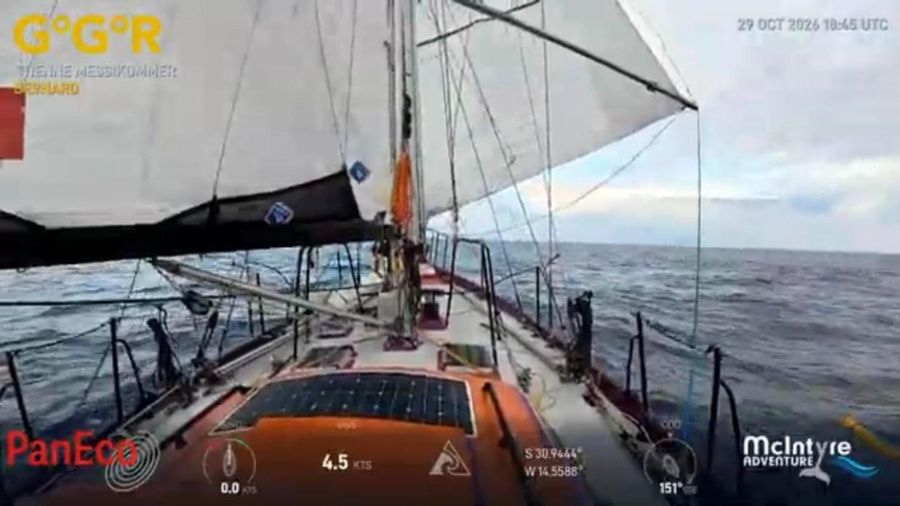
On Thursday evening UTC, Messikommer was on deck changing to a second Yankee for the southern run, watching white-chinned petrels and a slick of floating plastic, and fretting at the swell that kept slamming the sails empty. After a radio chat with Woodside, Christensen, Pinsky and Kveseth about the weather he passed on what he had heard: light westerlies on Friday, then a low on Sunday that should reach them on Monday.
Wootton in Privateer and Cantini in Hannah of Cowes are 14 miles apart, 20,866 and 20,880, making 58 and 56 miles. Nyman in Lazy Otter made 16 miles and is on 21,075. Rosli in Olleanna is on 21,172, Christensen in Pompoen on 21,288 and Woodside in Tipi Haere on 21,291.
What to watch
Our own read of the PredictWind forecasts, with the two global models side by side, shows a weak low wandering west of the fleet on Friday evening and light air across the whole pack. That matches what Kveseth and Christensen reported. Over the weekend a bigger low builds well south of 45 degrees south, with 35 to 45 knots in its westerly flow. Guillou and Beskardes should stay on its northern edge, where the breeze is strong but manageable.
The next problem is nearer the middle of the fleet. On Monday 2 November both models spin up a new low near 32 degrees south and 10 degrees west, with a ring of 30 to 35 knots round it. That is close to where the leading pack of the middle fleet will be heading. By Tuesday it has drifted east to about 33 degrees south and 3 degrees west, with a core of 35 knots or more, and it eases through Wednesday, leaving a patch of lighter air behind it. Both models work on a 100-kilometre grid, so the position and strength of a small low can shift by a few hundred miles. The skippers' own radio net was expecting a low to reach them on Monday, so the picture hangs together.
For Guillou the weekend question is how far the westerlies lift his daily runs. For Beskardes it is 35 degrees south and a steady westerly. Our report on the fleet stalling has the background, and the second gale shows what the leaders have already come through.
Follow the whole race on our dedicated Golden Globe Race 2026 page.