Damien Guillou is the only skipper in the Golden Globe Race still sailing at full tilt. At 20:00 UTC on Thursday 29 October he had 19,716 nautical miles to the finish at Les Sables d'Olonne. A 144-mile day, the best on the board, took his lead over second-placed Ertan Beskardes to 607 miles. Behind them a big high has squashed the fleet flat. Etienne Messikommer made 60 miles, Gunnar Christensen 47, Guido Cantini 45, Henry Wootton 42 and Isa Rosli just 22. Positions and distances are from the 20:00 UTC tracker unless stated.
Golden Globe Race 2026: distance sailed
Tracker snapshots, start to Day 53
Source: Golden Globe Race live tracker (Yellow Brick)
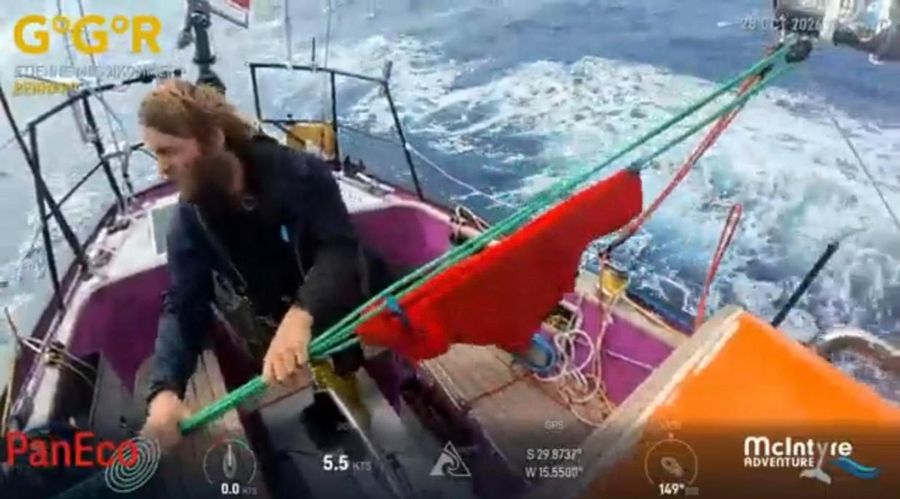
Guillou rolls on in a messy sea
Solarem was still making about six knots when race chairman Don McIntyre went on air on Thursday, with good breeze at 41 degrees south. McIntyre said the leader has never reported a problem with the boat, and that he knows when to push and when to simply survive. He is not pressing hard through the leftovers of the gale, which we covered in our report on the second storm.
McIntyre has also been measuring the leader against the 2018 winner's passage. He put Guillou about 600 miles, or four days, behind that pace, which would bring him to the Hobart mark around 17 December. Guillou himself had always pencilled in about the 20th. It is early to lean on the arithmetic, McIntyre said, but it gives a sense of how the race is shaping up.
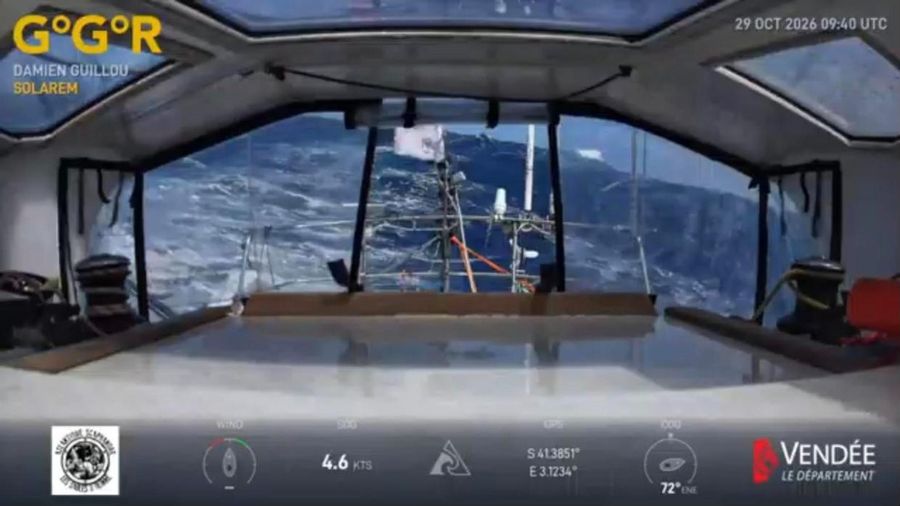
The sea is the trouble now. In a recording on Thursday Guillou described more sea than wind, a confused swell coming from several directions and one wave that caught him square in the face. The regulator on his windvane gear did not like it either. By the overlay he was at 41.4 degrees south and 3.1 degrees east of Greenwich on Thursday morning UTC, making 4.6 knots.
McIntyre said the race office is still hunting for the memory card from Guillou's camera. The footage from the peak of the gale will go out once it turns up.
Beskardes finds the calm after the storm
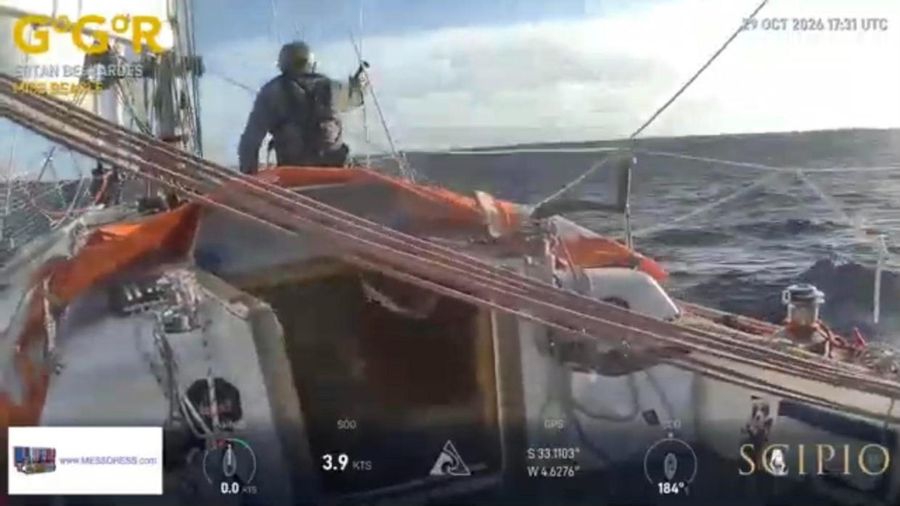
Ertan Beskardes in Miss Beagle has had the harder week. He described Wednesday as a storm that ran close to 24 hours, with waves of four to five metres and the boat surfing at double-figure speeds under a reefed main alone. He gybed in pouring rain, easing the main, shifting the preventer and then taking about an hour to get the sail back up, soaked to the skin. Once that was done he lay on the cabin floor for most of the afternoon, which he called the safest place on the boat. Starlink gave him no uplink for an hour and twenty minutes, however many times he restarted it. He skipped cooking and lived on cold soup, dry bread and a lukewarm hot chocolate.
By Wednesday night UTC the sea had eased and his mood lifted with it. He eased the genoa out a bit at a time, and the boat settled at six knots and more. Then he did his sums. A course of 150 degrees was close to what he wanted. The prize was 35 degrees south, past Cape Town's latitude, which he counts as the Southern Ocean proper and the place where westerlies should start to turn up.
There was work to do first. With the storm over he went forward in the dark, tied off the genoa sheet, shifted the staysail sheet to a free winch and let the sail out a bit at a time, feeding the line between gusts until every white sail was set. The job took close to an hour. He said the night felt almost civilised, the first time in a day that he had been able to sit upright like a normal person. He also drew up a list for the calm: stow the three gas bottles from the heads in the cockpit locker, and work out what he had pressed on the HF radio to scramble its settings. He can talk to the world on the SSB, he said, but cannot hear the race's own net, and he misses his daily BBC bulletin.
Then the wind went away. On Thursday there was bright blue sky and almost no breeze, and the sails slatted every thirty seconds. He turned south to find a beam reach and put the spinnaker up four times. Each time it collapsed round the mast and stays. He settled in the end on full main and full genoa, steering 140 to 150 degrees when he wanted 120 to 130, because the sails would not fill any closer. He averaged about four knots for most of the day and five by evening. No wind, he said, also means no sleep.
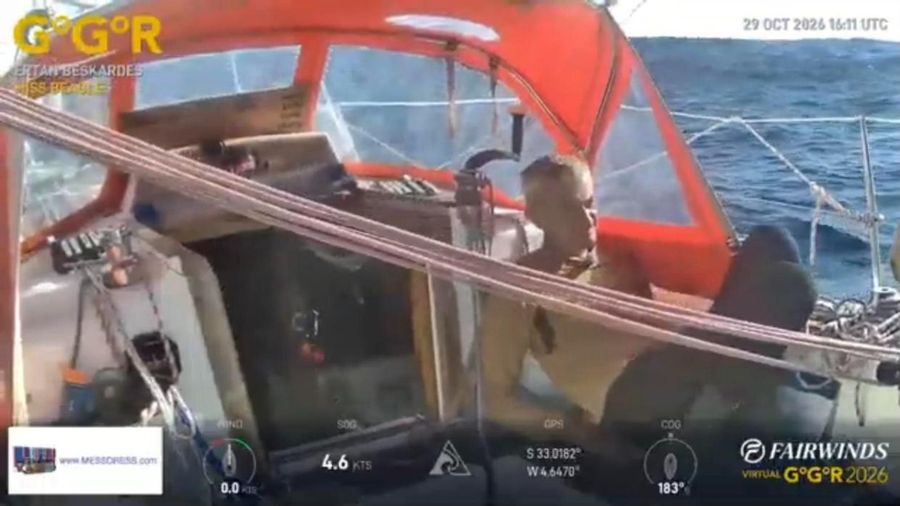
Not all of it was glum. He washed and aired everything and moved his bed to the port side. He cooked chips with mustard, fried onions and curry sauce, then fed most of them to the fish. He saw his first albatross. He replaced a line that had chafed through after eight years and swapped a bent shackle on the masthead spinnaker block for a beefier one, seized with wire and backed up with several turns of rope. The first repair he called a kamikaze fix. He also found that two knives stowed behind the compass had thrown it off, and moved them.
The self-steering is the bigger worry. His Hydrovane will not hold a course below about three knots, so more calm means more hand steering, and he sprays it with WD-40 every week. By the overlay he was at 33.0 degrees south and 4.6 degrees west, and he hoped to reach Cape Town's latitude by dawn, about 60 miles on.
A high squeezes the middle of the fleet
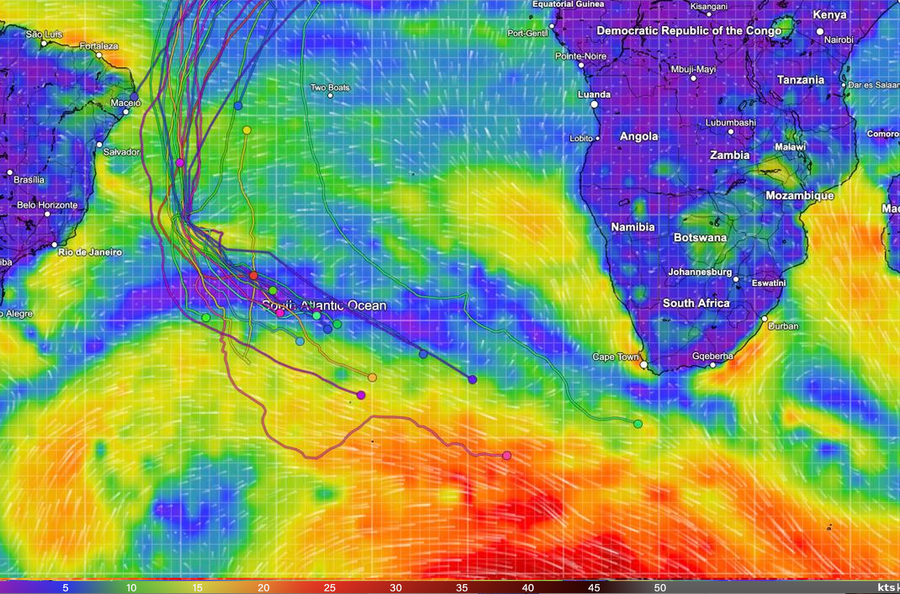
The cause is a large high sitting in the middle of the South Atlantic. McIntyre took his viewers through the Windy forecast and said it will hold the leaders and trap the rest. For the next day he expected Messikommer and Mara Kveseth to keep their breeze. Christensen, Cantini and Wootton sit on the edge of it and need to get south to stay in. Rosli and Christensen look worst placed over two days, while Daniel Pinsky is in a patch of very little wind and needs to get onto the other tack.
By the third day, he said, the calms may reach Andrea Lodolo and Messikommer, Kveseth and Messikommer will slow, and Pinsky will stop. Lodolo should keep going, and so should Guillou. McIntyre's summary was that the rich get richer, with the three at the front likely to open the gap again.
His Thursday morning figures showed the squeeze. Messikommer was making 1.8 knots, Cantini 1.7, Pär Nyman 1.9, Wootton 2.2 and Rosli 2.5. Pinsky was on 3.8, Kveseth 4.4 and Beskardes 4.7, with Lodolo on 5.7 and Matt Woodside under half a knot. Christensen was heading north-east, away from the mark. McIntyre said he would have to tack back through the centre of the high, and that Christensen will be watching his barograph to judge when.
Across the fleet
Lodolo in BiBi made 122 miles and is third with 20,488 to go. McIntyre also explained why he has gone quiet. He lost one of his two Starlink antennas and has chosen not to switch the other back on, preferring to concentrate on racing and the solitude. He phoned the race office two or three times in the heavy weather, McIntyre said, and sounds to be enjoying himself.
Kveseth in Showgirl is fourth on 20,807, though her tracker position is eight hours old. Messikommer in Bernard is 14 miles behind on 20,821. Pinsky in Exodus made 104 miles and is sixth on 20,904, ahead of Wootton in Privateer on 20,924 and Cantini in Hannah of Cowes on 20,936. Those two are 12 miles apart and both close to becalmed.
Further back, Nyman in Lazy Otter is on 21,091, Rosli in Olleanna on 21,203, Christensen in Pompoen on 21,333 and Woodside in Tipi Haere on 21,413, though his position is also eight hours old. Guy deBoer in Spirit did not appear on the tracker table. McIntyre had him doing 6.4 knots in the trade winds and slowly gaining on Christensen, with about 800 miles to go to reach him.
The live schedule is about to shrink. McIntyre said the race office will trim it over the next week or so, possibly to about 18 hours a day, since Kerdelhué is out, Lodolo is off the air and Kveseth and Christensen no longer appear overnight.
What to watch
Another system is forming in the Southern Ocean, and could reach part of the fleet in about three days. McIntyre called it far too early to read. The model had it under 30 knots, which would not trigger a weather alert, and it might open up or deepen. Guillou is also nearing the Agulhas Current. McIntyre said its eddies can add two or three knots on the favourable side and slow a boat on the other, though Guillou may dip south and miss it.
He also did some sums for Hobart. The middle of the fleet, he said, is unlikely to get there before about Christmas, with the earliest arrivals a little before. For Beskardes the next milestone is much closer: Cape Town's latitude by dawn on Friday, then 35 degrees south and some westerly wind. Our report on the build-up to the second gale has the context.
Follow the whole race on our dedicated Golden Globe Race 2026 page.