Guadeloupe does not give up its secrets easily, and the Route du Rhum fleet is about to be reminded why the island has decided fortunes since the very first edition in 1978.
Forcing competitors to sail round the island, leaving it to port rather than heading straight for Pointe-à-Pitre, was a stroke of genius from the organisers. It has produced some of the race's wildest reversals ever since. That first edition saw Mike Birch overtake Michel Malinovsky right at the death, and the legend of the "butterfly island" was born, a place where the smallest shift in wind can make or break a race.
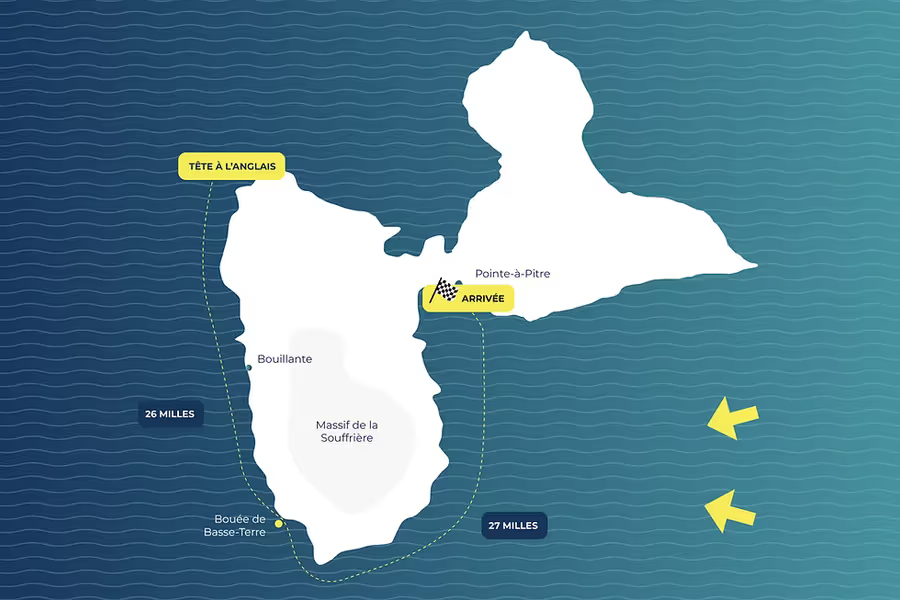
From the Tête à l'Anglais, a small islet at the island's northern tip, to the finish line, skippers still have 53 miles to cover. On paper that's barely 1.5% of the total course.
But ask Guirec Soudée about that. Becalmed for most of yesterday, the skipper of Liamm spent 12 hours and 14 minutes going round Guadeloupe, 6% of his entire race time. It's the longest anyone has taken to round the island in an Ultim since the class joined the Route du Rhum-Destination Guadeloupe. There was no sporting stake in his arrival, well behind Armand Thiéry (Louis Burton) and well clear of IDEC Sport-CIC (Alexia Barrier). Imagine the same scenario playing out among the Ocean Fifty fleet tomorrow night.
The remaining legs break down as follows: Tête à l'Anglais to Bouillante, 17 miles. Bouillante to Basse Terre, 9 miles. Basse Terre to Pointe-à-Pitre, 27 miles.
This year's leading Ultims enjoyed an unusual south-southwesterly wind pattern around Guadeloupe, which kept the west coast well ventilated. Thomas Coville (Sodebo Ultim) and Louis Burton (Armand Thiéry) rounded in daylight with little drama. Tom Laperche (SVR-Lazartigue) had a harder time of it at night, particularly near Basse Terre, where the wind collides with the high ground of La Soufrière, which rises to 1,467 metres.
Under trade wind conditions, now returning and due to strengthen midweek, the picture changes completely. Much of the 26-mile west coast stretch sits in the lee of the mountains. Boats only pick up decent wind well south of the Basse Terre buoy, as the terrain drops away near the Saintes channel. Most finish beating hard against the trade wind into Pointe-à-Pitre bay.
Night arrivals are a different proposition altogether. Daylight lets skippers read thermal breezes on the water's surface, while darkness multiplies the risk of getting stuck.
The Basse Terre buoy, which must be left to starboard, is particularly nasty. The wind shadow cast by La Soufrière stretches a long way out to sea, so tacking far offshore achieves little, since boats have to come back in regardless. Hugging the coast in search of any breath of air is the alternative tactic, the key being never to stop completely, even if that means drifting temporarily off the direct course.
In classes where routing assistance is permitted, shore teams can head out in RIBs to gather live wind readings at key points and radio advice through to their skippers. That kind of real-time routing is banned for the monohulls, which make up 73% of this year's fleet.
The history books are full of island drama. In 1978, Mike Birch, well behind Malinovsky's Kriter V, swept past the leader coming out of the Saintes channel to win by just 98 seconds. In 1990, Guadeloupean sailor Claude Bistoquet ran his trimaran aground on rocks near Capesterre-Belle-Eau, less than 10 miles from the finish, an incident so notorious the reef is still known locally as "Caye à Bistok".
In 1998, Marc Guillemot, racing La Trinitaine, lodged a protest after Franck Cammas beat him by 8 minutes aboard Groupama 2, having sailed without navigation lights between Basse Terre and the finish. Cammas was reclassified and dropped to third.
The most painful was probably 2018. Alex Thomson had Hugo Boss in the lead when, in the dead of night, his course track merged with the island's coastline on the chart plotter. He'd slept through his alarm. Forced to motor himself off the rocks, he was penalised, handing the IMOCA win to Paul Meilhat on SMA.
That same edition produced an Ultim classic. François Gabart held more than a 20-mile lead on MACIF passing the Tête à l'Anglais, only to watch Francis Joyon close the gap through the night aboard IDEC. By the Basse Terre buoy the margin was down to 17 minutes. Joyon shaved the Vieux-Fort lighthouse at the mouth of the Saintes channel, hugging the coast to dodge the downward current, and took the lead by 3 miles just 12 miles from home, before a tangle of lobster-pot rope round his starboard rudder slowed him down. MACIF closed back in, the wind died, and the two boats were level two miles from the line. Joyon gambled on an early tack and won by 7 minutes, the smallest margin since 1978, after twelve hours of fighting around the island.
For this year's fleet, still scattered across the Atlantic and closing on that final 53-mile gauntlet, the lesson of Guadeloupe is unchanged. The race is never over until the island says so.