Police are considering charges against Greenpeace protesters who occupied a state-owned ship in protest at seabed mining.
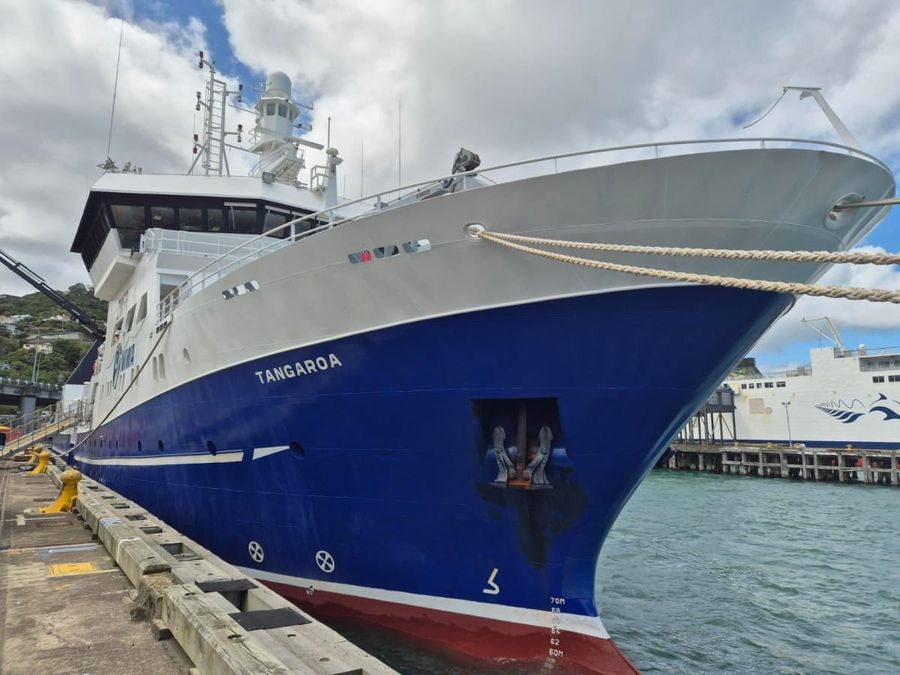
A group of activists boarded the Earth Sciences New Zealand owned-Tangaroa in Wellington Harbour on Saturday morning, Greenpeace said. One of the activists was dressed as US president Donald Trump and flew an American flag from railings on the ship, while another held a banner saying 'Don't Mine the Moana'.
However by early afternoon police said they had removed five protesters from the ship, and were considering charges.
Spokesperson Juressa Lee said the RV Tangaroa had just returned from the Clarion-Clipperton Zone in the Pacific, between Hawaii and Mexico, where it surveyed deep sea minerals for the company Glomar Minerals, which the environmental pressure group said could lead to a minerals grab in the Pacific.
Lee said they did not want a state-owned vessel being used for commercial exploration of the seafloor for a company intending to conduct sea-bed mining, and warned seabed mining could be used to feed into Project Vault, a US government plan to stockpile minerals for military purposes.
"These activists, and thousands of others, don't want to see our environment destroyed for the purpose of war," Lee said.
Greenpeace believes deep-sea mining is destructive to marine environments - stripping the seafloor and risking "irreversible damage" to the ocean, she said: "The New Zealand Government seems to be aligning with Trump's imperialist extractive agenda, instead of standing with our Pacific neighbours".
Minister for Resources Shane Jones said Greenpeace was trying to scare people, and the boat could be used for mineral research. The protest was nothing more than a "parasitic stunt" to raise funds, he said.
"Tangaroa is run by an independent board and a government-owned agency obviously driven to generate revenue as a part of its scientific mandate, and from time-to-time I've no doubt the Tangaroa is used for both domestic and international purposes - no one should be surprised by that."
Jones said the Tangaroa has highly-educated staff doing the work, and their livelihoods should not be "hijacked by Greenpeace".
"I think Greenpeace are trying to scare and catastrophise and intimidate Kiwis, well Kiwis are about to vote, and they're going to vote for resource development within guardrails."
Earth Sciences told RNZ they provide independent scientific research to both national and international organisations, including "internationally recognised expertise in deep-ocean environments, marine ecology and marine geology".
Questions about the Earth Sciences team's work for this client should be directed to the company, they said.
"Our work includes scientific surveys that collect and analyse data to improve understanding of the deep-sea environment, including its biology and ecology," Earth Sciences said.
"This research contributes to the scientific evidence needed to understand these environments and the potential impacts of activities within them. This enables stakeholders and regulatory agencies to base decisions on robust scientific evidence."
RNZ has approached American seabed minerals company Glomar Minerals for comment.
Earlier, Glomar said a team from their subsidiary UK Seabed Resources (UKSR) left Tahiti on 29 July to head to the Pacific Clarion-Clipperton Zone to survey for polymetallic nodules in its license area.
It was running the 65 day survey with Earth Sciences NZ, on the RV Tangaroa, which it said was "one of the most capable deep ocean research vessels in the world".
"UKSR's two International Seabed Authority CCZ license areas cover approximately 133,000 km² of deep seafloor, an area comparable in size to Louisiana, covered in polymetallic nodules containing manganese, cobalt, nickel, copper, and rare earths in a single ore," the company said.
The research was "moving the company closer to the integrated dataset needed for commercial recovery".
The research findings would be shared, adding to Glomar's record of transparency and contributions to marine science, Glomar chief executive Chris Williams said.
Earth Sciences was formed last year, when NIWA and GNS science merged.
This story was first published on rnz.co.nz