Graham Dalton's ambitions extend to nothing less than being the fastest man to sail solo around the world, and his weapon of choice is the New Zealand-flagged Open 60 Hexagon. The Kiwi skipper will carry those aspirations into the Around Alone single-handed race, set to depart Newport, Rhode Island, in September. During sail training on the Hauraki Gulf in 2006, Steve Raea joined Dalton aboard the boat and filed this report.
Pick up A Voyage for Madmen, the recently published account of the 1968 Golden Globe, and the contrast between Bernard Moitessier's boilerplate Joshua and Dalton's carbon fibre Open 60 Hexagon is almost impossible to absorb. The technology gap across fewer than four decades is staggering.
Everything about Hexagon points to the latest in racing yacht development, except perhaps Dalton himself, who faces the Herculean challenge of mastering that technology before the race begins. He is candid about where he stands. The boat is new and unproven, and by Around Alone standards his experience is limited. He is equally candid about the pressure this creates, particularly given how much of the yacht's performance depends on systems that must work flawlessly before the September start.
Those systems were the reason Hexagon could not contest last month's Round the North Island Yacht Race, and the same problems ended our day on the Hauraki Gulf less than a week later. But Dalton takes it in his stride. The boat had barely been afloat a fortnight at that point, and the expectations were always going to be considerable. He acknowledges his programme is tight yet remains confident that the financial backing and support around him will ensure he and Hexagon arrive at the start line ready for what lies ahead.
From any angle, Hexagon commands attention. A monolith of modern design, it spans from the tip of its 94 ft carbon fibre mast down to the bulb on the keel, a hybrid that sets a new standard among Open 60 race yachts. The designer is Merfyn Owen of the UK-based Owen Clark Design Group, the same man who drew Kingfisher, the New Zealand-built Open 60 that British yachtswoman Ellen MacArthur campaigned with such distinction in the 2001 Vendee Globe. Kingfisher proved herself in the Southern Ocean and has continued to be a force on the European short-handed circuit ever since.
Dalton considered French Finot-designed Open 60s before settling on Owen.
"I liked the look of Kingfisher. It was a fast boat and a good starting platform on which to build. It also made sense to work with the UK design group and thus avoid the language barrier. Timing was also critical. We needed a seemless operation."
The design process was expensive, and Dalton says some of that money was spent chasing dead ends. The research and testing programme was relentless, with weight reduction as its central obsession, a philosophy that is visible in every corner of the finished boat. While Hexagon shares a family resemblance with Kingfisher, the similarities are largely superficial. The yacht was initially conceived to Around Alone rules, a framework that gave Owen considerably more freedom to explore radical development.
That freedom, however, came at a price. After Dalton sought clarification on the rules from race organiser Robin Knox-Johnson, race organisers concluded he had gained an early advantage. Word reached competitors, and a number of European entries threatened to boycott. The organisers responded by rescinding the Notice of Race and instructing Dalton to comply with International Monohull Offshore Cruising Association rules instead. The cost to his team, in both money and time, was substantial, and Dalton makes no effort to conceal his frustration with how the situation was handled. "We're now just six months away from the start and we're still waiting for the Notice of Race. It's shameful."
Hexagon was built in Tauranga by Southern Ocean Marine, working closely with High Modulus to implement strict quality control systems on the shop floor. The carbon fibre and Nomex construction had to meet rigid weight tolerances, and within those constraints the boat was completed in 20 weeks, a real credit to the commitment of everyone involved. The finished yacht displaces just 4.5 tons, roughly equivalent to the average 30 ft keeler, yet stretches to 60 ft. The pursuit of light and strong has produced a vessel that could charitably be described as a shell, a floating no-comfort zone.
The rig is among the most immediately striking features. The Southern Spars carbon fibre mast towers over the deck, and the mainsail at 182 square metres utterly dwarfs the 120 square metre mains carried on the Volvo Ocean 60s. Dalton accepts that it is a large piece of sail but backs himself to keep it up once it is set. The sheer scale demands a cautious approach to reefing, something he says will be assisted by powerful winches, batten cars, and lazy jacks.
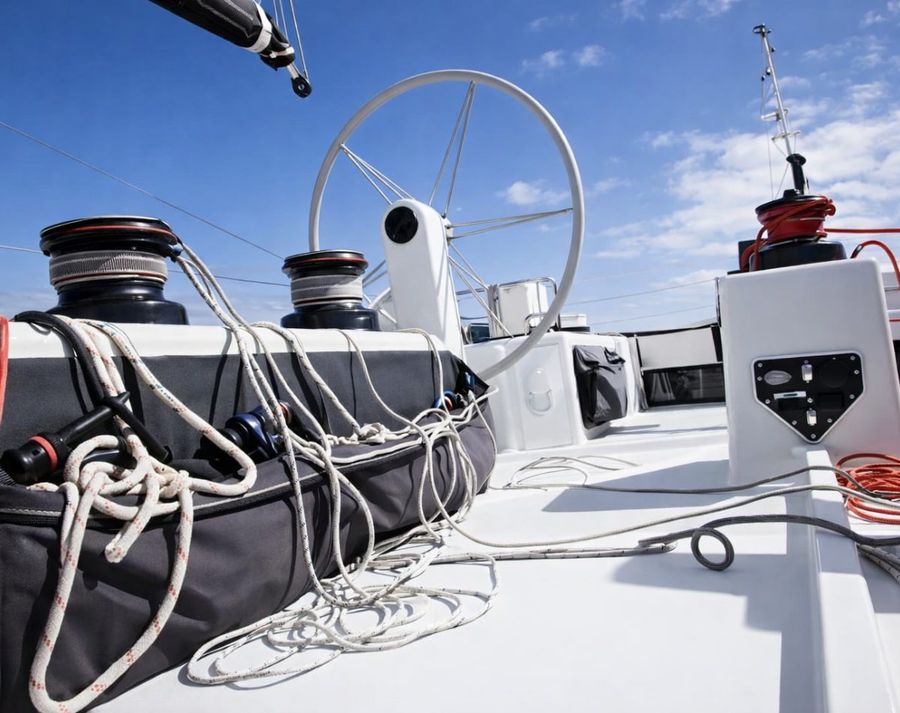
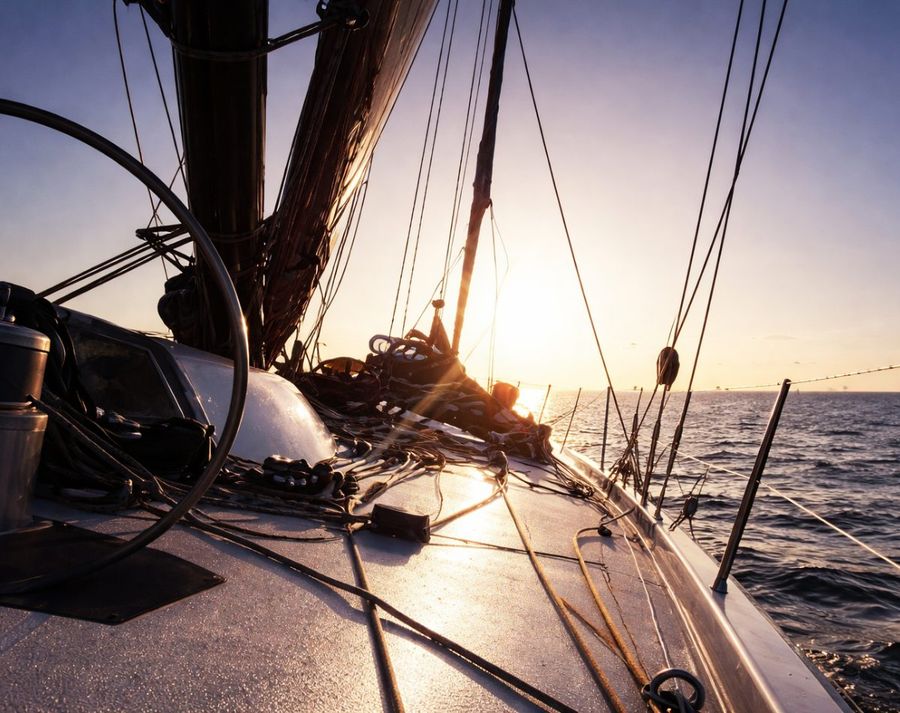
Hexagon also departs from convention in several other respects. The wide-open cockpit design is immediately obvious, as is the choice of twin titanium wheels in place of the tillers favoured by many European competitors. While the autopilots will handle most of the steering, Dalton plans to spend extended periods at the helm himself, nursing boat speed in light air. The wheels, he explains, are better suited to long stints of helming.
The underwater package does not stray far from the template established by Kingfisher, with twin angled rudders positioned well aft to maintain control when driving hard upwind. The electro-hydraulic canting keel tilts to 45 degrees from vertical, and Owen chose a single centreboard rather than the twin centreboard arrangement used on Kingfisher, positioned forward of the keel to preserve windward performance when the keel is fully canted. Water ballast is managed through built-in venturis that draw water into and expel it from the tanks. Dalton declines to disclose the size of the ballast tanks, which sit on the centreline to satisfy stability requirements under the rules. There are two tanks in total, one beneath the cockpit and one just aft of the keel.
On deck, the commitment to saving weight shapes every choice. The winch drums are off-the-shelf carbon fibre units from US manufacturer Harken, as are the blocks, cars, traveller, and twin self-furlers. Jammers and remaining deck gear come from Spinlock. Titanium has replaced stainless steel wherever possible, including in the stanchions and rails. The standing rigging is PBO from UK company Future Fibre, sheathed in an outer weave to guard against UV damage. Dalton notes that the rigging has a working life of just 20,000 miles and will be replaced before the race starts. PBO has demonstrated its worth in both America's Cup and Volvo campaigns, though Dalton acknowledges it comes at a steep cost. The inner forestay is hydraulically controlled from the cockpit, with a ram generating the tension needed to carry powerful headsails.
The sail wardrobe was built by the Auckland loft of Doyles and comprises a main, genoa, gennaker, code zero, code five, solent jib, and staysail jib. Dalton hints at a "secret weapon" still in development that will not be revealed until the start. A new generation II suit of sails will also be waiting at the start line.
The deck layout itself is uncluttered, with the mainsheet traveller running the full length of the stern. Cockpit instrumentation and keel canting controls are mounted in the bulkhead, sheltered beneath the cabintop overhang. Dalton describes Hexagon as a big dinghy, a comparison that goes some way toward explaining the positioning and configuration of the deck hardware.
Below, the mood shifts entirely. A small, almost circular hatch set into the bulkhead grants entry to the pod-like cabin, and negotiating it demands real agility, especially in a seaway. Comfort is not a concept that applies to Hexagon in any form, a deliberate sacrifice in the cause of weight reduction. The navigation station sits immediately inside the pod, roughly amidships, the only place to sit below and where Dalton expects to spend the bulk of his off-watch time. A narrow pipe berth runs along each side of the nav station. Three small oval ports in the pod provide the only natural light reaching the interior.
Beyond the pod, the rest of the boat lives in permanent darkness. There are no coatings below, another weight saving measure. A single-burner stove and a small wash basin aft of the nav station round out the domestic arrangements. A manual toilet is fitted well forward, intended for corporate guests, though it may yet be removed before September. Forward of the mast, a round deck hatch accesses generous sail stowage. Anchors, warp, and fenders are stowed further forward again.
The nav station is packed with the communications and computing hardware that modern offshore racing demands. Electronics include twin Furuno GP 31 GPS units, Furuno radar, Icom VHF and SSB radios, an electronic barograph, and a CD player. French NKE electro-hydraulic autopilots are interfaced with NKE wind and speed instruments to provide the navigational data needed to optimise sail performance. A VEI computer and a waterproof 20 inch LCD screen run MaxSea charting software, with a Toshiba laptop running the same programme as backup.
A Nera Mini M world telephone handles both voice and email communications from the boat. Hexagon is also equipped with an Inmarsat Sat C system, used alongside the MaxSea charting software to send automatic position reports to race organisers. Two cameras are mounted permanently on board, one on the stern post and one on the mast, with a third handheld unit stowed below. A Sony Vaio laptop running compression software processes the images and allows edited footage to be transmitted via the Nera Mini M satellite link.
With barely six weeks in the water behind her, drawing firm conclusions about Hexagon's performance would be premature, particularly when progress is being made every day and the systems are still being refined. Dalton, however, is happy with what he is seeing, and it is not difficult to understand why. The boat is fast. The early morning sail that forms the basis of this report was only his third outing since the February 15 launching, and it had the feel of a genuine voyage of discovery. Getting Hexagon off its berth and hoisting the enormous main proved a challenge in itself.
Under a shifty northerly of 10 to 12 knots, Hexagon slipped along at eight knots under main alone as we approached North Head, where we gybed and set a course for a windward beat toward Flat Rock off Kawau Island. The solent jib was sheeted home, the main trimmed, and Hexagon began to lift as the keel was canted to weather. Her pointing ability was evident immediately as we powered upwind, boat speed climbing until she found her groove. With apparent wind between 10 and 12 knots, she tracked comfortably at eight to nine knots up the East Coast Bays on a falling tide.
Despite conservative sail selection, Hexagon felt surprisingly stiff, gaining both height and speed in the gusts without any real inclination to heel excessively. The helm was light and positive, and the boat seemed almost to want to steer itself. Two things became clear while working her up the coast: the absence of anything solid to hold onto in the vast open cockpit, and the complete lack of shelter from sun, wind, rain, and sea. A safety harness is not optional, particularly around the primary winches.
The NKE instruments also gave pause for thought. Small in themselves, they risk becoming almost invisible in the scale of the cockpit, which could present a real challenge for an exhausted single-handed sailor. The beam and overall size of the boat also tend to mask the sensation of speed, something Dalton acknowledges readily. His view, though, is that the impression is deceptive.
"Because the boat is so wide you don't have the same sense of speed that you might in a smaller yacht. But when you look at the log you realise just how quickly your moving. Its effortless which is pleasing because the race is about building and maintaining averages."
At 4.5 metres of draft, Hexagon needs deep water, which meant frequent tacks as we worked toward Kawau Island. The boat responded quickly and the carbon fibre winches made light work of the sheeting. As with any fractional rig of this type, runners require attention at every tack, one of several tasks to manage simultaneously through each manoeuvre. The hydraulic canting keel takes time to return to vertical and longer still to complete its full 45 degree arc.
Hexagon was not conceived for buoy racing. The plan to tack through to Flat Rock and run back to Auckland was shelved when the keel hydraulics failed, leaving the keel swinging freely in its casing. The setback was met with a call for the number one gennaker. All hands went to the halyard, and up it went, the sock keeping the sail under control until the moment of set.
Hexagon carried the big sail well, averaging 11 to 14 knots in roughly the same apparent wind. Speed was hard to feel from the cockpit, but something else was not: noise. The slightest contact with the carbon fibre hull reverberates through the entire boat with the force of a thunderclap. Hexagon will be a loud companion, something Dalton is well aware of, as the six-stack CD player strategically positioned at the nav station suggests.
The third outing's dramas were not yet finished. Gybing the gennaker onto starboard for the run home, Hexagon refused to answer her helm as the big sail filled, a rudder fault later identified as the cause. She was pressed down onto her wide flat starboard topside and resisted every effort to bring her upright. Easing the mainsail and dumping the vang made no lasting difference. Each time she appeared to recover, the gennaker would fill and drag her back over, sending the boom into the water. The only solution was to sock the sail, which by that point was putting the rig under serious strain. Once the gennaker was cloaked the boat righted, and we bore away for home. The problem, Dalton later established, was that the angle on one of the twin rudders had been incorrectly set at five degrees rather than 15.
"She didn't have a chance. It was a good thing it happened when it did. We had a problem and its been corrected. Its part and parcel of learning about the boat and its systems and getting it right for when it counts."
The early setbacks have done nothing to dent Dalton's confidence. He is certain that he and Hexagon will be ready to take on the world when the real contest begins in September.
Specifications
LOA: 18.3 metres Displacement: 4500kg (dry) Draft: 4.5 metres Beam: 5.4 metres Designer: Owen Clark Design Group (UK) Builder: Southern Ocean Shipyards (NZ) Rig: Southern Spars (NZ) Sails: Doyles (NZ) Electronics supplier: Crystal Electronics (NZ) Engine: Yanmar 3GM30 Deck gear: Harken/Spinlock