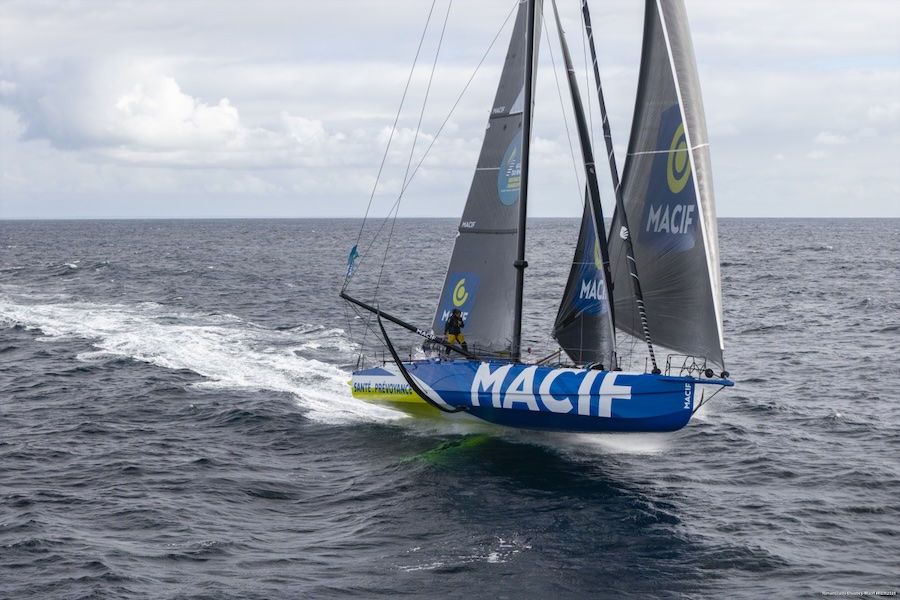
Sam Goodchild goes into the Route du Rhum - Destination Guadeloupe as the man to beat in IMOCA, but the MACIF Santé Prévoyance skipper refuses to look only at what's ahead of him. Twenty-one rivals line up alongside him in Saint-Malo, several with genuine claims on the win, in a fleet that has swapped a week of dockside crowds and autograph sessions for the quiet focus of final preparations.
Jérémie Beyou (Charal), Ambrogio Beccaria (Allagrande Mapei), Sébastien Simon (Groupe Dubreuil - Air Caraïbes) and Boris Herrmann (Malizia 4) headline the chasing pack. The fleet's depth runs well beyond the fight for outright victory, down to the eight straight daggerboard boats, which have their own private battle to settle.
Goodchild has set the pace all season. Speed, control, consistency: the Franco-British sailor has impressed with his ability to extract performance from his boat while avoiding costly mistakes. He accepts the favourite's tag, but won't call the race won.
"If I'm one of the favourites, I'm far from the only one. And then, it's a solo race: that resets everything, it opens up the game and the opportunities. We'll have to watch out for everyone!"
Goodchild is wary of reading too much into results from earlier this season. "We're starting in very good conditions and we're really pleased with the work done with the team. But our IMOCA is less comfortable on a transatlantic course that finishes in the trade winds than on the races sailed earlier in the season. The others know that too!"
Several rivals are sailing newer boats with considerable room still to improve. "Everyone will arrive in Saint-Malo with sails in good shape and well-prepared boats. The new projects are progressing very fast. We know our strengths and we've worked on the areas where we were more exposed, but we'll also need to avoid technical problems and make the right weather calls. Just because we've sailed well up to now doesn't mean it's won."
Even a flawless crossing offers no guarantee, Goodchild says, pointing to the final stretch around Guadeloupe where fatigue and coastal wind shadows can still turn the race on its head. "It's a moment when you'd love to sleep, because you're near the end and you're exhausted. But you have to keep your eyes open for the traps. Four years ago we saw Charlie Dalin arrive in the trade winds with a lead, only to be overtaken. We learn from all that. It's never over until you cross the finish line."
Beyou, at 50, is chasing a first Rhum win on his sixth attempt, having finished second in 2014 and third in 2022 despite a formidable record. Fresh off winning the 2025 Transat Café L'Or alongside Morgan Lagravière, he returns with Charal sporting a heavily reworked bow and clear intentions of fighting for the top spot.
Simon and Herrmann bring newer, recently launched boats whose true potential hasn't yet been fully revealed, backed by experienced teams capable of unlocking it quickly. Beccaria, meanwhile, has wasted no time making his mark since joining the IMOCA circuit this year, beating Goodchild outright at the Vendée Arctique.
"We're in a very positive mindset, with a team and sponsors who push us to learn from every race. I feel free to try things, to push my limits." Beccaria's second Rhum campaign looks nothing like his first in 2022, when he only took delivery of his Class40 two months before the start, yet still finished a remarkable second. This time the preparation has been methodical. "On paper, I couldn't be approaching this race in better shape. Confidence matters a lot, but it shouldn't become a weakness, where you put extra pressure on yourself just because you've prepared well. You have to accept that in offshore racing, you can break something two hours after the start. That's part of the game."
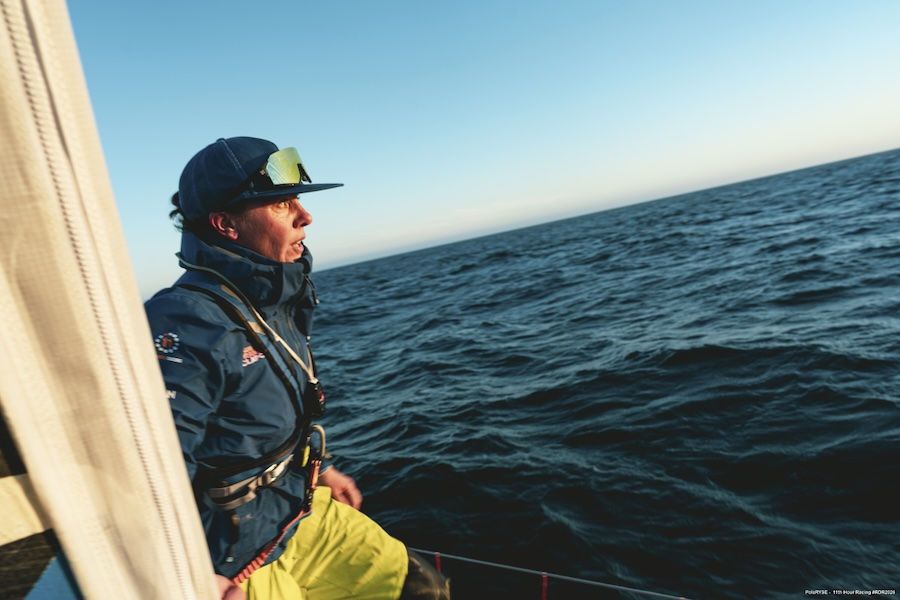
Corentin Horeau (MACSF) and Élodie Bonafous (Association Petits Princes - Quéguiner) are also finding their feet quickly in the class, alongside Violette Dorange (Initiatives-Coeur), already a Vendée Globe veteran despite her youth. "We've got great projects and we can progress together too. There's a brilliant energy, everyone wants to raise the bar," Beccaria says. Francesca Clapcich (11th Hour Racing), also flagged by Goodchild as one to watch, rounds out a group of newcomers capable of upsetting the seating plan.
Among the straight daggerboard boats, the fight is just as sharp. Nico d'Estais (Café Joyeux) has already shown this season that smart routing can occasionally trouble the foiling boats ahead of him. Approaching his second Rhum, he's feeling echoes of his first. "Four years ago, I'd only done one solo season in Class40 and, coming from the Mini 6.50, I already found the boat enormous. Today, it's a bit the same: I've only got one solo season in IMOCA, and it's still a very big boat for me!"
He's not holding back on ambition. "I'll try for the best possible result across all 60-footers. If I can trouble a few foiling boats, I won't hold back! Even if the course will probably suit us less than the early-season races, I'll be watching closely what happens among the daggerboard boats too. I'm not ruling out playing a bit of tactics against them." He names Pierre-Louis Attwell (Resilient) and Sébastien Marsset (Foussier) as dangerous opponents, the latter now intimately familiar with his boat after a Vendée Globe campaign.
Masa Suzuki (Milai - Furuno) and Robin Marais (Respire - Ma chance à moi aussi) will make their IMOCA debuts. Marais didn't expect to find quite so many rivals in older-generation boats. "When we bought the boat, I thought there might be four or five of us. In the end, there are eight! That makes a real fleet, and it's very interesting from a sporting point of view."
Coming from Olympic sailing and the Figaro circuit, Marais isn't treating this purely as a stepping stone to a first Vendée Globe. "It was important for me to keep a real sporting dimension. Long-term, I have big ambitions in the daggerboard rankings, even though the Rhum will be our first real test and it's too early to know where we stand." Tight budgets and a packed calendar meant keeping a well-used sail inventory rather than spending heavily straight away. "For now, the priority is learning to sail this boat and getting the best out of it. I want to do things in order, sail cleanly and not put unnecessary pressure on myself. But I'm going there to race!"
Beccaria wants to stay true to his attacking instincts, whatever happens over the course of the crossing. "I'll be happy if I get to the other side knowing I gave everything, even in the tough moments, without giving up. I don't want big regrets or to feel I made a huge mistake. You always make errors in racing, but the important thing is staying true to what you've built."
For d'Estais, there's history at stake too, Café Joyeux having already tasted Rhum victory in 2018 with Sidney Gavignet. "For all the teams, the village in Saint-Malo brings back great memories. And the Rhum is a race that's made me dream since I was a kid. Just being on the start line is a crazy thing. I don't know if I'll get to race it again, so I want to make the most of it."
Marais shares that feeling, though his first job is simply surviving the opening hours cleanly. "I want to get through the start cleanly first, it can be seriously rough. Then we'll take stock of where we stand and how we can keep improving. I'm confident in the boat's potential, but you can't rush the process."
Goodchild, for his part, knows he'll have to dig deep against rivals offering no favours. "Jérémie Beyou and the others aren't sailors who'll settle for second place. They'll fight to the very end." Twenty-two skippers, twenty-two different ways of tackling the Atlantic, and plenty of headaches ahead for anyone trying to call the winner.