Damien Guillou is still out in front in the Golden Globe Race, 767 nautical miles clear after 56 days at sea. Most of the fleet is moving again after the calm. Ertan Beskardes who navigates by sextant checked his position against a passing ship, and smiled. The resulting measurement was close enough.
At 20:00 UTC on Sunday 1 November, Guillou's Solarem had 19,264 nautical miles to run to the finish at Les Sables d'Olonne, after making 131 miles good in 24 hours. Ertan Beskardes in Miss Beagle is second on 20,031 after 117 miles, and Andrea Lodolo in BiBi is third on 20,318 after the fleet's smallest run of 49. Henry Wootton in Privateer made 126 and Etienne Messikommer in Bernard 123, so the chasers are keeping up with the leader. Our read of the forecast models has a compact low sliding past just east of the pack on Monday. Distances are miles to the finish or miles sailed, and daily runs are the tracker's 24-hour distance made good, all from the 20:00 UTC tracker unless stated.
Golden Globe Race at a glance, Day 56 (20:00 UTC, 1 November)
Leader: Damien Guillou, Solarem, 19,264 nautical miles to go, 7,850 sailed
Second: Ertan Beskardes, Miss Beagle, 20,031 to go, 767 behind the leader
Third: Andrea Lodolo, BiBi, 20,318 to go, 287 behind Beskardes
Best 24-hour runs: Guillou 131 miles, Wootton 126, Messikommer 123, Isa Rosli in Olleanna 122
Tightest scrap: Daniel Pinsky in Exodus on 20,583 and Mara Kveseth in Showgirl on 20,595, twelve miles apart
Golden Globe Race 2026: distance sailed
Tracker snapshots, start to Day 56
Source: Golden Globe Race live tracker (Yellow Brick)
Who is leading the Golden Globe Race on Day 56?
Guillou has now sailed 7,850 miles, 1,284 more than Beskardes. His lead on distance to go is 767 miles, up from 754 at the same time on Saturday and 656 miles in our last report on the calm. It grew by only 13 miles because the breeze has been kinder to everyone else: his 131-mile run beat Beskardes's 117 by just 14. Even so, his lead is bigger than the whole gap from second place to sixth, which is 564 miles.
Beskardes has stretched his cushion over Lodolo from 218 miles to 287, since Lodolo has found little wind. Behind them, five boats from Messikommer in fourth on 20,539 to Guido Cantini in Hannah of Cowes in eighth on 20,734 are squeezed into 195 miles. Pinsky holds fifth and Kveseth sixth, and Wootton's 126-mile day still left him seventh, 74 miles behind Kveseth.
Can a passing ship check your sextant?
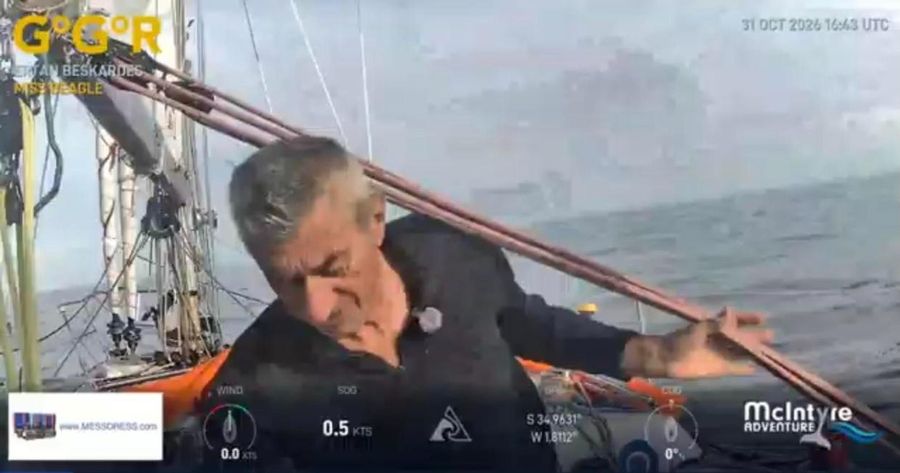
Beskardes spent a slow Saturday in Miss Beagle playing nursemaid to his spinnaker. In the light air it filled with a bang, tugged the boat along for a moment, then let her sag back to two knots. It is the 2018 spinnaker that came with the boat from Jean-Luc Van Den Heede, and after days of banging about in the calm he was relieved to find only a little chafe near the top.
Late in the afternoon UTC a ship came up on his beam, and he did what a skipper without modern navigation gear does: he called it on the VHF and asked where it was. The ship gave 34 degrees 57 minutes south. At lunchtime his sextant noon sight had put him at 34 degrees 56 minutes, and with a few miles sailed since, the two were within about a mile. By his own reckoning his longitude was only a few miles out as well. It does not prove the sextant, but it is a reassuring cross-check. The ship's crew also told him the wind would not return until morning, which was just what he wanted to know, so he took the kite down and waited. A second ship was loitering a mile off on the other side, the pair of them crawling along as slowly as he was.
Why couldn't Beskardes hear the fleet?
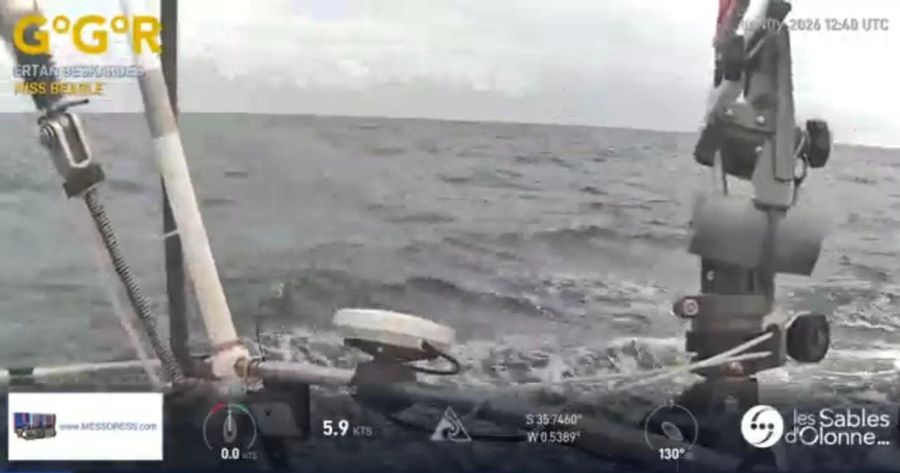
On Sunday the wind arrived as promised. A steady 15 knots from the north-east put Miss Beagle on a south-easterly course at over six knots, the self-steering doing the work. Beskardes sat under the dodger in a woolly hat with a bowl of chicken soup, and declared the whole arrangement perfect.
Then the mystery of the silent radio was solved. For days he had not been able to hear Messikommer or Kveseth on the HF set, and at about 12:50 UTC he found the reason: he had been dialling 6515 kHz when the schedule said 6516. Both came through loud and clear. He called himself a dipstick, promised to try again at eight that night, and told them that after the storm warning he had run east along the 28th parallel for two days and caught only the edge of it, while they had taken the worst. One of them agreed it had been an uncomfortable 24 hours, with waves of five metres.
On Sunday his aim was to cross 36 degrees south, reach the Greenwich meridian that night and keep the pace going. Anything over 150 miles a day, he reckons, is a good one.
How is Christensen coping with the squalls?
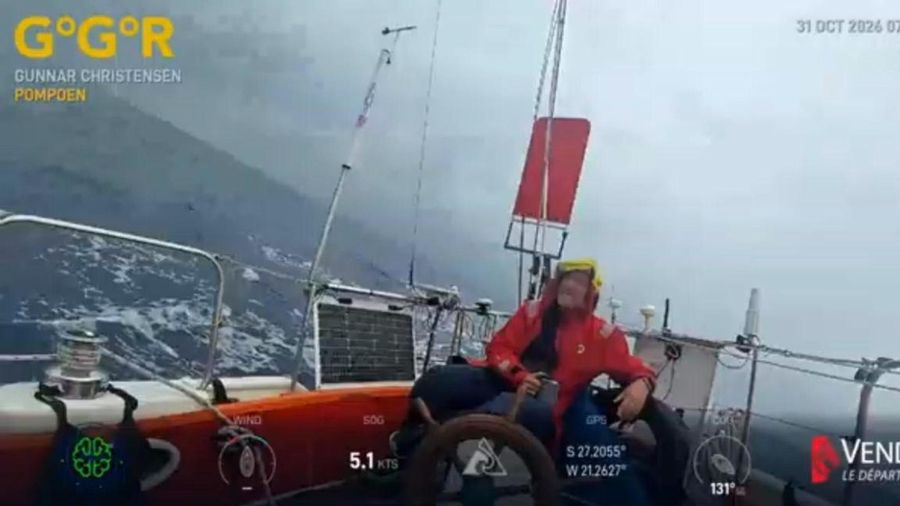
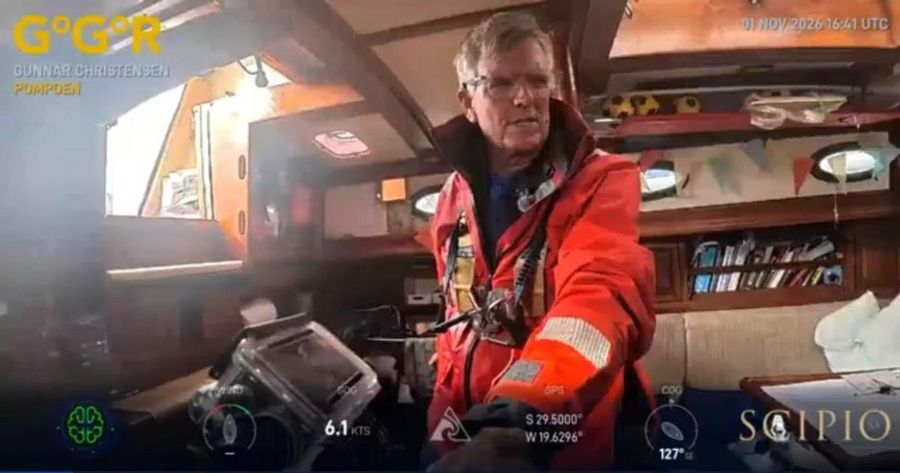
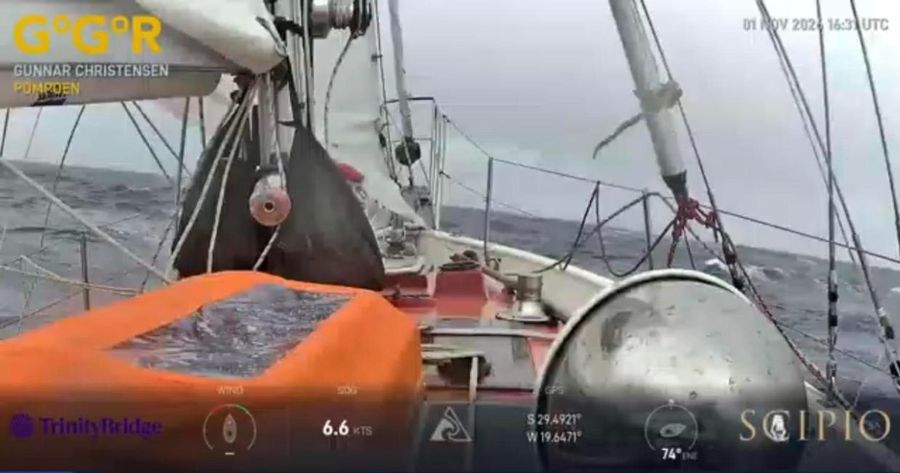
Gunnar Christensen's Sunday began with a bucket bath, a shave and a trim in the sun, and the tea towels washed and hung out to dry, all so he would look his best for the Sunday radio hour. Four hours later two waves filled his cockpit.
The south-westerly gale turned up earlier than he expected, with 35 knots and gusts to 40 in the squalls. He shortened down to a triple-reefed main and a reefed staysail, and found himself heading roughly east when he wanted south-east. By evening he was in no mood to be tempted by the wind gods, who he suspects wait until you are cosy below before sending the next squall. Lunch was mushroom risotto and dinner Asian noodles with chicken, eaten while he wrestled a camera mount that would not stay put. He was generous about the rest of the fleet, and about Guillou, who he put about two thousand miles ahead. The tracker makes it 1,811.
On the board Christensen had 21,075 miles to go at 20:00 UTC after a 108-mile day, with Rosli on 20,984. Woodside, the third of their little group, was last reported on 21,091 at 16:00 UTC, so the two are within about 16 miles of each other and their order will settle when his position updates. Messikommer has been passing weather to the group by single sideband.
Where is the weather risk for the fleet?
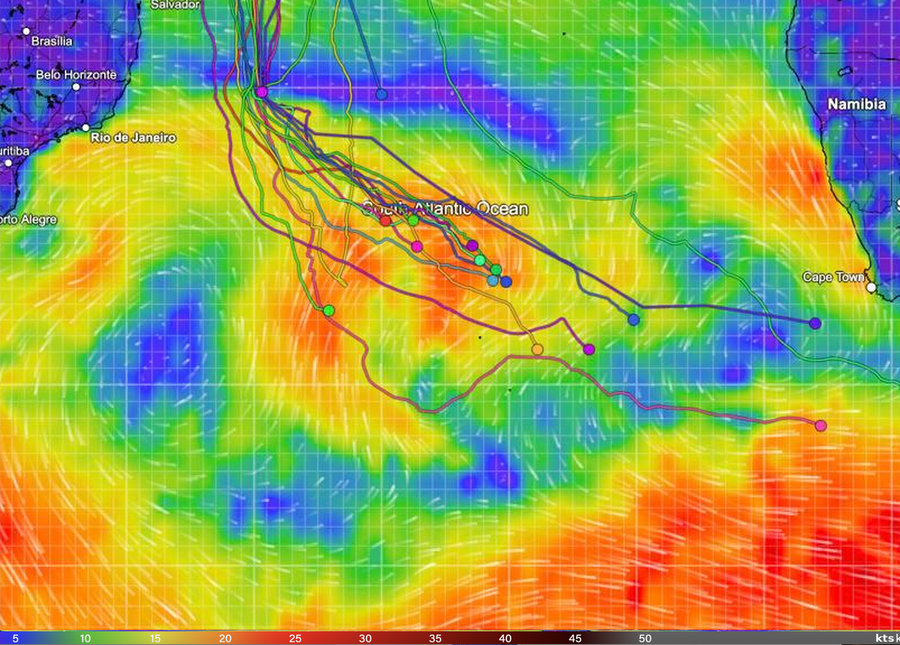
Our read of the two global models, the European ECMWF and the American GFS, side by side in PredictWind, is that the compact, deep low behind Christensen's squalls is sliding east and passing just to the east or south-east of the pack on Monday 2 November, with 25 to 35 knots near its core. Beskardes, further east, is closest to its track. By Tuesday it has moved away and the pack is left in light air, around 5 knots, between the South Atlantic high and the low, with a frontal band approaching from the south-west. Wednesday brings about 11 knots from the north-north-east, with a stronger 20 to 25 knot band to the south-west.
Thursday 5 November is the day to watch. A stronger frontal band or a new low builds in the south-west, and the two models disagree about its strength: GFS shows 30 knots or more, while ECMWF is weaker. These are forecasts, not observations, and the timeline labels in PredictWind are in local time, so we have kept to days rather than hours. We read the ECMWF and GFS runs available on Monday morning, NZ time. Our earlier reports on the second gale and Pinsky's night of hand-steering show how hard these systems can bite.
Follow the whole race on our dedicated Golden Globe Race 2026 page.