
Globe 5.80 Transat: Origami retakes the lead as the fleet threads the Canaries
8 min read
Dean Frost and Lee McCarthy have put Origami back at the head of the Globe 5.80 Transat. At 9am on Tuesday 24 November NZ time (20:00 UTC Monday), Origami led Viivi Moisio's Flow by 9.6 nautical miles in distance made good towards Antigua. It was the third change of leader in 48 hours. The leading boats have spent those two days finding their way through the Canary Islands in a building north-east trade wind. Four are now among the islands or south of them, while Bruce Payne's Meraki is still approaching Lanzarote. Katherine Urpani has had the best 24 hours of anyone so far, and both weather models have the breeze building to around 20 knots by Wednesday morning NZ time.
Globe 5.80 Transat 2026: miles made good towards Antigua
Nautical miles gained on the 3,532 nm tracker course from Lagos, from the start (1:01pm Saturday 14 Nov NZT, 00:01 UTC) to Tue 24 Nov 9am NZT (20:00 UTC Mon). Four-hourly tracker positions; times are New Zealand time.
Source: Globe 5.80 Transat live tracker (YB Tracking).
Who is leading the Globe 5.80 Transat?
The tracker at 9am Tuesday NZ time (20:00 UTC Monday), with miles made good towards Antigua since leaving Marina de Lagos and the gap to the leader:
1. Origami, Dean Frost and Lee McCarthy (UK): 640.6 nm made good
2. Flow, Viivi Moisio (Finland): 631.0 nm, 9.6 nm behind
3. Capucinette, Katherine Urpani (Malta): 619.8 nm, 20.8 nm behind
4. Inimini, Matthew Freestone (UK): 607.3 nm, 33.3 nm behind
5. Meraki, Bruce Payne (Australia): 485.2 nm, 155.4 nm behind
That leaves Origami 2,888.6 nm from the finish at the National Sailing Academy in Antigua.
How did the lead change hands?
Back and forth. When we last reported, at 9am on Sunday NZ time, Flow led by just 1.4 nm. Origami went ahead within four hours and was 6.7 nm clear by 5pm Sunday. Flow edged back in front at 5am Monday NZ time and stretched her lead to 5.7 nm by 9pm Monday. Then Origami got going again. She made good 18.8 nm in the four hours to 9am Tuesday, at 4.7 knots, the quickest in the fleet, while Flow managed 12.0 nm.
The fleet was finally covering some serious ground. In the 24 hours to 9am Monday NZ time every boat made good at least 90 nm, and Matthew Freestone's Inimini topped the table with 101.8 nm. In the 24 hours to 9am Tuesday, Origami made good 98.8 nm, Capucinette 94.9, Inimini 94.6, Flow 88.8 and Meraki 69.3.
Katherine and Capucinette posted the best 24-hour run of the race so far: 109.1 nm made good in the 24 hours to 9pm Monday NZ time. Inimini was close behind with 108.0 nm in the 24 hours to 5pm Monday.
Three routes through the Canaries
By Tuesday morning the boats had spread across three different routes through the islands.
Origami and Inimini took the eastern side, sailing down between Lanzarote and Fuerteventura on one side and the African coast on the other. Both are now south of Fuerteventura, about 34 nm apart. Capucinette passed Lanzarote's western side and ran down west of Fuerteventura; she is now between Fuerteventura and Gran Canaria. Flow stayed well out to the west and is about 19 nm north of Gran Canaria, roughly 100 nm north-west of Origami on the water.
With two aboard, Origami can share watches and sail handling, while the solo skippers do everything themselves. That makes Viivi's position all the more notable: after 10 days at sea, she is just 9.6 nm behind in distance made good.
Meraki is the one boat still north of the islands. At 9am Tuesday Bruce Payne was about 38 nm north-east of Lanzarote, on a course that points him towards the eastern channel that Origami and Inimini used.
Life aboard the little boats
Katherine Urpani's updates home have offered a very personal look at life on a 5.8 m boat crossing the Atlantic.
In her Day 7 message, sent on 20 November, she warned her followers never to trust the arrival estimates on the tracker leaderboard. Those had her reaching Antigua in February and Bruce in March. She expected to pick up the pace a little, though she was quick to add that she was no racing hotshot.
The previous 36 hours had been her fantasy of sailing, with clear skies and the boat moving well. The rainy, salty first week had left its mark, though. Her clothes were still damp, and much of her fruit had gone mouldy. She was down to two apples, a few oranges and some clementines, and she blamed the clementines for starting it, pointing out that they normally last forever.
She had also been steering a deliberately wavy course to keep the sun on her solar panels as her batteries ran low.
By Day 9, 22 November, she was sailing right past Lanzarote with plenty of wind and reckoned she had averaged about 5.5 knots that day. She called it a rough day of dead-downwind sailing, with all the quirks that brings, and planned to stay awake overnight to steer through the islands. About an hour before writing, she had sailed past a floating pallet. She was very glad she had missed it, because hitting it could have ended her race.
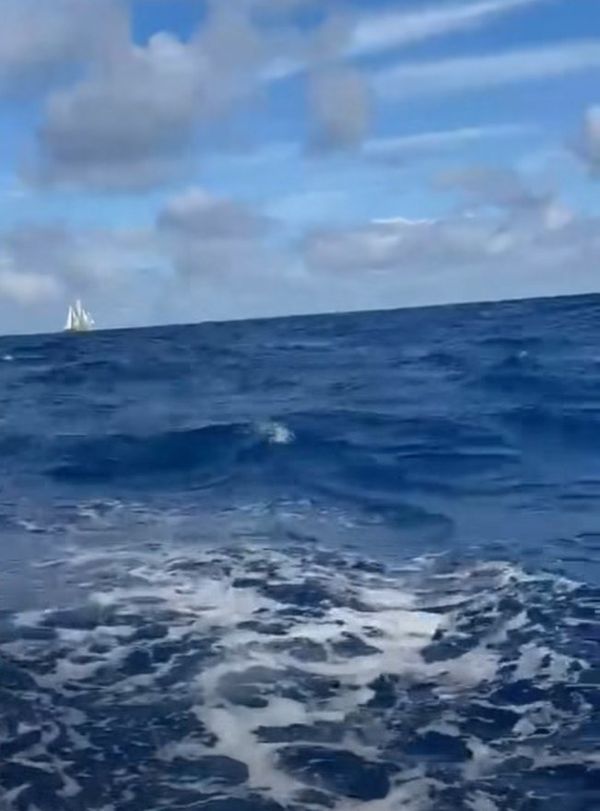
On Flow, Viivi had company on Day 9. Her team reported that a tall ship sailed alongside her for a while, which made a fine sight on the horizon. In her video she is grinning in the cockpit with the wind behind her, making about five knots and clearly loving it. She was also looking forward to seeing how the fleet's different routes through the islands would work out.
Day 10 was harder work. Her team said that finding the right sail combination turned into a real challenge, and in the end she had to climb the mast to rescue a halyard.
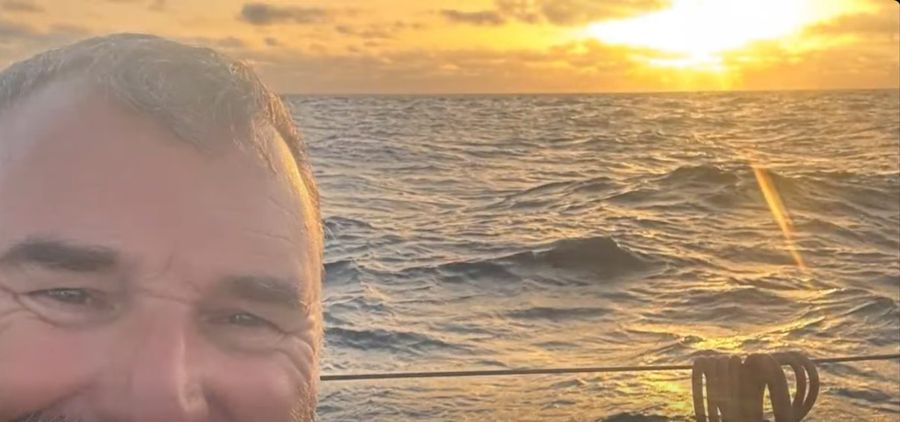
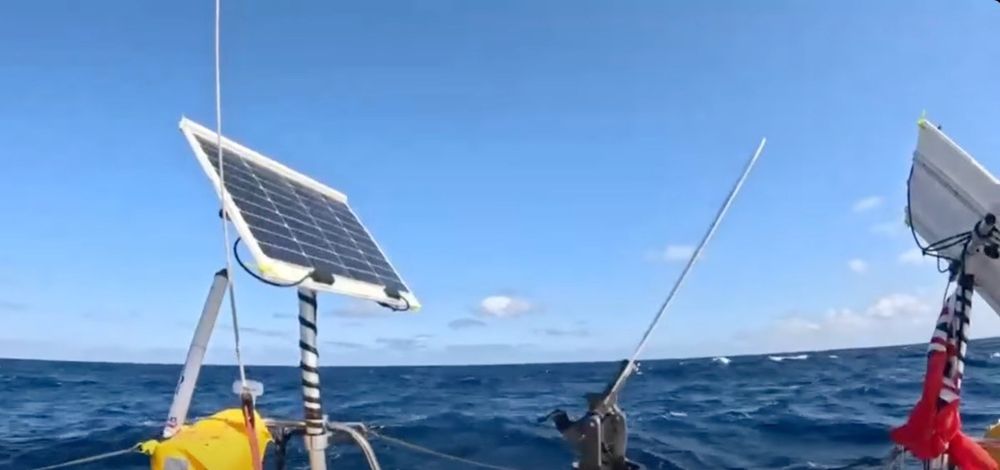
On Origami, a short Day 8 video from Dean and Lee shows the solar panel and wind vane at work over a lumpy blue sea, the pair pointing out something off the bow together, and Dean grinning into the camera at sunset.
Neither Matthew nor Bruce has posted a fresh update on their own pages since the start.
Where is the race director?
Still in Lagos. Race director Keri Harris is due to follow the fleet across in a support boat, which the race tracker last showed at Marina de Lagos. In his Day 10 update, race founder Don McIntyre said Keri had had to change crew, and that the organisers were making contingency plans in case he cannot catch a fleet now around 650 miles ahead.
What is the weather forecast for the Globe 5.80 Transat?
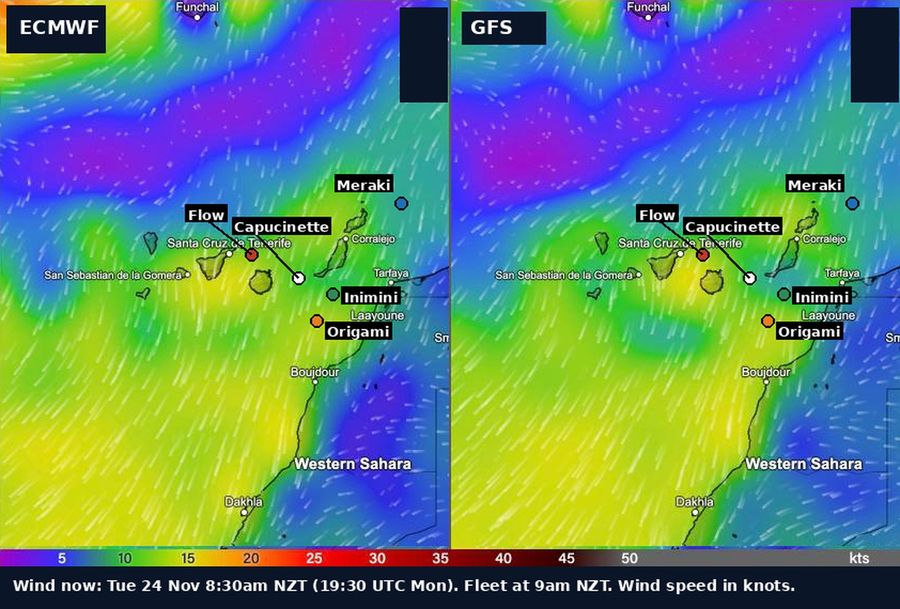
A stronger trade wind. This is our own reading of the free ECMWF and GFS models on PredictWind, taken at about 8:30am Tuesday NZ time at two fixed points: one near the leaders, at 27.5°N 15.0°W between the eastern Canaries and the African coast, and one further down the course, about 150 nm south-west of the islands at 25.0°N 19.0°W.
Now (8:30am Tuesday NZ time, 19:30 UTC Monday). Both models have 11 knots from the north-north-east near the leaders and 14 knots from the north-east down the course. The models also show a band of lighter breeze north of the islands, on Meraki's approach.
Tuesday 9pm NZ time (08:00 UTC Tuesday). 14 to 15 knots from the north-north-east near the leaders, and 15 knots from the north-east down the course.
Wednesday 9am NZ time (20:00 UTC Tuesday). 19 knots from the north-north-east near the leaders, and 18 to 19 knots from the north-east down the course. Both models fill most of the area with 18 to 25 knots. GFS also shows stronger acceleration zones of more than 25 knots between the islands, and a light patch in the wind shadow south-west of Gran Canaria.
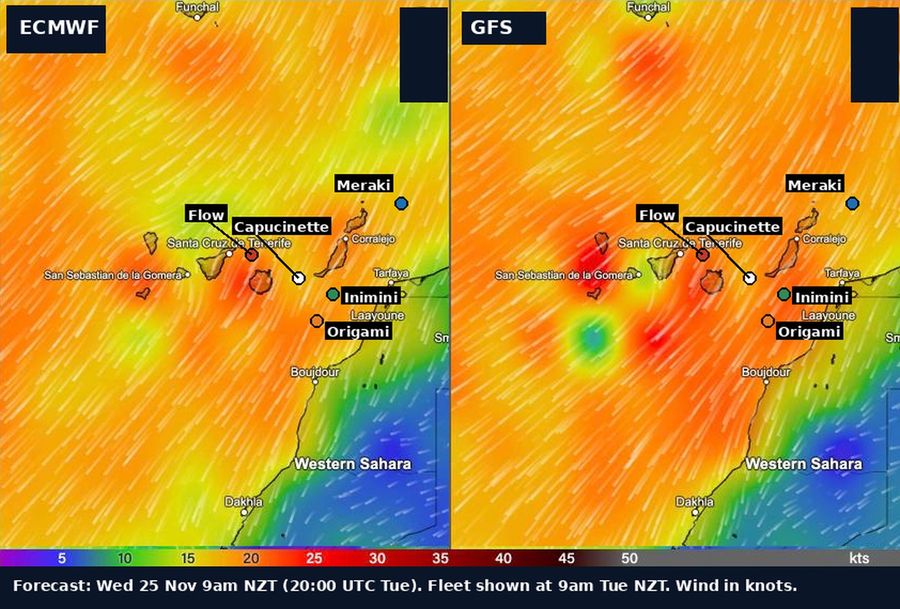
Thursday 9am NZ time (20:00 UTC Wednesday). The strongest of the run: 21 knots from the north-north-east to north-east near the leaders, and 22 to 23 knots from the north-east down the course.
Friday 9am NZ time (20:00 UTC Thursday). Easing a little, to 16 to 18 knots from the north-north-east near the leaders and 15 knots from the north-east to east-north-east down the course.
These are forecast average winds at fixed points, and what each boat meets will depend on where it is when each change arrives. On our reading, the models point to stronger, more settled north-easterlies over the next two days, from behind the fleet. For a 5.8 m boat in 20 knots or more, though, the job switches from finding wind to keeping the boat under control.
What happens next?
From the Canaries the tracker course runs south-west towards the Cape Verde Islands, then turns west across the Atlantic along about 18.5°N to Antigua. After 10 days at sea, Origami has made good 640.6 nm towards the finish, and has sailed 737 nm over the ground to do it.
For now the race is about two things: getting cleanly out of the islands' wind shadows, and whether Flow's western route or Origami's inshore line pays off once the stronger breeze arrives. Bruce, still north of Lanzarote, is next into the islands.
Earlier reports
Globe 5.80 Transat: Origami closes to 1.4 nm as the trades arrive
Globe 5.80 Transat: Flow slows as Meraki logs her best day
Meet the skippers
Go Boating has profiled every sailor in the race: Viivi Moisio and Flow, Dean Frost and Lee McCarthy on Origami, Katherine Urpani and Capucinette, Matthew Freestone and Inimini, and Bruce Payne and Meraki. The Globe 5.80 Transat is a sister race to the Golden Globe Race, which Go Boating follows every day.