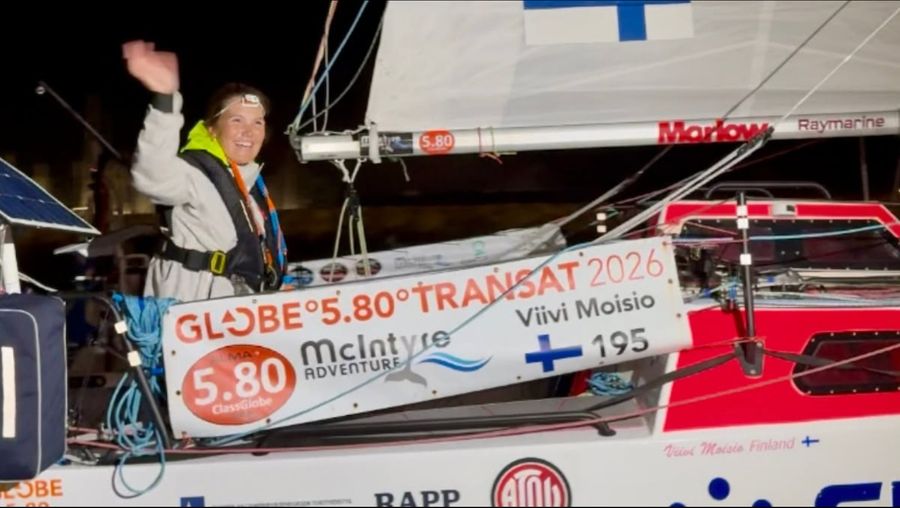
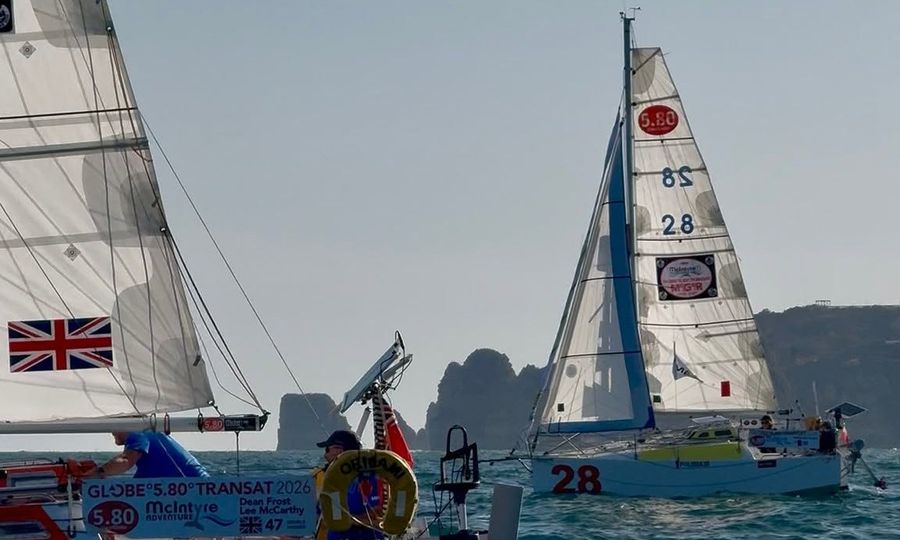
Origami still leads the Globe 5.80 Transat, but her margin is down to less than a mile and a half. At 9am on Monday 16 November NZ time (20:00 UTC Sunday), 44 hours after the start, Dean Frost and Lee McCarthy were 1.4 nautical miles ahead of Viivi Moisio's Flow, with Katherine Urpani's Capucinette another mile and a half back. The leaders were about 110 miles south-west of Lagos and moving at barely a knot, and a south-westerly headwind is forecast to fill in from Monday night NZ time.
Globe 5.80 Transat 2026: miles made good towards Antigua
Nautical miles gained on the 3,532 nm tracker course from Lagos, from the start (1:01pm Saturday 14 Nov NZT, 00:01 UTC) to Mon 16 Nov 9am NZT (20:00 UTC Sun). Four-hourly tracker positions; times are New Zealand time.
Source: Globe 5.80 Transat live tracker (YB Tracking).
Who is leading the Globe 5.80 Transat?
The tracker at 9am Monday NZ time (20:00 UTC Sunday), with miles made good towards Antigua since leaving Marina de Lagos and the gap to the leader:
1. Origami, Dean Frost and Lee McCarthy (UK): 106.8 nm made good
2. Flow, Viivi Moisio (Finland): 105.4 nm, 1.4 nm behind
3. Capucinette, Katherine Urpani (Malta): 103.9 nm, 2.9 nm behind
4. Inimini, Matthew Freestone (UK): 99.2 nm, 7.6 nm behind
5. Meraki, Bruce Payne (Australia): 82.2 nm, 24.6 nm behind
Yesterday morning Origami led by 2.9 nm and Capucinette was fourth, 5.6 nm back. She is now third, 1.5 nm behind Flow. Origami has still sailed the furthest over the ground, 118 miles, against 91 for Meraki.
How did the fleet go overnight?
In fits and starts. Through Sunday afternoon NZ time the boats crept along, making good only two to six miles every four hours. A breeze came through in the evening, and between 9pm Sunday and 1am Monday NZ time (08:00 to 12:00 UTC Sunday) every boat had its best four hours of the day. Katherine made the most of it, gaining 12.9 nm towards Antigua, more than anyone else. At 1am she, Viivi and Matthew Freestone were separated by two tenths of a mile in miles made good.
Then it went light again. In the last four hours to 9am Monday, Inimini lost a tenth of a mile in distance made good towards Antigua, while Bruce Payne on Meraki made the best gain in the fleet, 4.3 nm. Over the full 24 hours to 9am Monday, Capucinette made good 36.1 nm, Flow 35.0, Origami 33.3, Inimini 28.6 and Meraki 26.6.
Race founder Don McIntyre, running through the tracker in his Day 2 live briefing on Sunday night NZ time, pointed out that the leaders were close enough to see each other on the horizon and would be chatting on VHF. He reckoned they would be having a right royal time.
When Don spoke on Sunday night, he put Bruce about 15 miles behind that group on the water. By 9am Monday Meraki was 24.6 nm behind the leader in miles made good towards Antigua, the measure the tracker uses for its order. Don said Bruce had been sailing conservatively under reduced canvas, with a long way still to go.
Dolphins, sunsets and a very flat sea
Viivi's team said she was enjoying the reaching conditions on Day 2, catching up on well-earned rest and sharing the water with dolphins. In her video, filmed at sunset as the wind died away, she said she had been very tired, but was eating and drinking well and feeling super good. Her clip shows the dolphins right alongside the boat.
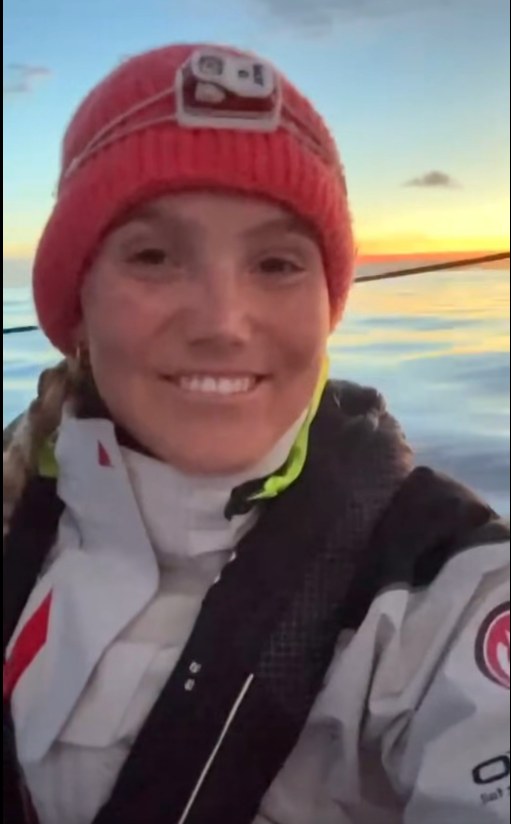
Katherine had company too. Her page posted from Capucinette on Day 2 with a single word of explanation: dolphins.
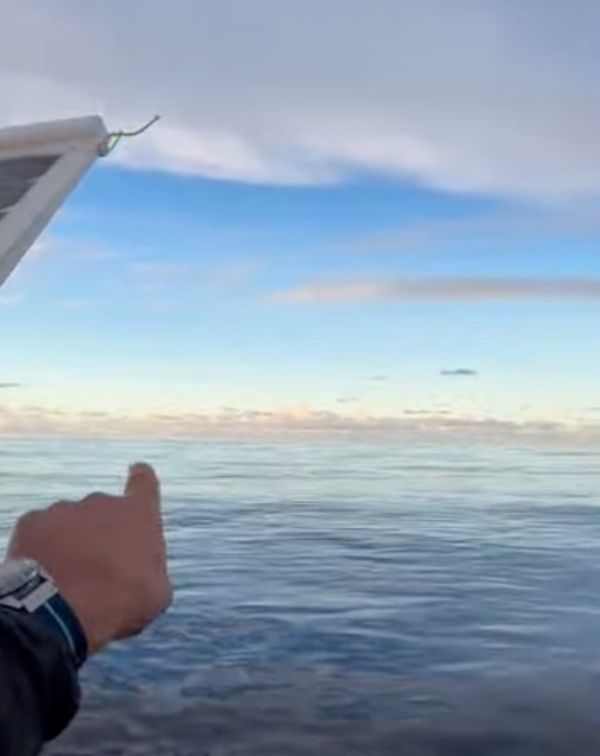
The race page shared the latest video from Dean and Lee on Origami under a short caption about having no wind again, followed by a row of grimacing emojis. The footage shows a sea like glass. One follower suggested the beards would be a good deal longer by Antigua.
Don also had some fun with the divisions. He won the seniors division of the Transat himself in 2021, and said he was pretty sure he knew who would win this year's two-handed division. Origami is the only two-handed boat in the race.
How do the skippers stay in touch?
None of the boats carries HF radio. Don explained that the class rules limit each boat to 200 amp hours of battery capacity and 200 watts of solar panels, and an HF set uses too much power to transmit. Wind generators are allowed, but water generators are not. That leaves VHF, satellite phones and, on all but one boat, Starlink. Matthew Freestone, on Inimini, is the skipper without Starlink, and his own page has had nothing new since he left the pontoon.
Don said the Transat was once meant to be sailed in near isolation, as the Mini 6.50 sailors still do, but competitors in earlier editions kept calling home anyway. With the Transat now serving as a qualifier for the McIntyre Mini Globe Race, where open communication is allowed, the organisers let everyone use Starlink.
Race director Keri Harris is on the water too, sailing his own boat down the coast to Lagos with four aboard to collect an outboard that belongs to Bruce. Don said Keri then plans to chase the fleet, photographing each boat as he passes, and reach Antigua in time to meet them at the finish, though he doubts Keri will catch them before the Cape Verde Islands.
What is the weather forecast for the Globe 5.80 Transat?
A headwind first, then light patches, and then, if the models are right, a northerly by Friday. This is our reading of the free ECMWF and GFS models on PredictWind, taken at about 10:30am on Monday NZ time at the fleet's current position, 35.5°N 9.6°W, unless stated otherwise.
Now. Both models have 3 to 4 knots from the west-north-west, which matches what the tracker shows.
Monday night and Tuesday. By 9pm Monday NZ time (08:00 UTC Monday) the breeze swings into the south-south-west at 5 to 6 knots, right on the nose for a course to the south-west. By 9am Tuesday NZ time (20:00 UTC Monday) both models have a south-westerly of 10 to 12 knots, with 15 to 25 knots further out to the north-west.
Wednesday 9am NZ time (20:00 UTC Tuesday). 11 to 12 knots from the west-south-west at the fleet's position. Further down the course, at 32°N 13.5°W, a band of light air lies between Madeira and the Moroccan coast, with only 4 to 5 knots from the north-west.
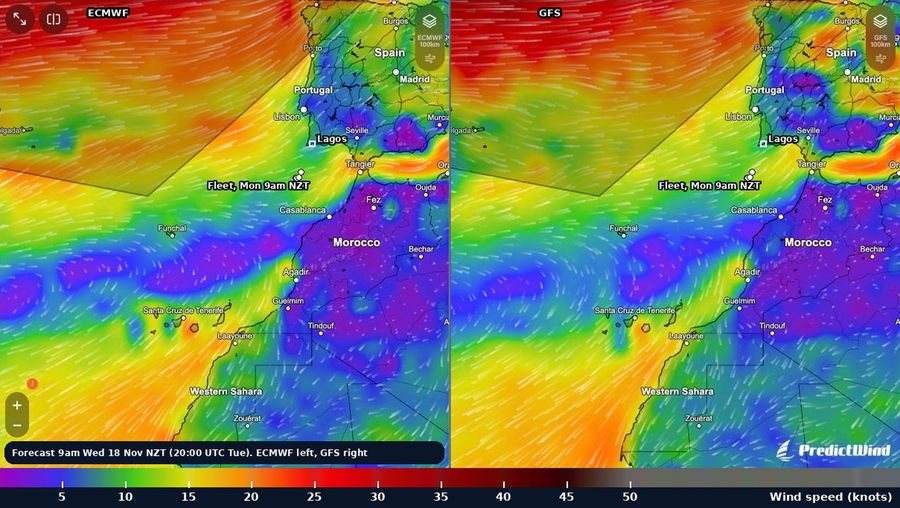
Thursday 9am NZ time (20:00 UTC Wednesday). The west-south-westerly peaks at 13 to 17 knots where the fleet is now, with 30 knots or more off northern Portugal. At 32°N 13.5°W it is still light, 4 to 6 knots.
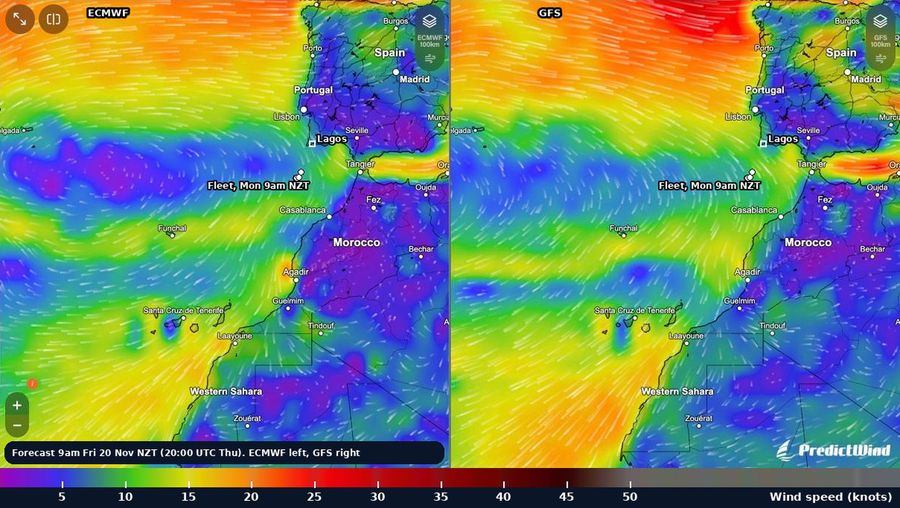
Friday 9am NZ time (20:00 UTC Thursday). At the fleet's current position the wind goes into the north at 8 to 9 knots, and at 32°N 13.5°W both models have 10 to 13 knots from the north-north-east to north-east, a fair wind for the course and the kind of breeze the fleet has been hoping for, though one model run is no promise of settled trades.
Don's own read in his briefing was similar. He said the Atlantic was a confusion of small weather systems, but that the trade winds were starting to show around Morocco and the fleet was trying to get down to them. He expects tacking and slow going for a few days, reckoned the boats might not get their first real chance to break through until around 18 November, and thought it could be after the weekend before they reach the Canaries.
These are forecast average winds at fixed points, and what each boat meets will depend on where it is when each change arrives. On our reading, the fleet faces two or three days of headwinds and light patches before any northerly, and the boats that get furthest south in the meantime should reach it first.
What happens next?
The trackers report every four hours, and Don's tracker briefings move to about 9am UTC each day, which is 10pm NZ time. Origami, Flow and Capucinette go into the headwind within three miles of each other, and the tracker will show soon enough who picks the better tack.
For the first night at sea, read our Day 1 report, and for the midnight start, read our start-day report.
Meet the skippers
Read our profiles of Dean Frost, Lee McCarthy and Origami, Viivi Moisio and Flow, Katherine Urpani and Capucinette, Matthew Freestone and Inimini, and Bruce Payne and Meraki. The Globe 5.80 Transat is a sister race to the Golden Globe Race, which Go Boating follows every day.