
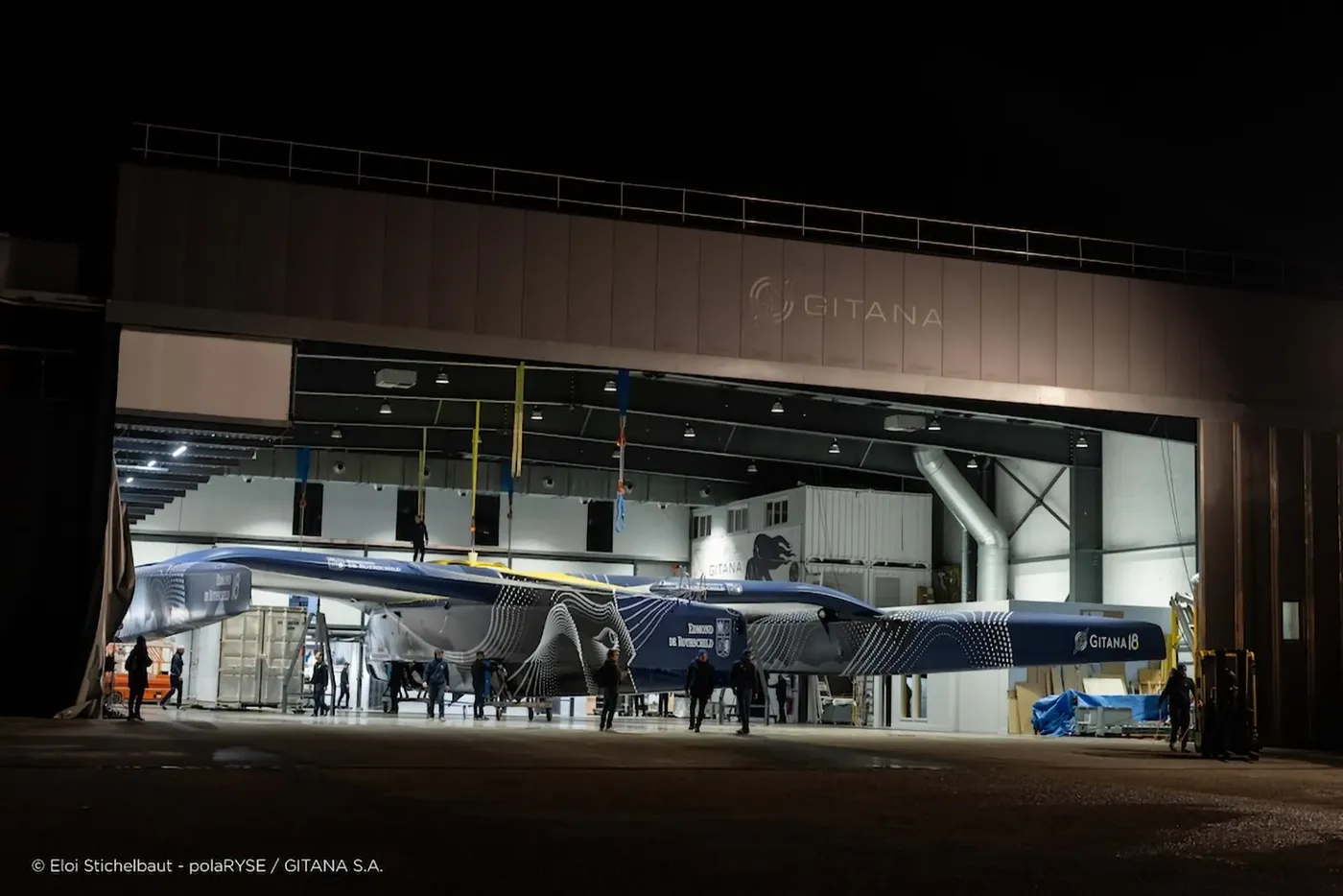
Gitana 18, the Maxi Edmond de Rothschild, was launched on 14 February in Lorient, France, marking the start of her operational phase as the team prepares for sea trials and the 2026 offshore racing season.
The 32-metre Ultim trimaran is the product of 36 months of development, more than 50,000 hours of design study, and 200,000 hours of construction, with over 200 specialists contributing to the project. Around 80 percent of the platform was manufactured in autoclave.
Gitana 18 is the twenty-eighth vessel to carry the Gitana name, a lineage that reaches its 150th anniversary in 2026.
The ambition driving the project has been clear from inception. Gitana 18 has been engineered to move beyond hybrid foiling and into sustained, fully airborne offshore flight. Simulator data points to a projected performance gain of 10 to 15 percent over Gitana 17, with average speeds approaching 40 knots in race conditions.
Skipper Charles Caudrelier set out the vision: "With this new boat, we hope to achieve as close to perfect flight as possible. Ideally, we'll be able to fly very high without ever touching the waves. We hope to be able to fly in 3 metre waves and reach an average sailing speed bordering on 40 knots."
The technical architecture of Gitana 18 reflects both evolution and genuine innovation within the Ultim class. Key features include retractable, three-dimensionally adjustable Y-shaped foils with a span exceeding 5 metres, U-shaped rudders designed to increase stiffness and reduce cavitation at high speed, a canting but fixed-height central board, and dynamically adjustable spreaders allowing mast bend control while underway.
That last element is a first at this scale within the Ultim class. The adjustable spreader system gives the crew active control over mainsail power without requiring full sail changes, a meaningful advantage in the solo and short-handed offshore conditions for which the boat has been built.
The aerodynamic package was developed through collaboration between North Sails, Southern Spars, and Future Fibres, all operating under the wider North Technology Group structure.
Southern Spars warrants particular mention here. Founded in New Zealand, the company maintains its primary manufacturing and design hub in Avondale, Auckland, despite being part of the US-based North Technology Group. It has built a global reputation in high-performance carbon fibre masts, rigging, and structural components for elite racing yachts and superyachts worldwide. For Gitana 18, Southern Spars produced a rotating mast engineered to handle Ultim-level loads, integrated with the dynamically controlled spreader system and built to manage extreme load cases while retaining efficiency and durability offshore.
Future Fibres supplied the standing rigging and load sensing systems, including fibre optic monitoring for continuous performance analysis. North Sails developed the sail inventory using 3Di RAW and 3Di Helix technologies, providing a full race wardrobe from the mainsail through J0 to J3.
Sam Watson, CEO of North Technology Group, commented: "This latest stunning trimaran marks a major leap forward and we are proud that there was only one organisation that could be trusted to bring Gitana 18 to life."
The platform launch and mast stepping were completed in Lorient under suitable weather conditions. Gitana 18 is now moored at her base while the team completes final appendage installation and dockside commissioning. The Y foils will be fitted once initial structural and systems checks are complete, with static testing and calibration scheduled ahead of the first sea trials off Lorient.
Owner Ariane de Rothschild reflected on the occasion: "A new chapter begins in the Gitana lineage with the launch of Gitana 18. For 150 years, my family, through these legendary boats, has recounted its passion for the sea and sailing performance and cultivated innovation."
The team now turns to an eight-month development and optimisation programme with the Route du Rhum firmly in view. The race starts 1 November in St Malo. Caudrelier acknowledged the scale of what lies ahead: "Building a Maxi like Gitana 18 was already a major technological and human challenge, and now an equally significant challenge awaits us in its fine tuning. With Gitana 18, we're entering another dimension."
The principal specifications of Gitana 18 are: length 32 metres, beam 23 metres, air draft 38.4 metres, displacement 19.5 tonnes, upwind sail area 450 square metres, downwind sail area 630 square metres, and six appendages including twin Y foils and a triple rudder configuration.
Commissioning is under way, with performance validation to follow as Gitana 18 works toward her competitive debut in 2026.