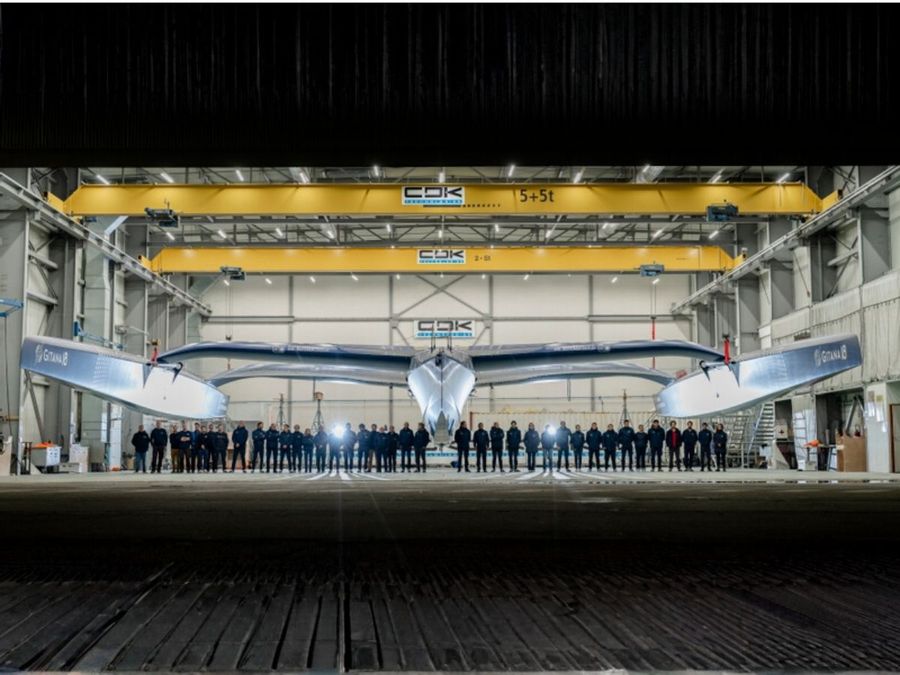
Eight years of accumulated ocean miles, technical breakthroughs, and hard-won racing victories gave the Gitana team the confidence to start with a blank page. The result, unveiled in Lorient to a crew who had spent the better part of a decade preparing for this moment, is Gitana 18, the new Maxi Edmond de Rothschild. It is a trimaran that does not look like a vessel shaped for the sea so much as one shaped to leave it behind entirely.
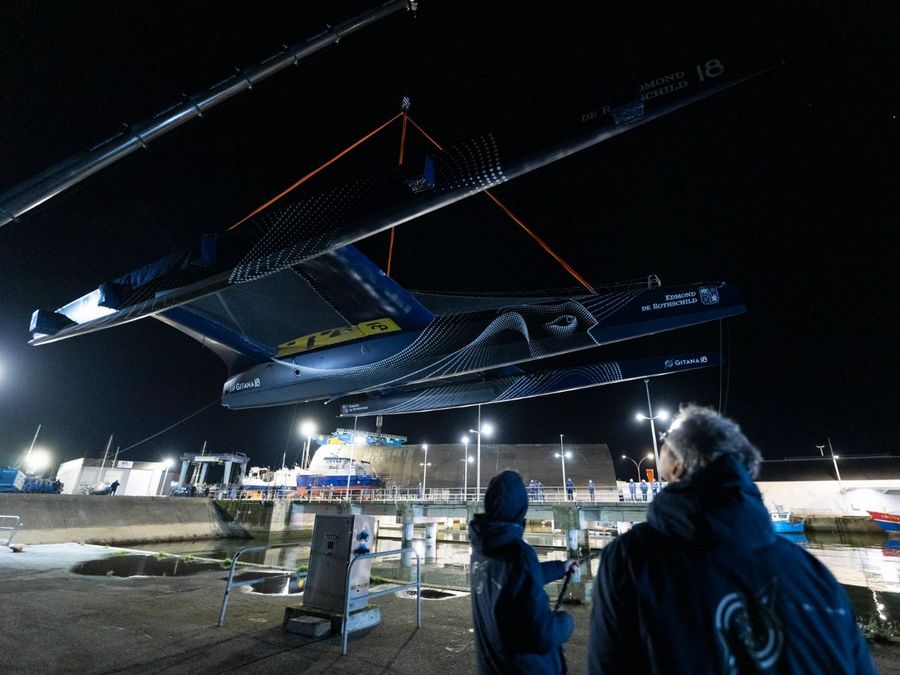
When the doors of the build hall rolled back in the early morning light and the team guided the boat outside, the shape that emerged was arresting. The flat, sharp underbodies, the commanding rig, the sculpted fairings, the extended appendages: every surface communicated a single overriding intent. A machine built to fly.
The programme's foundation sits on the enormous body of experience gathered from her predecessor, Gitana 17, which had flown more than 200,000 nautical miles since her launch in 2017. That boat made history as the first offshore multihull to achieve sustained oceanic flight and the first to complete a full foiling circumnavigation. Her record of victories, including the Fastnet Race, the Brest Atlantiques, the Transat Jacques Vabre, and the 2024 Arkea Ultim Challenge, gave the team a technical database richer than anything available elsewhere in the class. "Gitana 17 brought us to the edge of what was possible," says design office director Sebastien Sainson. "Gitana 18 required us to step beyond it."
From hybrid mode to continuous flight
The brief was unambiguous. The team did not want a boat that climbs onto her foils when conditions cooperate. They wanted continuous flight from the instant she exceeds take-off speed, through whatever the ocean throws at her. Achieving that demanded a fundamental rethink, not a refinement.
Architect Guillaume Verdier describes the project as an exceptional professional opportunity. "It is not often in an architect's career that a client encourages so many innovations at this scale. We asked ourselves what would be possible if we questioned everything."
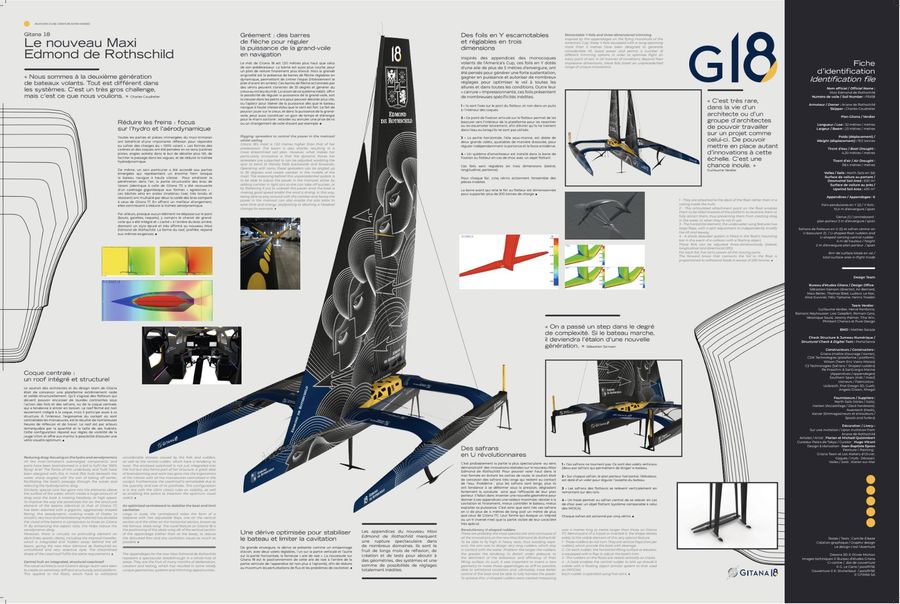
The platform that emerged is stiffer, cleaner, and more aerodynamically efficient than anything the team has built before. Oratex fairings run along the floats and beams, doubling the effective chord of the structure and cutting the drag that accumulates where fast-moving air meets the boat's frame. On deck, every unnecessary projection has been stripped away. The mainsheet traveller sits concealed behind the aft beam, running lines disappear into enclosed conduits, and the coachroof flows into the central hull as a single unbroken form. The logic is consistent throughout: reduce resistance, in the air and in the water alike.
Below the waterline, the hull shapes are flat and sharp, designed to rebound quickly when the platform re-enters a wave, limiting deceleration and allowing the foils to regain lift without delay. Theoretical top speeds on calm water were never the objective. The goal is stable, controllable, sustained flight in the kind of conditions the real offshore world delivers, steep ocean swells and all.
The Y foils: configurable lift for every point of sail
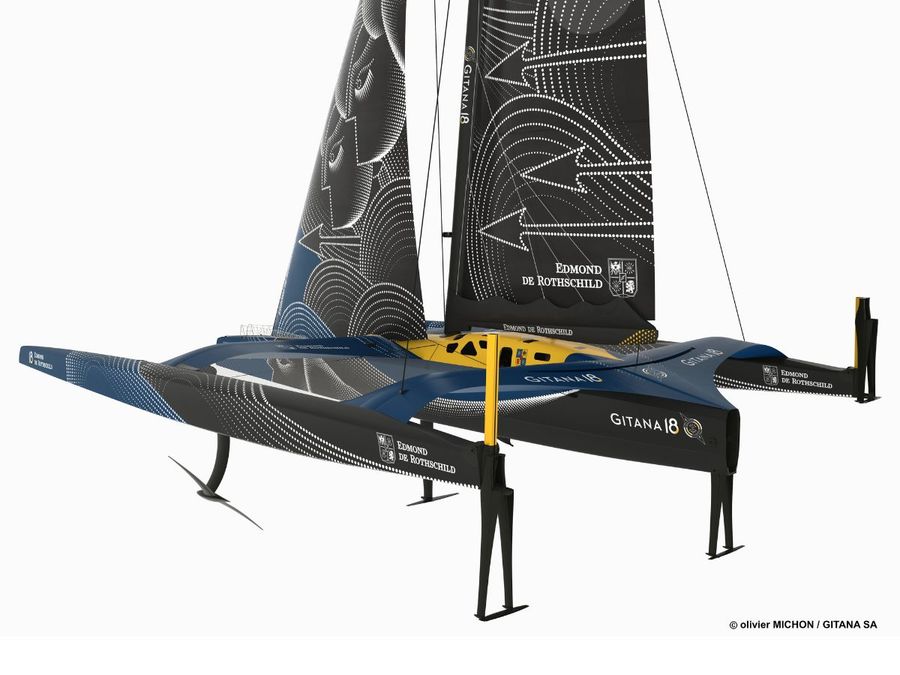
One of the most significant departures from previous Ultim thinking is the pair of giant Y foils, one mounted on each float deck. Positioning them on articulated arms outside the hulls gives the crew the ability to swing the foils inward to centre the lift or retract them completely to eliminate drag at inappropriate moments. Horizontal wings with independent flaps allow lift and leeway forces to be adjusted separately, a level of precision that makes reliable offshore flight genuinely achievable rather than aspirational.
The mounting system incorporates a built-in shock absorber. Should a foil make contact with debris, the structure can yield slightly rather than fracture catastrophically. Five hydraulic rams control each foil, managing angle, depth, and trim. The forward brace is engineered to cope with loads exceeding 200 tonnes.
Skipper Charles Caudrelier sums up the objective with characteristic directness. "We want to fly very high without touching the waves. Stability is speed."
U-shaped rudders: stiffness without distortion
Long rudders are a foiling boat's necessity and its problem simultaneously. They must remain fully immersed in a rough sea state, but the longer they are the more they flex under load, eroding elevator authority and introducing unpredictability. The Gitana team's answer is a U-shaped rudder configuration, where the structure forms a continuous closed loop. That geometry resists bending and reduces cavitation at the speeds this boat is expected to reach.
The float rudders retract vertically on tracks, protecting them during approach to shore and in the event of an obstacle strike. The central rudder uses a kick-up mechanism similar to the systems fitted to IMOCA yachts, providing an equivalent layer of protection. Each rudder carries a horizontal elevator with an adjustable flap, delivering fine control over pitch and ride height.
A centreboard shaped like a tailplane
The centreboard on Gitana 18 owes more to aircraft design than to sailing convention. Its horizontal skate wing is positioned aft of the vertical fin rather than at its base, a configuration that reduces disturbed flow, delays cavitation, and strengthens directional stability. Two flaps, one vertical and one horizontal, allow further trimming as conditions change. Taken together, the centreboard, the rudders, and the Y foils form a three-dimensional control system that mirrors the flight surfaces of an aircraft more than it resembles a traditional sailing yacht's underwater package.
A dynamic rig that tunes its own power
The rig above deck carries its own share of innovation. The mast stands one and a half metres taller than that of Gitana 17, paired with a shorter boom to improve overall efficiency. The central development is a set of dynamic spreaders that allow the mast to bend fore and aft under load. In light air, sailors can increase camber through the middle section of the mast to build power. When the breeze strengthens, they can flatten the sail without reefing or changing headsails, a significant saving in time and energy, particularly during solo passages. The spreaders articulate up to 35 degrees, giving the sail plan a range of response that no fixed rig can replicate.
A platform shaped for the realities of offshore flight
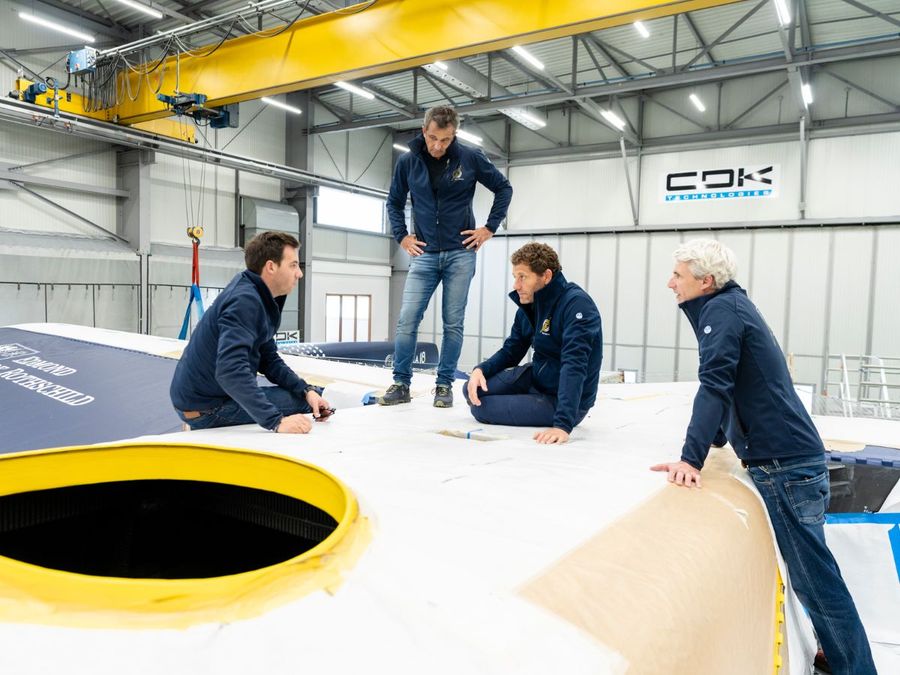
The coachroof is both an aerodynamic surface and a structural one. It stiffens the central hull and resists torsion, contributing to the overall rigidity of the platform. The cockpit was shaped through thousands of hours of ergonomic study, with large windows offering wide visibility across the water. Beneath the access panels, the interior spaces contain an intricate network of hydraulics, electronics, and control systems. Technical director Pierre Tissier puts it plainly: "You open the access panels and realise it is a living machine, incredibly complex but very refined."
Performance and expectations
Simulation work points to a performance gain of ten to fifteen percent over Gitana 17. Average speeds approaching 40 knots in racing conditions are anticipated, and the team believes peak speeds above 50 knots are within reach, though chasing those numbers for their own sake was never the design intent. Caudrelier is clear about the philosophy. "Brute speed is pointless if you cannot hold it in a real sea state. This boat is designed to attack."
Artistic identity
The visual livery was created by the Quistrebert brothers in collaboration with the Palais de Tokyo. Their graphic patterning follows the curvature of each hull, tracing and amplifying the dynamic lines of the platform. Even stationary, the trimaran carries a sense of kinetic energy.
Specifications
| Category | Details |
|---|---|
| Official name | Maxi Edmond de Rothschild (Gitana 18) |
| Length overall | 32 m |
| Beam | 23 m |
| Air draught | 38.4 m |
| Draught | 4.20 m |
| Displacement | 19.5 tonnes |
| Sail area upwind | 450 m² |
| Sail area downwind | 630 m² |
| Appendages | 6 total |
| Y-foils (2) | 10.4 m span, retractable, independent flaps |
| Centreboard | Vertical fin with 3 m span tailplane (“skate-wing”) |
| Rudders | 2 U-shaped float rudders + 1 U-shaped canting central rudder |
| Foil loads | Forward foil brace engineered for loads > 200 tonnes |
As Gitana 18 settled outside the hangar for the first time, the mood among the team was quietly certain. "We wanted a boat that would reset the standard," said general manager Cyril Dardashti. "Looking at her now, I believe we've done it."
Gitana 18 is due to launch in early 2026, a matter of months before Charles Caudrelier returns to the Route du Rhum to defend his title. By then, the team will have their answer: whether this new machine has not merely learned to fly, but has changed what offshore flight means altogether.