There was a moment in the 1980s when an Auckland Coastguard vessel became home to the first VHF marine radio bolted into a New Zealand rescue boat. The unit was bulky, thirsty for power, and needed constant attention to stay operational. When it crackled to life, though, it changed everything. For the first time, people on the water could speak to one another and to those waiting on shore. Coastguard New Zealand, reflecting on half a century as a nationally united service, has since described that moment as "the beginning of everything."
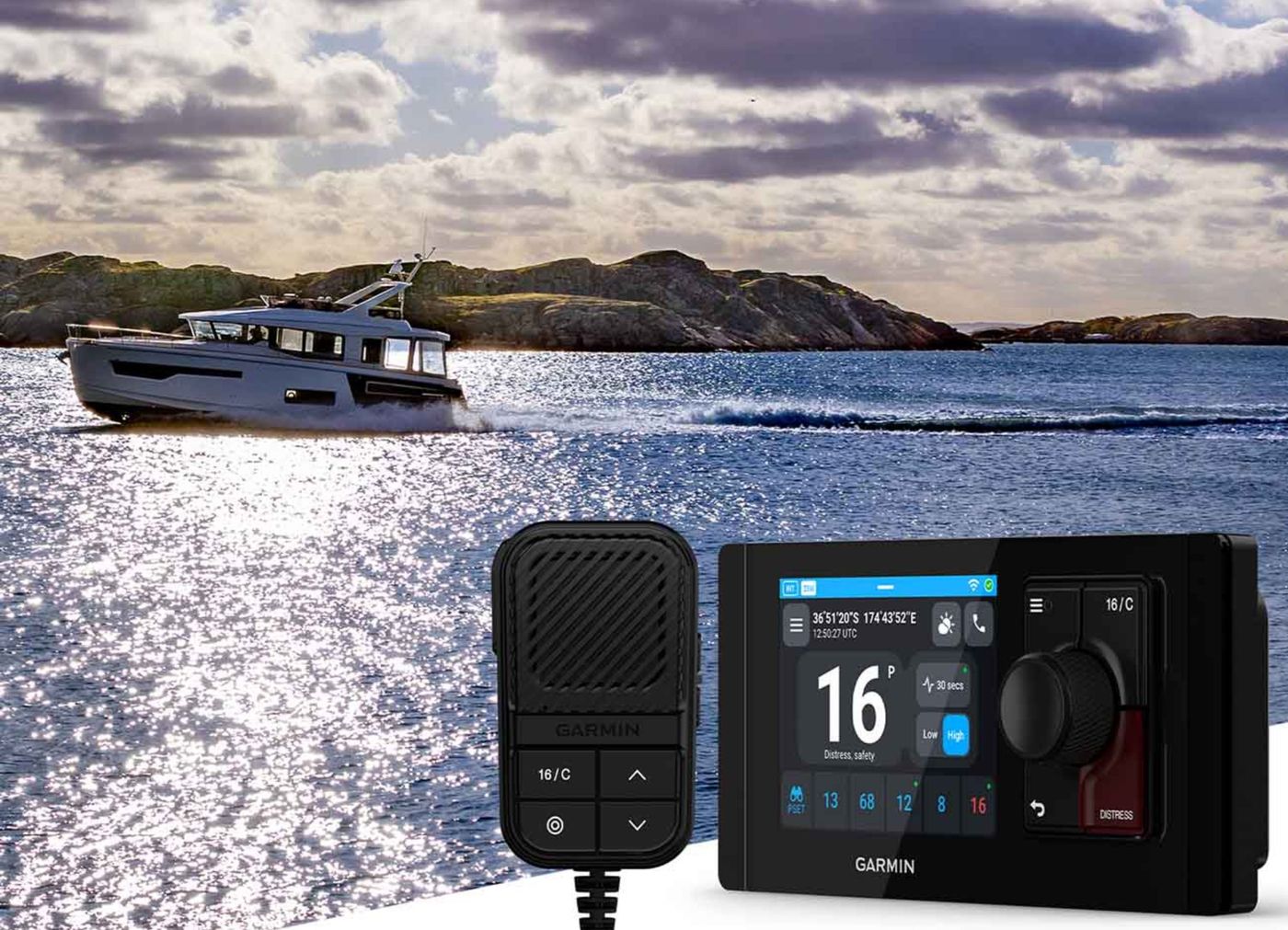
More than four decades later, the contrast with those pioneer units could hardly be sharper. Garmin has introduced the Signal VHF 400 and Signal VHF 220, radios that rank among the most compact all-in-one marine VHF units ever built. Both incorporate an industry-first 3.5-inch colour touchscreen with edge-to-edge glass, along with built-in AIS, GPS, DSC, adaptive noise cancellation, and Wi-Fi connectivity, in a package small enough to sit neatly at any helm. Equipment that once demanded a professional installer and careful protection from spray now updates its own software wirelessly.
The two models occupy different positions in the range. The Signal VHF 400, priced at $2,399 NZD, is the flagship, housing a Class B AIS transponder that both receives and broadcasts vessel name, position, course, and speed to other AIS-equipped boats in the vicinity. The Signal VHF 220, at $1,799 NZD, is receive-only for AIS, making it a practical choice for skippers who want solid situational awareness without committing to a full transponder setup.
Both radios feature adaptive noise cancellation to strip out background interference for cleaner, clearer audio. A VHF playback function records up to three minutes of transmission from any active channel, across three channels simultaneously, so nothing is missed in a busy or noisy situation. An advanced watch mode allows monitoring of six channels at once, which is particularly valuable on congested waterways or during offshore passages where keeping across multiple frequencies is essential.
The supplied fist mic delivers 95 dBA of audio at 0.5 metres, producing enough volume to cut through engine noise, wave action, and wind. It can be mounted independently from the head unit, giving flexibility to suit a range of helm configurations. Class D Digital Selective Calling is integrated throughout both radios. Pressing the distress button automatically broadcasts the vessel's position and identity to emergency responders and nearby vessels, and DSC calls can be initiated directly from the AIS plotter screen.
Installation has been kept straightforward. On the Signal VHF 400, VHF, DSC, and AIS all share a single antenna, and both 12V and 24V electrical systems are supported. The integrated GPS removes the need for a separate antenna to supply position data. MMSI programming, configuration, and over-the-air software updates are all handled through the ActiveCaptain smartphone app via Wi-Fi.
Owners of larger vessels or those with a flybridge can add the optional Signal RM 100 remote station at $1,199 NZD. Connecting via Garmin Marine Network, it delivers full radio control from a secondary helm position, complete with its own 3.5-inch display and fist mic. An intercom function enables communication between the remote station and the main unit. Both radios also integrate with Garmin chartplotters via NMEA 2000, Garmin Marine Network 1.0, and Garmin BlueNet, with support for external speakers and loudhailer connections.
New Zealand's maritime geography explains why these features carry particular weight here. Radio signals travel in straight lines and cannot follow the curve of the Earth, meaning a vessel rounding a headland or threading through the channels of the Marlborough Sounds could vanish from contact without warning. The response over the decades was a national network of repeater stations, positioned one by one on high ground to bridge those gaps and extend coverage across the coastline.
That infrastructure has matured considerably, and the technology now sitting at the helm has matured alongside it. The integrated AIS transponder in the Signal VHF 400 means other vessels, harbourmasters, and rescue services can track a boat's movements on their own plotters without a single radio call being made. The DSC distress function transmits position data automatically in a crisis, lifting the burden from a skipper under pressure of having to relay coordinates verbally. The six-channel watch mode reduces the risk of missing traffic on a secondary frequency while maintaining a permanent ear on Channel 16.
Ccoastguard's own words frame the stakes clearly. The operators who maintain around-the-clock radio watches depend on fast, accurate information, including a vessel's position, the number of people on board, and the nature of any emergency. Technology that handles that exchange automatically, transmitting identity and position without requiring human input at a critical moment, directly improves outcomes for people in trouble on the water.