A growing waste problem in the renewable energy sector may be about to find an unexpected solution on the water. Retired wind turbine blades, long considered a headache for landfill operators, are being reimagined as raw material for catamarans and pontoons by a company called Akvotransiro, whose Wind2Water process is turning end-of-life composites into functional, affordable marine vessels.
The logic is compelling. Turbine blades are manufactured from fibreglass and carbon fibre reinforced resins, the same family of materials used in modern FRP boat hulls. Engineered to endure decades of relentless stress, punishing winds, and extreme weather conditions, these blades hold onto much of their structural stiffness and strength even after their working life on a turbine is over. Their slender, curved profiles bear a natural resemblance to hydrodynamic hull forms, meaning only minimal cutting and shaping is needed to prepare them for a second life on the water.
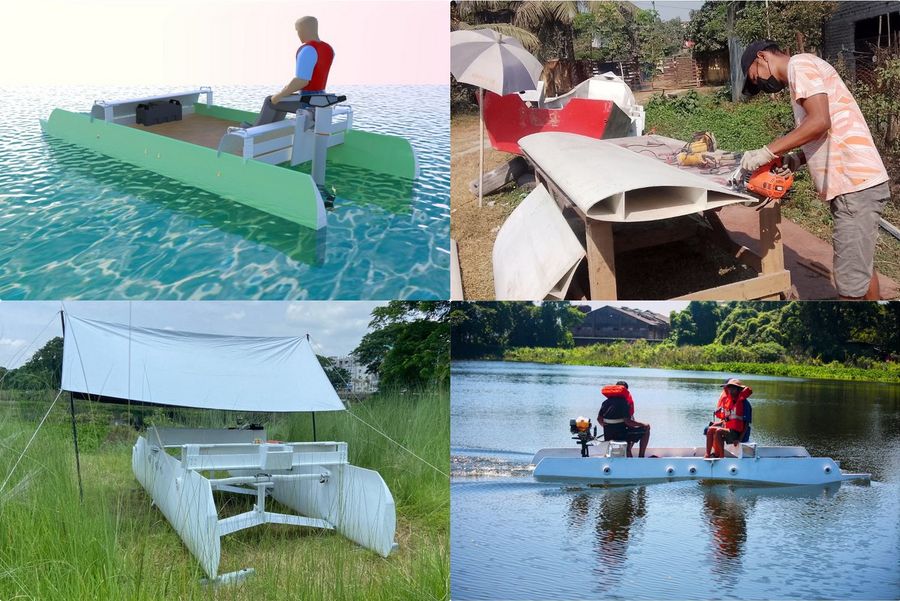
Rather than putting the material through energy-intensive recycling streams, Akvotransiro has developed its Wind2Water process to adapt whole blade sections into modular components. Those sections are cut to lengths that fit inside standard shipping containers, allowing them to be transported to virtually any location around the world before being assembled into vessels or floating platforms. The approach keeps energy consumption and associated emissions low while extending the useful life of a material that would otherwise be written off entirely.
A four-passenger modular catamaran built from discarded blades, with bamboo composite poles used as reinforcement, served as the team's proof-of-concept prototype. The vessel was inexpensive to construct, could be fully dismantled when required, and demonstrated solid stability on the water. For Akvotransiro, that result confirmed that turbine blades were capable of moving beyond token sustainability gestures into genuinely scalable, real-world boatbuilding.
The team draws part of its inspiration from a striking historical precedent. In Southeast Asia, surplus US fighter jet fuel tanks were once cut down and adapted into aluminium canoes, many of which remain in active use more than fifty years later. In Akvotransiro's view, turbine blade composite is an even better fit for marine environments, offering a combination of light weight, high strength, and a service life that stands comparison with aluminium.
The potential applications stretch well beyond passenger catamarans. Pontoons, floating jetties, and other inland water infrastructure all represent viable uses for the material, and the modular nature of the Wind2Water system means components can be configured to suit different requirements in different parts of the world. The approach simultaneously addresses a mounting waste problem in the renewables industry and opens a cost-effective pathway into boatbuilding for communities and operators who might otherwise find conventional vessel construction out of reach.