Seventeen start-ups will line up in the Leisure Marine Start-Up area at Metstrade this year, with another eight taking their place in the Superyacht Start-Up area in Hall 8.
The start-up areas are co-organised by Yachting Ventures, an accelerator that helps newly founded marine businesses find funding, connections and visibility. Founder Gabbi Richardson says the scene has rarely looked busier.
"The marine startup community has never been more active," Richardson says. "Across the Start-Up area and Superyacht Start-Up area, we're seeing founders tackle an increasingly broad range of challenges, from electrification and sustainability to maintenance, safety and the day-to-day realities of running a yacht."
Artificial intelligence crops up again and again in this year's line-up.
"One noticeable development is the growing use of AI and connected technology," Richardson says. "In both pavilions, a considerable number of the companies are building AI products. This reflects a broader shift towards using technology to simplify operations, reduce administration and help people make better decisions."
Four of the companies heading to Amsterdam give a sense of just how wide that net is being cast.
Slovenian company Primum has spent around ten years developing Elvalen, a device that turns a boat's rocking motion in waves into electricity. Founder Primoz Kunaver explains the mechanism: an internal eccentric mass moves up and down, driving an electrical generator through a gearbox, with complex electronics converting the variable electrical output into a suitable charging voltage for a 12-volt onboard battery system. It can generate electricity at anchor, on a mooring or underway. Its most important function is battery maintenance, preventing batteries from fully discharging over winter, though it can also provide some supplementary charging during summer sailing. In moderate waves the output is approximately 3 watts, and a removable handle lets the crew move the mechanism by hand to generate electricity when the battery needs quick recharging.
Dutch venture YachtPass is tackling the paperwork every boat owner knows too well: sailing permits, Yachtmaster's certificate, boat registration, insurance documents, radio certificates, and manuals for engines, navigation equipment and maintenance, most of which boaters still keep on board in paper form. YachtPass keeps all these documents certified in one app, with a QR code that allows authorities to scan and confirm authenticity.
With manufacturer manuals for all onboard systems integrated into the app, its AI function can explain how to carry out maintenance or repairs. The app can also archive a boat's ownership, maintenance and repair history, a feature founder Nard Kempers says is especially valuable for brokers.
"In the automotive industry, registration of car maintenance history, ownership and more is automised," says Kempers, of the Dutch company. "It will be of immense value for boat resellers if this could also be done for yachts. We go to Metstrade to try to convince the yachting industry that digitisation of boat's maintenance history and ownership is needed and that we have the tool for just that."
Spanish company NZero Marine, the marine branch of a business that already makes non-fossil lubrication products for skiing, snowboarding and cycling, is bringing plant-based lube, grease, degreaser and wax to boating from 2025. Guillem Capellades says the goal is to give professionals and boaters functional products "that enable efficient work, while simultaneously reducing reliance on certain mineral-based raw materials," adding that because boats sail in direct contact with the aquatic environment, "the composition of the products they use is of particular importance." Sustainability, he says, "must be an integral part of technical decision-making, rather than merely a marketing argument."
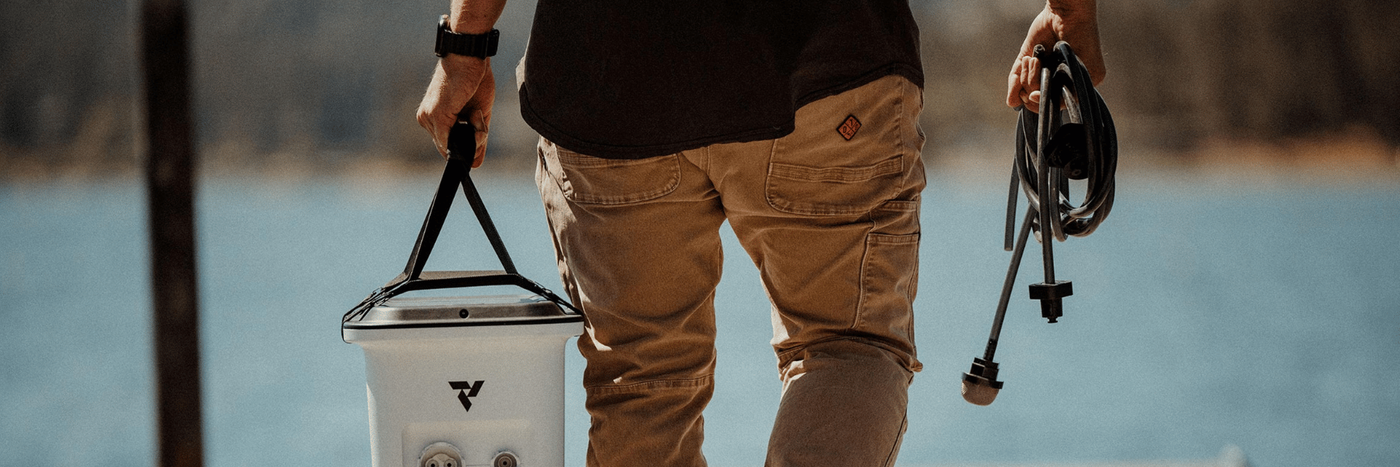
Californian company Vital Lyfe has built Access, a watermaker-in-a-box weighing 11.3kg and measuring 50 x 23 x 20.5cm. Founders Andrew Harner and Jonathan Criss say it can run for an hour on its internal battery, producing almost 23 litres of water from salty seawater or over 45 litres of clean water from contaminated fresh water, with cleaning done at the molecular level by pressing water through a membrane at high pressure.
The device is controlled from a smartphone app and can run on its own battery or an external 12-volt supply, needing no complicated installation. "Our portable and simplified tech is ideal for sailors, bluewater cruises, leisure boaters," Harner says. "Because it's portable, you can also take it ashore, which a fixed unit can't do."