Two thousand years ago, the waters of northern Europe were merciless to any vessel not equal to the task. Dugout canoes hewn from oak sat heavy and sluggish and were liable to split. Rafts could carry a load but became unmanageable the moment real surf arrived. Sewn-plank construction failed persistently as fibres stretched and rotted in the cold and wet.
The North Sea and Baltic imposed conditions that demanded something altogether different. Tides surged through narrow channels, storms threw up steep, short chop, and the shallow beaches of the region meant boats had to be dragged ashore at the end of every day. Builders needed a hull that combined lightness with real structural strength, one capable of carrying warriors, settlers, or traders across open water without falling apart beneath them.
The answer was clinker construction: planks laid so that each one overlapped the edge of the plank below, fastened with iron nails hammered through the overlap and clenched back over roves on the inside face. The hull was built shell-first, with each strake helping to define the shape of the finished vessel. Those overlapping laps stiffened the whole structure without adding meaningful weight, and the resulting hull could flex just enough to absorb a hard sea rather than fighting it. It was a northern solution to a northern problem.
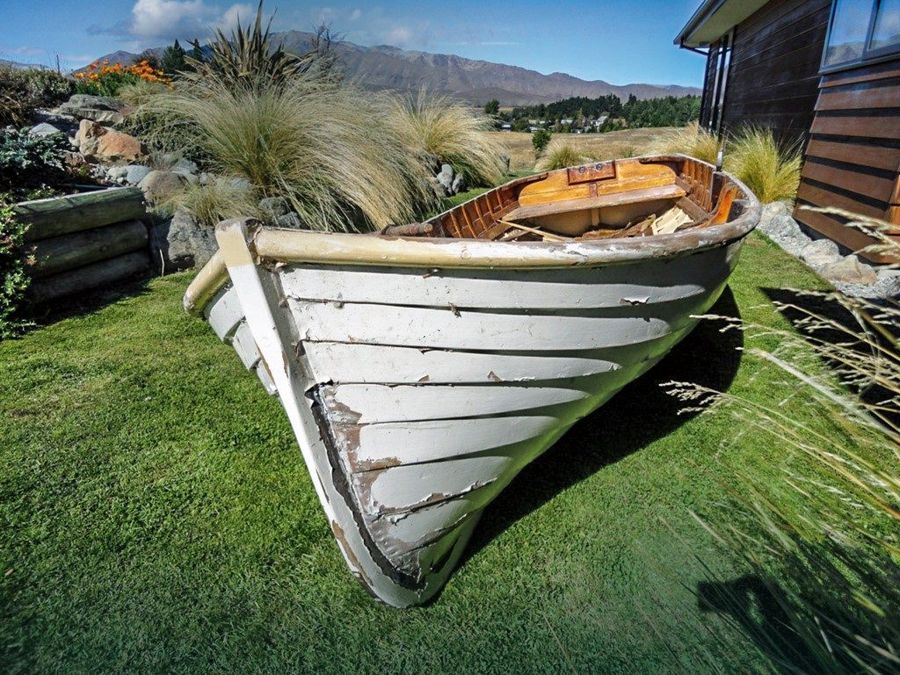
The earliest archaeological evidence traces the shift from extended dugout to true planked hull. The Björke boat, dating to around 310 AD and found in Sweden, sits at that boundary. Close behind it came the Nydam boat, built around 320 AD, the oldest substantially complete clinker-built vessel known to survive. Its oak planks overlapped in the now-familiar way, fastened with iron nails clenched over internal roves. Reinforcing frames were fitted only after the shell was complete, a feature that became a defining characteristic of the technique. Examined closely, clinker planking has a distinctly stepped appearance, each fastener driven through the lap and hammered home with no glue or mastic involved.
The construction process looks straightforward but rewards patience and demands the right equipment. Forum discussions suggest the basic toolkit runs to a ball-pein hammer, a drift for roving, and pinchers to cut copper nails. A newly built clinker hull is watertight by virtue of its tight laps and clenched fastenings, but wood is not static. Left ashore through winter, planks dry out and shrink. Relaunching in spring can mean hours of pumping while the boat slowly takes up. The leaks can look alarming at first, then almost without warning the laps swell, the joints close, and the hull seals itself. Splits sometimes open along rivet lines over time, but the repair is not complicated: pull the affected plank, use it as a template for the new one, and re-rove with fresh copper. Treated with reasonable care, a clinker hull can outlast several generations of owners.
By the 7th century, clinker boats had spread widely across Scandinavia and Anglo-Saxon England. The Viking longships of the 8th to 10th centuries took the form to its logical extreme. Finds such as the Oseberg and Gokstad ships show long, fine-ended hulls capable of being rowed at speed, sailed across open ocean, or hauled overland between waterways. The broader-beamed cargo version, the knarr, carried goods, livestock, and settlers as far as Iceland, Greenland, and Vinland. In the 10th century a new type emerged: the cog, square-rigged and clinker-built, with a flat bottom and high freeboard. Running between 15 and 25 metres in length and carrying anywhere from 30 to 200 tons of cargo, the cog became the workhorse of the North German Hanseatic League's merchant fleet, extending the commercial reach of northern Europe considerably. In 2021, UNESCO recognised clinker boatbuilding as part of the Intangible Cultural Heritage of Humanity, acknowledging its central place in shaping Nordic identity.
Wherever Europeans eventually settled, clinker construction followed. By the 19th century it was well established in both Australia and New Zealand. Local builders here quickly recognised the value of the timber growing around them. Kauri, straight-grained and dependably strong, made excellent planking material. Pohutukawa, with its naturally curved branches, yielded the knees a clinker hull required. Working with these timbers, New Zealand builders could produce hulls that matched or surpassed anything coming out of Europe.
Percy Vos worked in Auckland through the 1920s and 30s, turning out clinker yachts and fishing boats alongside one another. Jack Guard of Nelson produced a clinker-built launch around 1930. Through the 1940s and 50s, other builders turned out around 130 clinker dinghies and small launches, among them vessels associated with Lake Alexandrina. In Tasmania, builders favoured Huon pine, King Billy pine, and celery-top pine for their durability. On the New South Wales mainland, firms including Lewis Bros, Everingham, and Hammond built reputations on clinker ski boats and runabouts.
Clinker construction also found a permanent place in naval service. The Montagu Whaler, introduced in 1910, became the standard seaboat across the Royal Navy and Commonwealth navies. At 27 feet by 6 feet, double-ended and clinker-built, it could be worked under oars or rigged for sail. New Zealand naval whalers remained in service until at least the 1960s, with some accounts pointing to use continuing into the 1990s. Many New Zealanders of a certain generation carry clear memories of pulling hard on a Montagu Whaler's oars during training, or of learning to handle a boat under sail in one of these clinker service boats.
The breadth of New Zealand's clinker heritage is captured in the Tino Rawa Trust's 2017 publication The New Zealand Clinker Boat, which covers everything from simple tenders to centre-boarders such as the Frostbite, Silver Fern, International 14, and M Class, and on through racing skiffs and naval whalers. Events like the Lake Rotoiti Antique and Classic Boat Show draw clinker hulls out in numbers, gathering them alongside steam launches and early speedboats. One account from Waitemata Woody records that in 2019, Aurora, a kauri clinker built in 1935, took top honours at the show following a full restoration carried out by Nelson's David Gollop. Originally an explosives lighter, she now carries a Stuart Turner petrol engine and gleams with fresh varnish.
George Empson's story runs along a different thread. As a boy in the 1950s he helped his father patch a storm-damaged Fairlie clinker. Decades passed, and then he came across the same boat again, still afloat on Lake Alexandrina, tarred seams and all. For New Zealand families, clinker boats were never simply tools. They were companions on fishing trips, the vessels in which young sailors found their sea legs, and objects that passed between generations carrying stories along with them.
The tradition has not stood still. The late Iain Oughtred pioneered glued-lapstrake plywood construction, replacing rivets with epoxy and bringing clinker principles to modern materials. His designs fed directly into the St. Ayles Skiff, a community rowing class now built and raced in countries around the world. British designer Paul Gartside continues to draw traditional-inspired clinker craft. In Taupō, Mark Dumble recently completed The Daphne G, a Gartside skiff built in glued lapstrake using marine ply and sapele, adapted for trout fishing, fitted with a 25hp Yamaha, and finished in ivory white. It shows that clinker construction remains as practical as it is handsome.
The technique began as a response to a specific problem: how to build genuinely seaworthy boats from small trees in rough, cold seas. In Australasia, builders took the method and remade it with local timbers and local needs in mind. Families built their lives around these hulls, restored them when they aged, and handed them on. Riveted oak or epoxy-bonded ply, a clinker hull still carries with it the logic of those first northern boatbuilders, and the story of everyone who has worked on one or trusted their lives to it since.