In the post-World War II years, the sailing world witnessed a wave of adventure and innovation, sparked largely by the exploits of daring sailors.
One such sailor is the English sailing legend Patrick Ellam, whose iconic Atlantic crossing aboard the tiny yacht
Sopranino
has inspired generations of ocean-going adventurers.
Today, that pioneering spirit sails on in the form of the McIntyre Mini Globe Race (MGR).
Sopranino—the tiny yacht that could
Patrick Ellam, described as "larger-than-life", had been an accomplished sailor from childhood, familiar with the coasts of England and France long before his daring exploits in World War II as part of Britain's Special Operations Executive. His wartime escapades—smuggling arms, rescuing captured servicemen, and sailing covertly through occupied French ports—prepared him uniquely for his post-war sailing adventures. The story begins with
Sopranino
, a miniature 19-foot, 11-inch sloop designed by English naval architect, Jack Laurent Giles specifically for Ellam. Accompanied by Colin Mudie, the young yacht designer who drew up Giles' plans for
Sopranino
, Ellam set out from England in 1951, sailing
Sapranino
across the Atlantic via the Canary Islands to the Caribbean and eventually reaching New York.
Sopranino
itself was revolutionary for its time—a scaled-up version of Ellam’s previous 20-foot sailing canoe,
Theta
. With its minimalist cockpit, small galley, and simple yet practical accommodations,
Sopranino
proved remarkably seaworthy and paved the way for many small yacht ocean voyages that followed. Unlike previous transoceanic voyages in small craft, which were often desperate, dangerous stunts,
Sopranino
’s passage was undertaken in a seamanlike and dignified manner, even including smart shore attire for yacht club visits—evidenced by photographs of Colin Mudie sporting a tie and jacket at ports along the way.
Building an offshore racing legacy
Sopranino
’s successful voyage had lasting implications. It directly inspired the formation of the Junior Offshore Group (JOG), affiliated with the Royal Ocean Racing Club (RORC), proving conclusively that small yachts could be both competitive and seaworthy. Ellam and Mudie’s captivating narrative of their journey, documented in their celebrated book "Sopranino", further popularised small-boat sailing with its charming storytelling and humorous anecdotes—including the antics of a stuffed elephant accused of drinking the ship's supplies dry.
Trekka carries the legacy forward
Among those captivated by
Sopranino
’s story was British sailor John Guzzwell, who commissioned Jack Laurent Giles to design
Trekka
—a 20-foot, 6-inch yawl specifically for singlehanded ocean voyages. Guzzwell’s solo circumnavigation from 1955-1959 aboard
Trekka
became legendary in its own right, spawning another beloved sailing classic, "Trekka Round the World", which inspired thousands more sailors to embrace small yacht voyaging. One such sailor deeply influenced by Guzzwell’s achievements was Don McIntyre, who after years sailing his 29-foot sloop Skye around the South Pacific, decided to revive the spirit of
Trekka
with modern materials and design.
Birth of the McIntyre Mini Globe Race
Don McIntyre’s passion led to the creation of the Class Globe 580, designed by Janusz Maderski—a plywood and epoxy yacht that reflects the dimensions of
Trekka
but is lighter, broader, and theoretically faster. McIntyre not only conceived this modern take on small ocean racers but also launched a series of transatlantic races beginning in 2021, setting the stage for the ultimate challenge: the McIntyre Mini Globe Race (MGR).
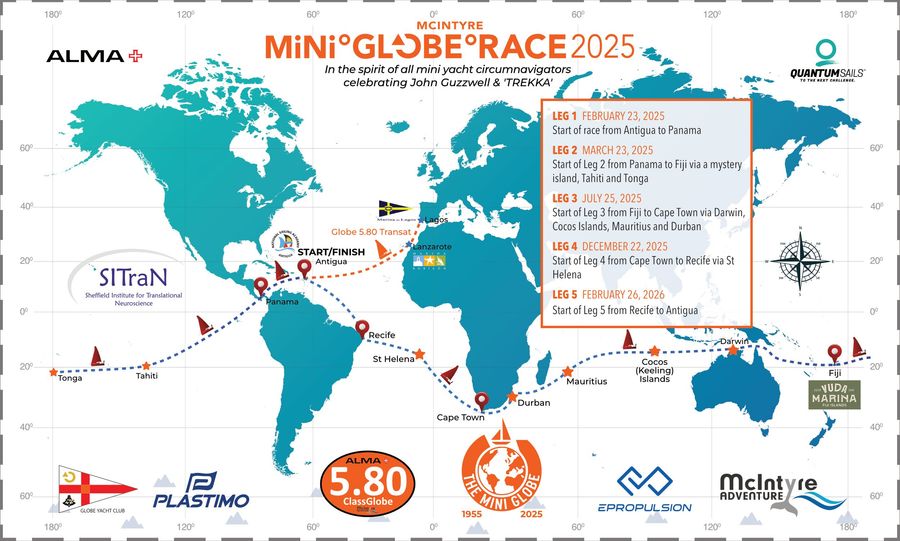
Competitors navigate westwards via the traditional trade wind route, in five demanding legs, each followed by mass restarts. On the 23rd of February, 2025, Leg 1 of the race, from Antigua to Panama, began. Leg 2 leaves from Panama to Fiji via Tahiti and Tonga (and a mystery island) on March 23rd. This if followed by Leg 3 which starts on July 25th from Fiji and finishes in Cape Town via Darwin, Cocos Islands, Mauritius, and Durban. The fourth leg departs just before Christmas Day, on December 22, from Cape Town to Recife (Brazil) via St Helena. The fifth, and final, leg departs on February 26th, 2025, from Recife and ends back in Antigua. A critical aspect of the McIntyre MGR is the requirement for entrants to spend at least seven days in designated pit stop ports between legs, although skippers can extend their stays, strategically restarting their race clock after the compulsory stop. Additional unscheduled stops are permitted, though these carry a significant tactical penalty, with the race clock continuing uninterrupted.
Honouring John Guzzwell
To further underscore the historical connection, John Guzzwell himself has been named Patron of the McIntyre MGR, bringing his invaluable legacy and deep understanding of small yacht voyaging to a new generation of sailors. Competitors are encouraged to learn from Guzzwell’s meticulous seamanship, innovative self-steering techniques, and even his high-seas culinary ingenuity—such as baking cakes aboard
Trekka
using a pressure cooker.
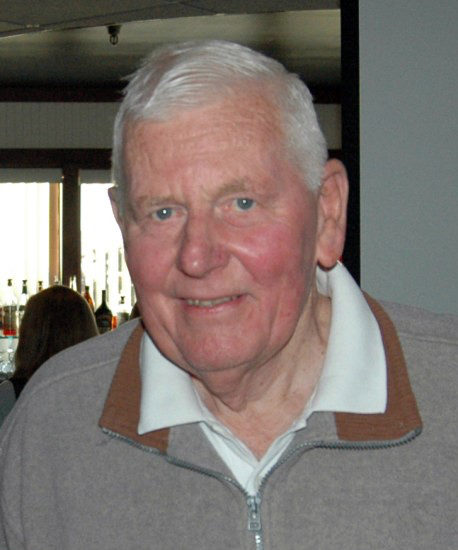
The McIntyre MGR will test sailors’ abilities to balance speed, seamanship, and self-sufficiency. Like the pioneers before them, competitors must intimately understand their boats, maintain essential gear, manage conditions below deck, and develop effective self-steering techniques for sustained rest periods during long ocean passages. As these contemporary adventurers prepare for the ultimate small-yacht circumnavigation, the shadow cast by
Sopranino
,
Trekka
, and their legendary skippers serves as both inspiration and challenge, urging sailors ever onward into the unknown.