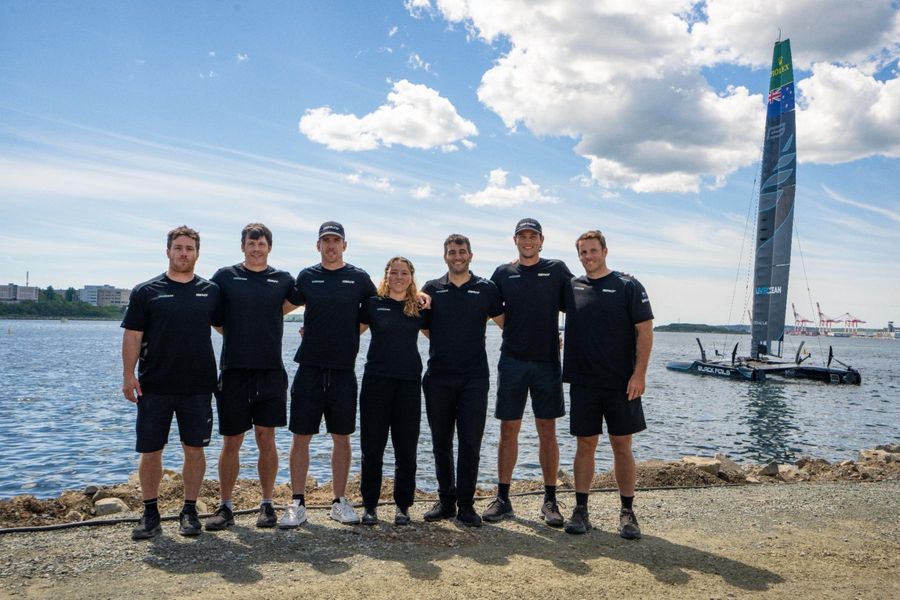
Deep inside SailGP's composite workshop, raw carbon fibre sheets undergo a transformation that most fans never witness. The process, from first cut to finished component, reveals just how much engineering lies beneath the polished exteriors of the F50 fleet.
Pick up a sheet of pre-impregnated carbon fibre and it bends easily between your fingers, almost weightless. It seems impossible that this material is the foundation of one of the fastest sailing craft ever built. Yet the SailGP F50, a foiling catamaran capable of cracking 50 knots, owes its extraordinary performance almost entirely to it.
The logic is straightforward, even if the execution is anything but. Carbon fibre offers an exceptional strength-to-weight ratio, the same property that makes it indispensable in Formula 1, aerospace, and high-performance cycling. In SailGP's world, where fractions of a knot separate winners from the rest, every gram removed from a component is a gram that no longer needs to be lifted onto foils and driven to racing speed. Every component must also survive punishing structural loads, race after race, without failure.
Pre-impregnated fabric, known as prepreg, is the standard starting point. Each fibre bundle arrives already saturated in resin that remains workable at room temperature but cures only when heated. This gives the technicians laying up the parts the time they need to work accurately without the material setting prematurely.
The process starts with a mould shaped precisely to the finished part. Engineering drawings govern everything: the number of plies required, the grade of carbon specified for each layer, and the angle at which each sheet must be orientated. Those fibre angles are not arbitrary. By varying them across successive layers, engineers give a single component the ability to handle loads arriving from multiple directions simultaneously, an essential quality when the boat is hammering through chop at highway speeds on thin foils.
Cutting and placing each sheet is painstaking manual work. A component might call for eleven individual layers, with the opening plies establishing the geometry and the final six concentrated in areas where stress concentrations are highest. Markings on the mould surface indicate precisely where additional reinforcing patches are needed.
When the lay-up is complete, the assembly is enclosed in a vacuum bag. A perforated release film and a breather mesh sit between the carbon and the bag itself, allowing air to be drawn out without the bag bonding to the part. Once the vacuum pump is running, atmospheric pressure compresses the stack firmly against the mould surface, pressing out air pockets and pulling the layers tightly together.
Before any heat is applied, the bagged component undergoes non-destructive testing to check for internal defects that visual inspection could never detect. Parts that pass go into an oven, where precisely controlled temperature converts the pliable lay-up into a rigid, high-strength composite structure.
One of the most consequential recent additions to the F50's carbon inventory arrived for the 2024 to 2025 season, in the form of new titanium and carbon fibre T-foils. Strata Manufacturing built the foils, with Armstrong Foils engineering the carbon-fibre wing tips. The design targets three things: less drag, better stability, and higher top-end speed. The carbon tips are made to be detachable, a deliberate safety feature that limits the damage caused by a collision, while their carefully refined profiles help the boat fly at greater height and speed.
After curing, components move to the fit-out area where the boat starts to take shape as a complete structure. Internal bulkheads, cockpit floors, and foil cases are bonded into position, and the junctions between high-load elements, particularly where the foil case meets the hull, receive additional carbon laminates. These are vacuum-bagged in place to draw resin fully through the joint and guarantee a solid bond.
A moisture-sealing coat goes on next, protecting the carbon beneath from water ingress. Once the deck panel is bonded down, the installation of steering systems, hydraulic controls, electronics, and team graphics can begin. At that point, what started as a flimsy roll of fabric has become a structural component of a precision racing machine.
Suppliers like Strata Manufacturing and Armstrong Foils continue to refine what is possible within the F50 platform, and their work feeds directly into how the boats perform on the racecourse. From the wing tips that pierce the water surface to the wing sail structure towering overhead, carbon fibre makes the entire concept viable.
When an F50 rises onto its foils and accelerates away from the fleet, thousands of hours of cutting, stacking, bagging, curing, and fitting are at work beneath the sponsor graphics. The spectacle on the water is real, but the foundation of it is built quietly, layer by layer, in the workshop.