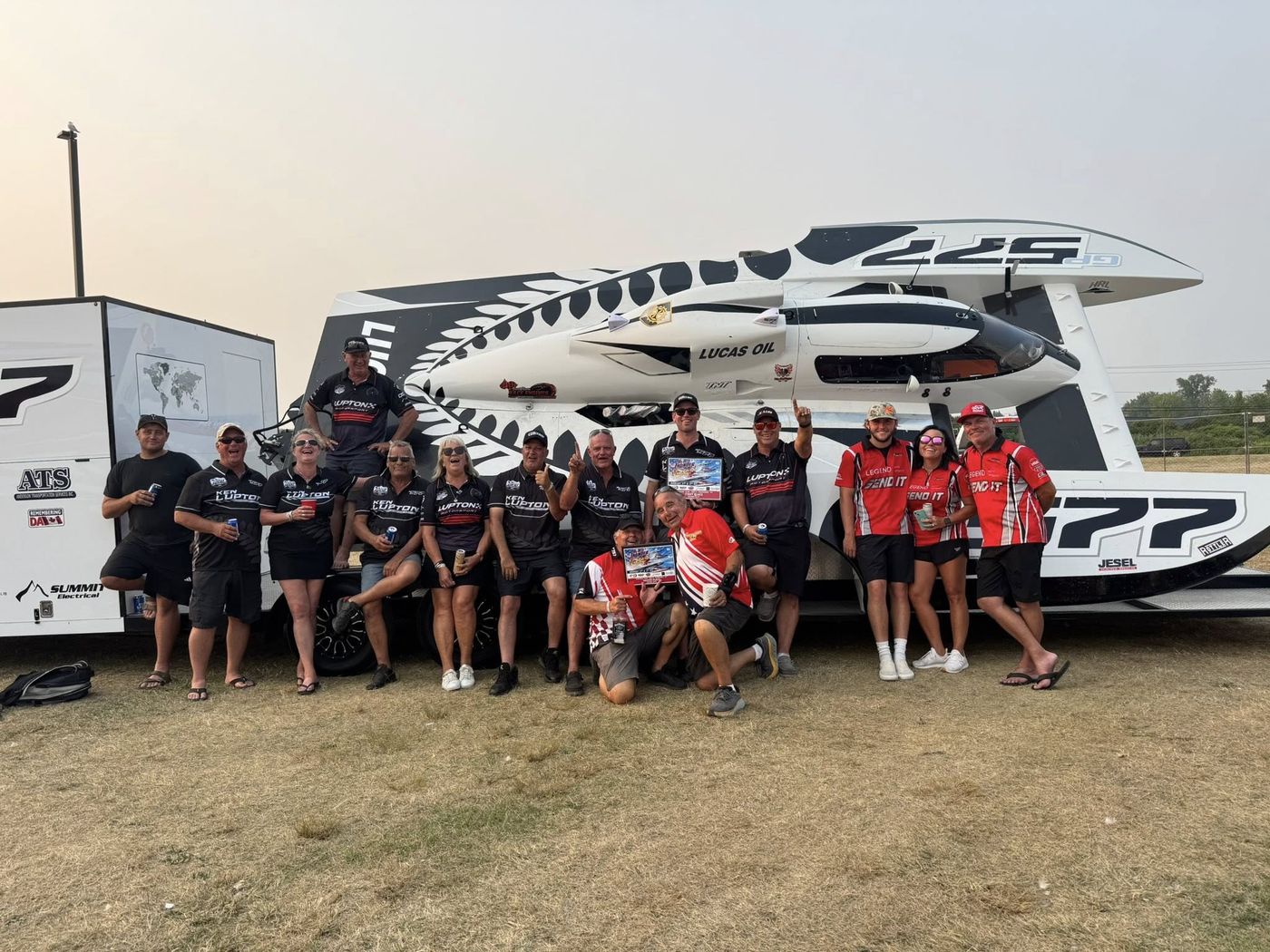
Ken Lupton made the long journey from Waverley to the banks of the Niagara River, and this time he returned with exactly what he came for.
Just days before boarding his flight to Tonawanda, New York, Lupton was already sitting at the top of the Hydroplane Racing League (HRL) points table. After competing in the Thunder on the Niagara, the season's penultimate round, he left with the Grand Prix final trophy secured from the cockpit of Lucas Oil GP-577. With one round still to run, the championship is now his to lose.
Getting there, though, was anything but straightforward.
Seven boats lined up for the Grand Prix fleet in Tonawanda, among them Lupton's brother Jack in GP-33, Brandon Kennedy piloting TMSpecial (GP-35), Andrew Tate in The Wild One (GP-71), and a late arrival that immediately changed the complexion of the weekend. Canada Boy (GP-757), led by Kent Henderson and running engines prepared by René and Gilles Lessard, had skipped several earlier rounds but turned up at Tonawanda to finish the season on a competitive note. Their last-minute entry shook up the standings and raised the stakes considerably.
The weekend also produced one of its most alarming moments when TMSpecial's cockpit escape hatch blew off at speed during the final, flooding the boat and injuring Brandon Kennedy's leg. Kennedy was forced to retire, though he is expected to make a full recovery.
A further layer of complexity came from a simultaneous split across the continent. While the HRL was racing in Tonawanda, a separate group of Grand Prix boats was competing at Seafair in Seattle, more than 4,000 kilometres away. Both distance and the spread of competitors across the region account for that geographical divide.
Lupton's own path to the final included a significant setback. A battery lead short-circuited during Heat 1, putting GP-577 out of action temporarily. His brother Jack had his own alarming moment, launching off a roller and punching through a rooster tail in Turn One. Despite the dramas, both Kiwis managed to qualify for the six-boat championship final.
Heat 3A gave the brothers their qualification ticket. Jack took the win with Ken close behind in second. The two came through with equal points, though Jack's marginally faster heat time earned him lane three for the final, with Ken slotting into lane four. Both Canada Boy and The Wild One qualified ahead of them and posed a genuine threat.
When racing got underway in the final, Lupton navigated the rough water and surrounding traffic with the composed authority that has defined his campaign. He crossed the line first, collecting the points that now make him the near-certain 2025 HRL champion.
Before the weekend, Lupton had been direct about what he needed: "If I can win, I'll pretty much win the series. That's the goal."
He was not wrong. With the season's closing round scheduled for Beauharnois, Quebec on 23–24 August, Lupton holds 387 points at the top of the HRL standings. Canada Boy is his nearest rival, sitting 65 points back. The Wild One and TMSpecial both occupy the positions behind, each having endured a difficult weekend in Tonawanda. Whether Lupton even needs to travel to Quebec, the numbers make his position clear.
Away from the race circuit, Lupton's daily reality is firmly rooted in the Taranaki countryside. He manages several dairy farms near Waverley with his family, overseeing thousands of cows and calves. The physical demands of farm work keep him both grounded and fit for the intense pressures of top-level hydroplane racing.
His father, Warwick, a celebrated hydroplane racer himself, remains an active part of the programme. Warwick handles engine preparation and tows the boat to regattas, supported by a reliable North American crew. The operation the family has built spans both hemispheres, with two near-identical hydroplanes, one based in New Zealand and the other in North America, sharing interchangeable components. The arrangement allows Lupton to fly in, race at the highest level, and return home, sometimes within the space of a single week.
Jack Lupton's presence alongside his brother in the Tonawanda final underscored the growing weight of New Zealand's contribution to international Grand Prix racing. Though Jack finished outside the podium, his pace and consistency are drawing notice from competitors and promoters in North America. Between them, the brothers are raising expectations for what a Kiwi campaign in the GP class can achieve.
The wider effect of their success is generating interest beyond the HRL itself. With Grand Prix racing now running across opposite coasts of North America at the same time, and with Australian teams showing interest in the class, conversations are beginning around the possibility of a Trans-Tasman series capable of matching its Northern Hemisphere counterparts. It would require sponsorship, careful logistics, and substantial coordination, but the talent and appetite in this part of the world are clearly present.
The HRL season reaches its conclusion in Beauharnois, Quebec later this month. Whether Lupton lines up for that final round or watches from his farm with the title already secure is yet to be decided. His name will define this season regardless, a journey from the paddocks of South Taranaki to the podium in Tonawanda, built on genuine speed and an understated determination that has proved more than enough.