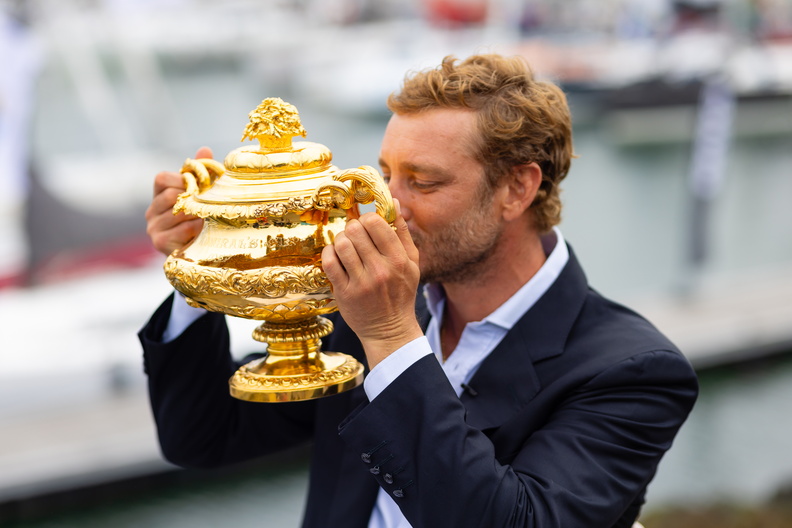
Monaco had never entered the Admiral's Cup before 2025. By the time the final results were tallied at Cowes, Yacht Club de Monaco had not merely competed in the event's long-awaited return, they had won it outright. Two boats, a carefully assembled crew, and a campaign built on patience and precision delivered the club its first appearance and its first title in the same breath.
The team's Class 1 entry, Jolt 3, did the heavy lifting in the inshore series. The Botin-designed TP52, owned by Peter Harrison and skippered by Matt Adams, was consistent where it mattered most. A second place in Race 2 was followed by back-to-back wins in Races 3 and 4, then another second in Race 5. Only a 9th-place finish interrupted what was otherwise a near-flawless run of inshore results. When the fleet turned its bows toward Fastnet Rock, Monaco had built a cushion. A 21st in the offshore classic was far from ideal, but the team had enough in reserve to hold its ground.
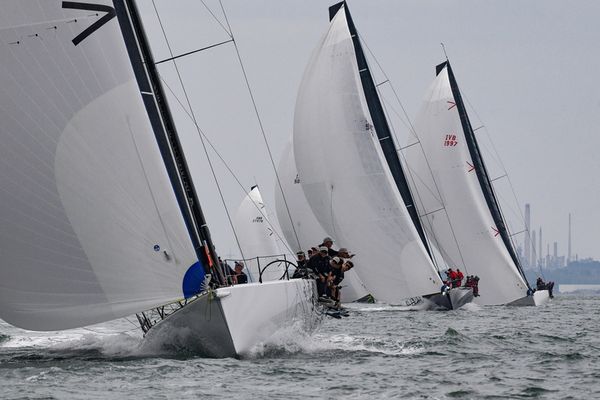
Jolt 6, the team's Class 2 entry, was just as important to the outcome. The Carkeek 40 Mk2, helmed by Tom Dawson, carried a crew that included young Kiwi Oakley Marsh, a graduate of the RNZYS Mastercard YTP. Jolt 6 stayed competitive through the inshore legs, but it was a third place in the Fastnet that proved decisive, securing Class 2 honours and, with it, Monaco's overall title. Their tally of 28 points was the lowest of any boat in either class.
Harrison and co-leader Pierre Casiraghi made sure both boats were staffed by some of the deepest offshore talent in the fleet. Veterans Ed Baird, Cameron Dunn, Stacey Jackson, Andy Green, and Kiwi offshore legend Robbie Naismith were spread across the two crews. The result was a campaign that never looked hurried or desperate. Monaco simply did the job, race after race.
The return of the Admiral's Cup
The Admiral's Cup was first contested in 1957, conceived by the Royal Ocean Racing Club (RORC) as a national team competition in which each country sent three of its best offshore yachts to race out of Cowes on the Isle of Wight. The format combined short inshore races with longer offshore passages, with the Rolex Fastnet Race, a 600-mile test taking in Fastnet Rock off the southwest coast of Ireland, as its centrepiece. At the event's peak, more than a dozen nations competed regularly, among them the UK, USA, Australia, France, Germany, and New Zealand. New Zealand lifted the trophy in 1987, and Australia claimed the 2003 edition, which turned out to be the last for more than two decades.
The 2025 running was staged to mark the RORC's centenary, but the organisers were not content to simply dust off an old format. Two-boat teams replaced the traditional three, the entry list drew from a genuinely global pool, and the Fastnet was once again central to proceedings. For sailors whose mentors had raced the Cup in its golden years, the revival offered a rare chance to contest a title that had felt beyond reach for a generation.
A global line-up of teams, boats and big names
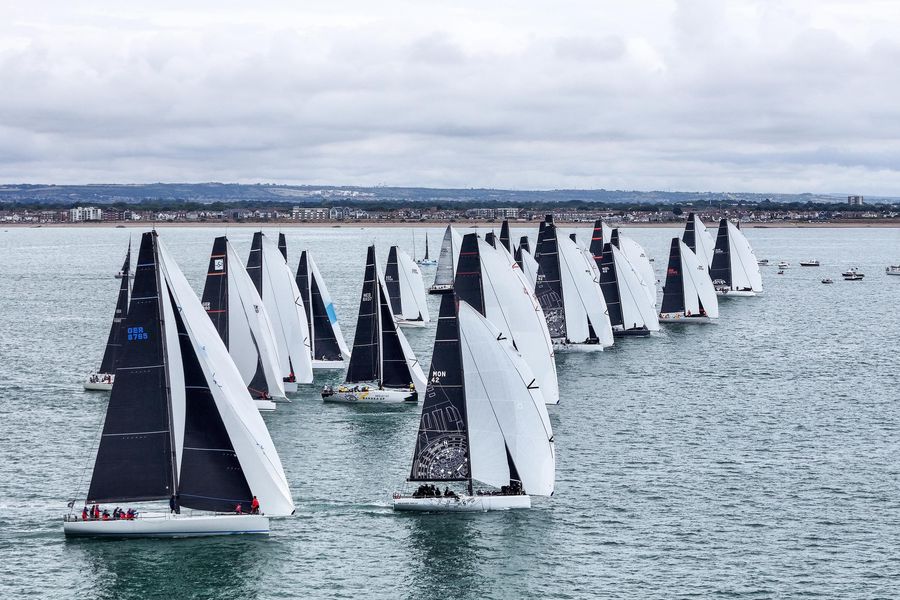
Fifteen teams and thirty boats gathered at Cowes for the 2025 edition. Each team fielded one larger Class 1 offshore yacht alongside a higher-performance Class 2 racer, a pairing that demanded range across both ocean miles and tight inshore work. The competing clubs included RNZYS, CYCA, RHKYC, RORC, YCCS, and others from the USA, the Netherlands, Germany, Ireland, and Monaco. Some were returning after long absences; others arrived for the first time with genuine ambitions.
The hardware on the water reflected that breadth of ambition. TP52s, Ker 46s, Fast 40s, and modified Cape 31s all lined up, each chosen for all-round capability in mixed conditions. Kiwi, European, and Australian crews brought their own offshore instincts and racecourse sharpness to the same starting line.
With no discards permitted and both boats' scores combined, there was nowhere to hide. A single tactical blunder or a blown sail could unravel weeks of preparation. Every race, every wind shift, and every mile of the Fastnet carried full weight.
Hong Kong nearly stole the show
Royal Hong Kong Yacht Club finished second overall, and they came close enough to the top to underline everything that makes Karl Kwok's Beau Geste programme a force in offshore racing. Kwok, marking 50 years of membership at RHKYC, helmed with characteristic composure. His Class 1 TP52, also named Beau Geste, opened the regatta with a fourth in the Channel Race and held steady through the inshore series, even if a difficult Fastnet ultimately cost the boat its class placing. Crew members Gavin Brady, Wade Morgan, and Olympic medallist Nick Rogers gave the programme its competitive spine.
The Class 2 entry, Beau Ideal, was the sharpest weapon in the team's arsenal. Podium finishes in five of the first six races and a third in Class 2 overall kept Hong Kong right at the top of the standings. The boat carried several of New Zealand's most respected offshore sailors, including Dave Swete, Nick Egnot-Johnson, and Ryan Houston. Second overall for RHKYC was earned through precision and cohesion rather than any single spectacular result.
Costa Smeralda brought an unexpected twist
Yacht Club Costa Smeralda is more commonly associated with Porto Cervo superyacht racing and the Azzurra TP52 programme, but in 2025 the club sent a serious challenge north to Cowes and finished third overall.
Django WR51, their Class 1 Wally Rocket 51, was skippered by Giovanni Lombardi Stronati and announced its intentions early with a second in the Channel Race. A win in Race 8 added further momentum, and consistent results across the inshore series earned fourth in Class 1. The Class 2 boat, Django JPK, a JPK 11.80, took longer to find its rhythm, but a late-regatta run that included a second, a third, and a solid Fastnet result pulled it to fourth in Class 2.
Spread across both boats was a crew drawn from the top of European and international racing, including Vasco Vascotto, Guille Parada, Chris Hosking, and Bruno Zirilli. The Italian campaign was efficient rather than flashy, which suited the format perfectly.
Team RNZYS returns
The Royal New Zealand Yacht Squadron made its return to the Admiral's Cup with two campaigns that offered sharply contrasting experiences. Caro, a Botin 52 skippered by Max Klink and crewed by Celia Willison, James Paterson, and Justin Ferris among others, ran into trouble in the Channel Race and never fully recovered. A damaging Fastnet result compounded the difficulty, and the boat finished eighth in Class 1.
Callisto told a different story. The Hakes-built GP42, skippered by James Murray, carried a crew that included Mike Sanderson, Dean Barker, James Dagg, and PG de Felice. Three inshore race wins gave the campaign real momentum, and a 12th in the Fastnet was sufficient to hold second place in Class 2. It was not a flawless regatta for the squadron as a whole, but Callisto's performance was a reminder of how much depth New Zealand's offshore sailing community possesses, across both experienced campaigners and emerging talent.
Australia's fight
The Cruising Yacht Club of Australia leaned on Zen, Gordon Ketelbey's TP52, as its primary points scorer. With Chris Nicholson, Tom Addis, and Tom Barker among the crew, Zen was composed and consistent throughout, ultimately claiming second in Class 1. The Class 2 entry, Back to Black, a modified GP42 co-skippered by Sean Langman and Josh Alexander with Gordon Maguire and Lincoln Dews aboard, had a far harder time. A punishing Fastnet left the boat eighth in Class 2, and the team's overall standing reflected the imbalance between its two campaigns. Zen delivered what was asked of it. Back to Black could not find the same footing. Australian grit was present, but the two-boat format left little room for one partner to absorb the other's difficulty.
A game of pairs
The two-boat scoring format stripped away any possibility of hiding behind a strong partner. Monaco won because both Jolt 3 and Jolt 6 contributed meaningfully. Hong Kong placed more reliance on Beau Ideal, while Beau Geste provided steady support. Costa Smeralda's Django WR51 carried the greater share of points, but Django JPK's recovery in the final races proved it mattered too. New Zealand and Australia inverted the pattern, with Callisto and Zen outperforming their team-mates, yet unable to fully compensate for what the other boats cost them.
The 2025 Admiral's Cup showed that one of offshore sailing's most storied trophies still has the power to draw serious competitors from around the world. The revised format blended deep-water racing with tight inshore contests, rewarded consistency over brilliance, and made every team's weakest performance just as important as its strongest. Offshore team racing had simply been waiting for the right moment to return.