A phone call from Mike Sanderson is the kind of thing that would rattle most sailors, and it certainly rattled Andrew McFarlane.
He'd just bought Retro, a boat with genuine pedigree, once owned by the New Zealand sailing great. Word had it Sanderson kept a book of the boat's old tuning settings, so McFarlane fired off an email. His phone rang minutes later.
"Andy, congratulations on buying the boat, great to hear it's going... yeah, absolutely, more than keen, let's have a yarn about what we used to do," Sanderson told him.
McFarlane still laughs about it. "Mike, if you're watching this, we need to have that conversation again. I don't think I retained any of it; I was way too nervous!"
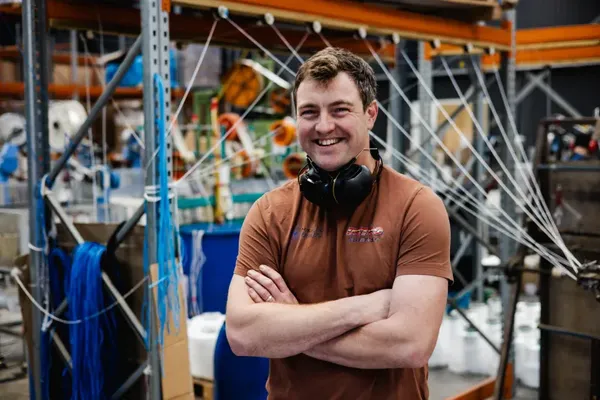
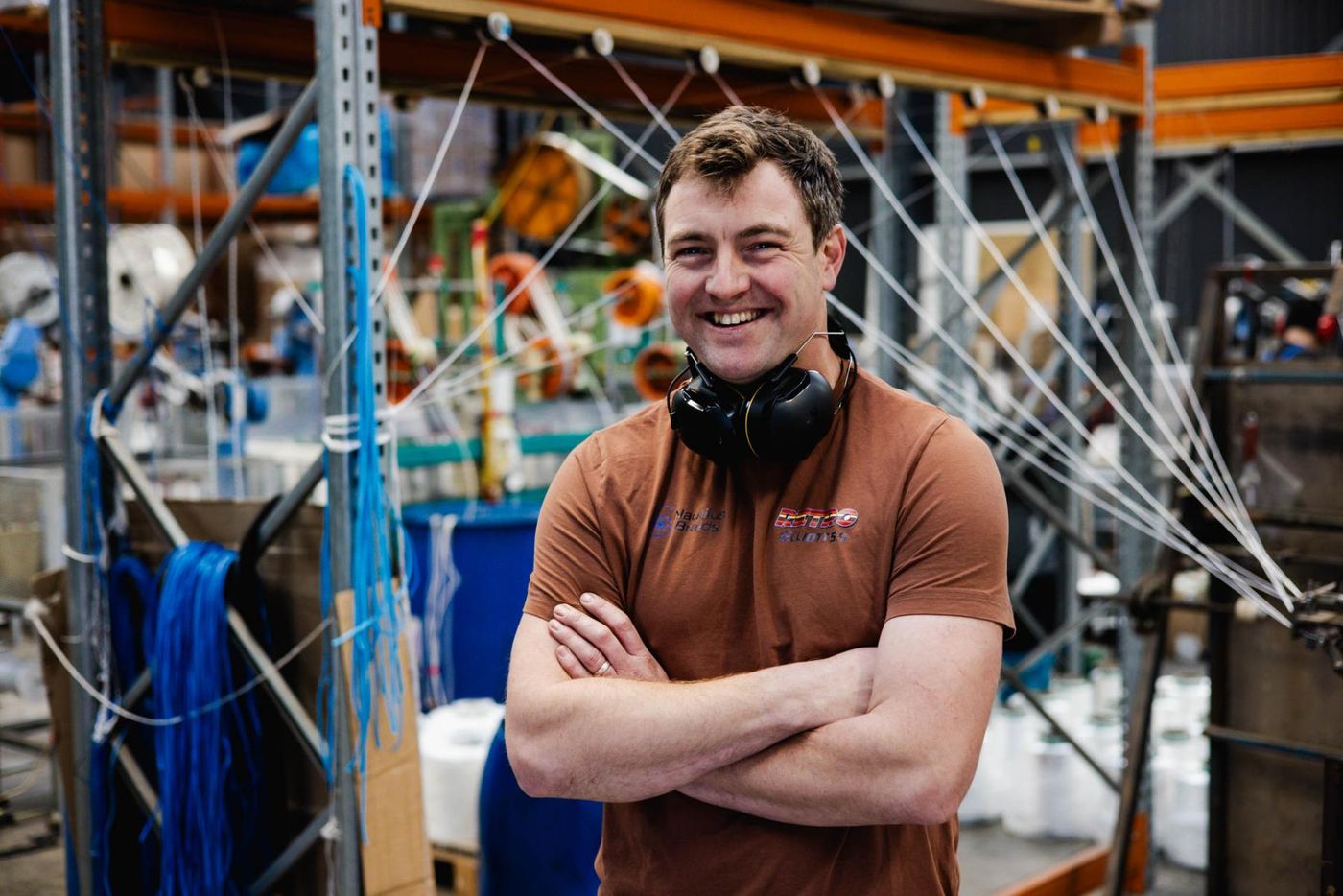
The tuning book, it turns out, doesn't actually exist. But the moment sums up exactly what keeps McFarlane hooked on sailing, a theme that runs through the first episode of Yarns with Yachties, a new collaborative series from Yachting New Zealand and Live Sail Die. The episode was filmed at the Nautilus Braids factory in Rolleston, just outside Christchurch, where McFarlane is the second generation of his family to run the business.
"I really love the camaraderie," McFarlane says. "While we're out there competing against your peers, everyone is happy to lend a hand, give you their experience, give a suggestion that might get you that extra half a knot of boat speed."
That spirit runs both ways. McFarlane now spends his working life making the ropes that help sailors go faster, through Nautilus Braids, one of only a couple of rope manufacturers based in New Zealand, and the only one on the South Island.
The business began almost by accident. McFarlane's father Ian, a scientist working in the woollen industry, had access to textile-processing machinery and an old Davidson 28 that needed a new set of sheets.
"He had a bit of a head-scratch and said, 'I think I could make those myself, let's give it a go,'" McFarlane says. "It came out of a bit of Kiwi ingenuity and Number 8 wire, backyard mentality."
McFarlane was about five at the time. He wasn't exactly enthusiastic about the family trade growing up.
"I was forced to roll reels of rope for pocket money as a child and decided that really wasn't where I wanted to end up," he says. He studied electrical engineering at Canterbury University instead, and moved to Marlborough.
That's where sailing properly took hold, even though he'd missed the usual dinghy pathway as a kid. "Unfortunately, as a kid I missed out on the dinghy scene, got into a P-Class without knowing what I was up to, and it scared the achiever out of me!" Keelboats suited him far better, particularly once he joined the crew on Satellite Spy, alongside Mr Kerr and Mr Robertson. "That was really the game-changer," he says. "We did an awful lot on Satellite Spy and just haven't stopped since."
Eventually his father asked if he wanted to come home and take over the business. The pitch included one particularly good perk.
"When the pitch was, 'Andrew, come down and look after the business; we need a yacht for a test development platform, you can choose whichever one', my hands were tied. Decision made right there!" He picked an Elliott 5.9. "I won't lie, being able to go for a yacht in the 5.9 and calling it product development is a pretty good perk."
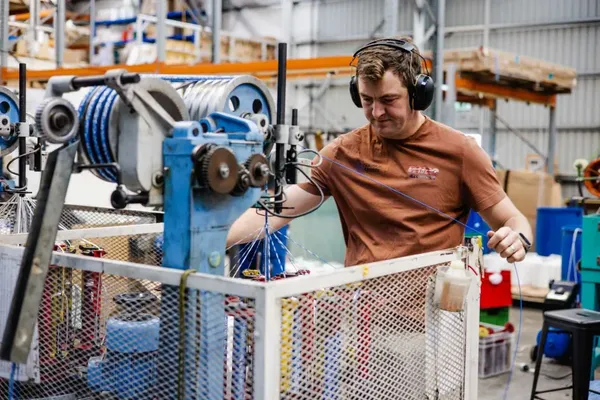
Nautilus is a small operation, just seven people, and McFarlane is hands-on across the board. "I make rope, I do all the strength testing, I do all the splicing, I probably should be doing a bit more marketing, but that's the nature of the business."
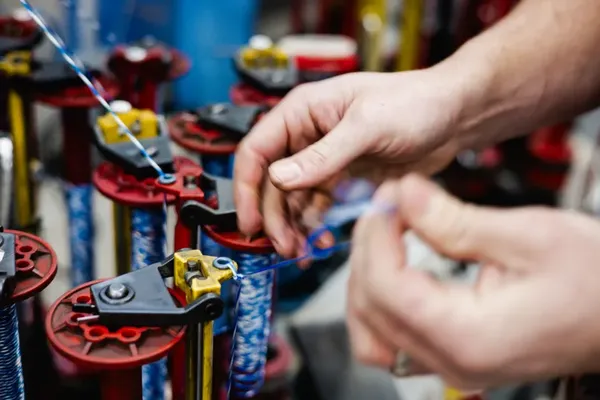
The factory floor is dominated by a 24-carrier braiding machine, which produces most of the yacht braids the company is known for. But sailing is only a third of the business. Another third goes to agriculture, supplying cut-release cords and irrigator winch ropes. The rest covers mountaineering, arborist and abseil ropes, dog and horse leads, glider tow lines, even lightweight rope for theatrical rigging up in the gantries.
"It's far and wide what we do."
There's real science behind a modern rope, McFarlane says, even if the machinery hasn't changed much. Polyester, nylon and polypropylene remain the workhorse fibres, but high-performance materials like Dyneema, Vectran, Kevlar and PBO keep pushing strength further. "The scientific improvement is from the fibre," he says. As for the exact process his factory uses, he's keeping that close to his chest. "There's a bit of IP that goes into it, we try not to scream it from the rooftops, our secret recipes, like the Colonel's chicken."
He demonstrates the point by making a soft shackle from Dyneema single braid, folding and splicing the rope back through itself before tying off the stopper knot. "The hard part's the knot, but once you've done it a few thousand times it becomes muscle memory." The finished shackle looks tiny. Tested to breaking point, an 8mm soft shackle made by McFarlane holds around four tonnes, while a separate rope test reaches roughly five tonnes before giving way.
Beyond the factory, Nautilus has become a quiet fixture of the sailing community, supplying prize packs of tapered sheets and control lines to events around the country. "I don't think there's an Elliott 5.9 that hasn't won one of our prize packs yet," McFarlane says. Support has extended to Sharon Ferris-Choat's Vixen Racing campaign, young 29er and Waszp sailors, and Naval Point Yacht Club, his home club since moving back to Christchurch four years ago, which the company has offered to supply with lines for its 420 fleet free of charge.
"We're just doing what we can to help the sport we love," he says.
Racing itself, he reckons, is close to therapy. "It doesn't matter how your day has gone. It could have been the worst day in the world, you get on the boat, by the time the five-minute gun goes, everything else just clears from your mind."
Then there's what comes after. "Just the passion to get out and get amongst it and do it, and tell the stories in the bar afterwards," he says. "We've all done some pretty incredible stuff, but there are many, many stories and experiences the yachting community are keen to share."
It started with one family, an old Davidson 28, and a problem that needed solving. Decades on, the McFarlanes are still making the ropes that tie sailors to their boats, and to each other.