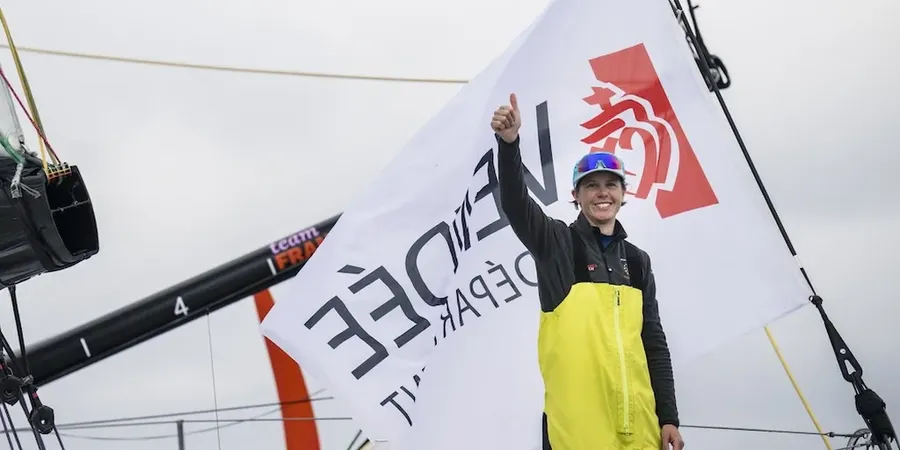
Francesca Clapcich returned from the Vendée Arctique with a fifth-place finish, but the result was almost secondary to what the race itself had demonstrated. Eight days and twenty hours in some of the North Atlantic's most demanding waters amounted to something more valuable than any single placing: confirmation that she belongs at this level of solo offshore racing.
Her finish off Les Sables d'Olonne came at 19:03 NZST on 16 June, at the end of a course that had pushed the fleet north beyond the Arctic Circle and back south again. Her IMOCA covered 3272 nautical miles at an average of 15.4 knots, a speed that kept her within reach of the leading group for nearly the entire race. Where any gap did open, it opened late, and it did not open because she had given ground willingly. At no point while the race still had something to offer did she trade speed for caution.
The nine days she spent alone at sea set this campaign apart from anything in her previous solo experience. Cold, fog, and the particular disorientation that high-latitude sailing brings are abstract enough as concepts. Living them at the helm of a foiling 60-footer for the better part of a week and a half is something else entirely. At one point a fishing net crossed her path mid-race. She dealt with it and sailed on, treating what could have become a crisis as little more than an interruption.
What defined her campaign was not any single standout moment but a quality of sustained, clear thinking maintained across the full distance. Each time a weather system shifted she adapted rather than held to an approach the conditions had already made redundant. When the boats ahead changed their calculations, she reanalysed rather than simply tracking them. Keeping that kind of mental agility intact over such a duration, on minimal sleep, in that kind of cold, is exactly the skill that goes unnoticed in benign conditions and announces itself loudly when conditions are working hard to grind it away.
With only hours left before the finish, after nine days of barely any proper rest, she was still entirely genuine about what the experience had meant to her. "I love racing, I love sailing and I love being here," she said. It was not a carefully constructed line designed to project the right impression. It was the straightforward answer of someone who had pushed themselves through something genuinely hard and found they still meant every word.
Crossing the Arctic Circle carried its own meaning beyond the competitive result. Clapcich was among the eight IMOCA sailors who made up this first generation to take their boats above 66 degrees north, alone, in a competitive race, and return to port. She acknowledged the significance of that without dressing it up.
A 30-minute penalty for a broken seal was applied to her time after she finished, revising the official figure to eight days, twenty hours, and thirty-one minutes. Set against the broader picture of what the race had delivered, that adjustment was largely beside the point. She was returning with nine days of hard-won experience aboard a foiling monohull in heavy weather, with evidence that she could meet the full demands of the distance, the conditions, and the solitude without losing her grip, and with a level of confidence that no training programme can manufacture. Genuine racing in genuine conditions is the only thing that can produce it.
For a skipper with serious ambitions still ahead of her, the Vendée Arctique had provided exactly what a race of that nature is built to provide: proof, earned against real competition in real circumstances, that the next step is within reach.