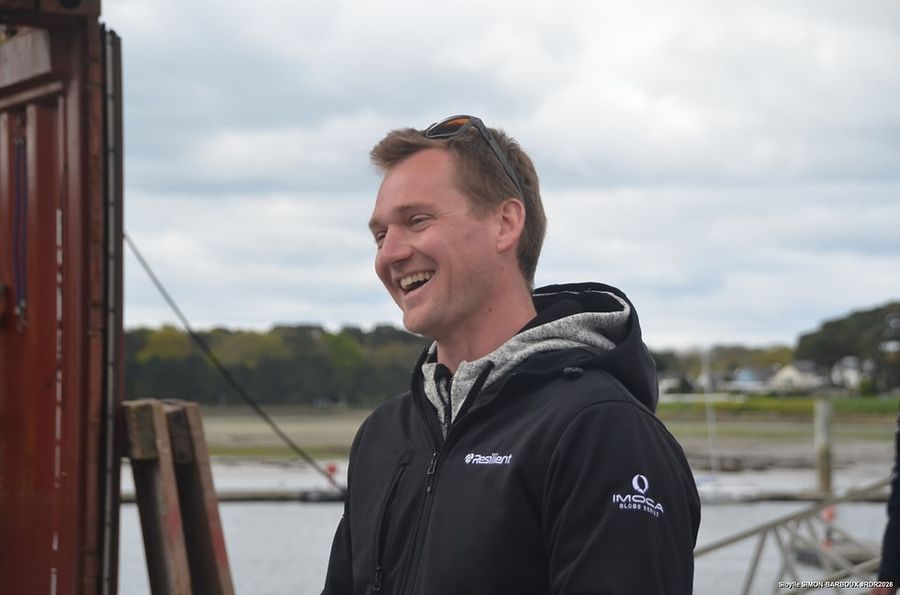
Pierre-Louis Attwell is new to the IMOCA class this season, but he is no stranger to the pontoons of Saint-Malo. Four years ago the 30-year-old skipper from Honfleur lined up there in a Class40.
This time he will cross the Atlantic at the helm of the former monohull of Tanguy Le Turquais, a boat he has renamed RESILIENT. Attwell lives with Crohn's disease, and the project is about more than racing performance. His boat carries a message of hope for anyone dealing with an invisible disability.
Asked how he feels days out from the start, Attwell says the team has just finished the final technical adjustments before arriving at the village. "I would have liked to sail more, but the budget is tight and we're still looking for partners," he says. Training has gone well, though, and he points to last month's Défi Azimut as proof his campaign is competitive.

Moving into IMOCA from Class40 has meant adjusting to a far more structured environment, where major technical matters are debated at general assembly. Even so, he says the welcome from the fleet "has been more than warm." He credits Louis Duc, a long-time friend he calls "a bit of an older brother in offshore racing," for helping shape the project and sell it to partners.
Jean-Baptiste Daramy, Nicolas d'Estais, Ambrogio Beccaria and Sébastien Marsset have also offered support, part of what Attwell describes as a small cluster of daggerboard boats where natural affinities have formed between skippers.
Arriving without foils in a fleet increasingly dominated by them does not faze Attwell. Daggerboard boats, he argues, remain a smart stepping stone from Class40 and, in the current economic climate, the only new builds and sales actually happening in IMOCA. "It's maybe a strong signal," he says, pointing to the value-for-money such designs offer cautious sponsors.
The village period is intense, especially for a team still chasing funding. Attwell plans to disconnect for two days early next week, go home, maybe get out wing foiling if conditions allow, and recharge before the start on 1 November.

He always carries the same spoon for his freeze-dried meals, a gift from his late father before his first Solitaire du Figaro. It has done 100 percent of his races, he says, and reminds him of his father and the passion for the sea he passed on to him.
The boat's former name was "Vogue avec un Crohn". The new name, RESILIENT, points to a wider goal: putting invisible disabilities in general in the spotlight, not just his own.
Ahead of the Vendée Globe, he will trial a new remote health-monitoring protocol with Nantes University Hospital during the Route du Rhum. It includes a portable ultrasound device, which he will operate himself under live guidance from a doctor, and a swallowable video capsule camera that films the digestive tract for around twelve hours, with images relayed to the medical team via a patch worn on his abdomen. He will also carry equipment on board to run routine tests, letting the team track the disease and adjust treatment in real time.