There is a particular kind of design thinking that starts not with what to build, but with what to remove. Pegasus, the electric hydrofoil from Foil.One, begins exactly there. Rather than scaling down an existing hull or fitting a battery where an engine once sat, its creators posed a more uncomfortable question first: why does a single person crossing a stretch of water need to drag thousands of kilograms of hull, fuel and engine along with them?
That question shapes everything about the boat, from its narrow carbon fibre body to its almost silent motor. Once you understand the logic, the machine starts to make complete sense, even if it looks like nothing else currently afloat.
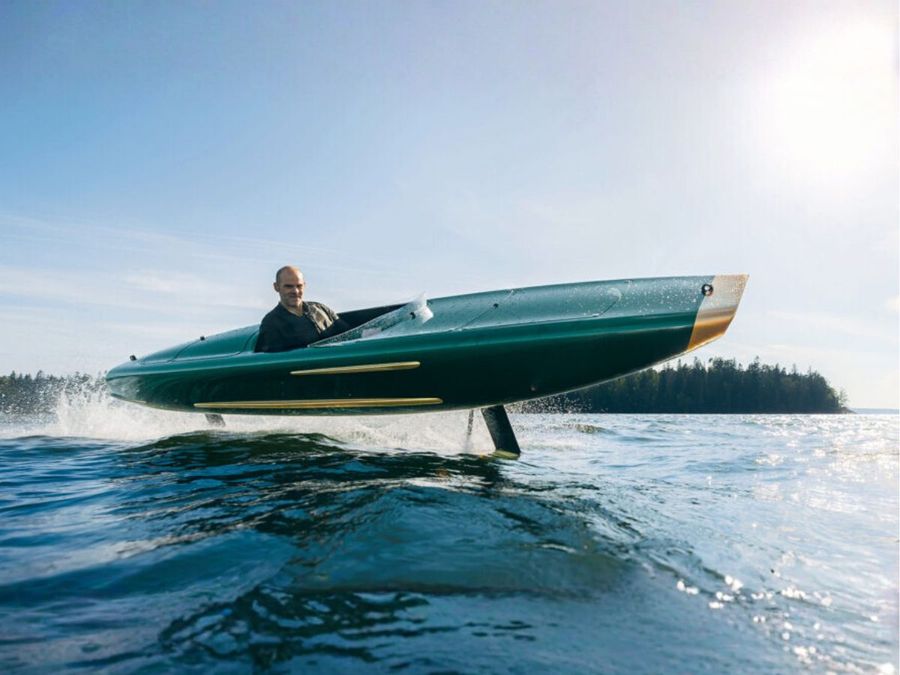
The shape of Pegasus is not a styling exercise. It is a direct response to physics. A long, slim hull. A single cockpit. Two foils mounted in a straight line beneath the boat. Each of those choices targets the same enemies: weight and drag. Electric propulsion remains constrained by battery mass, and batteries still weigh a great deal relative to the energy they store. The only way to make high-speed electric boating genuinely viable is to take the hull out of the water altogether. Lift it clear, and drag collapses. The 14.9 kilowatt motor and twin Torqeedo batteries can then hold a steady cruise of around twenty knots for two hours or more, producing almost no noise and barely a ripple of wake. The foils generate enough lift to raise Pegasus onto its struts at around ten knots, and from that point the ride changes entirely.
What sets Pegasus apart from many electric foilers is the decision to keep the height-control system entirely mechanical. Other craft in this space depend on software, sensors and active electronics to maintain their flying height. Pegasus uses a wand. A small physical probe hangs from the front strut, skimming the water surface. When the hull drops and the wand touches the water, the contact pushes it back, altering the flap on the front foil and increasing lift. When the hull rises too high and the wand clears the surface, it swings forward again, reducing lift. This cycle repeats many times per second, quietly correcting height without any electronic intervention. Riders can adjust the sensitivity of the system to suit conditions, dialling in softer responses for choppy water or sharper feedback on flat harbour surfaces.
The steering carries the same philosophy of working with existing human instincts rather than demanding new ones be learned. The handles mimic a bicycle's handlebar. Push with one hand and pull with the other, and the front foil twists beneath the hull, leaning Pegasus into a turn just as a bicycle leans through a corner. Throttle is controlled by the right foot. The result is a craft that asks for balance, lean and countersteering, yet one where the basic movements feel recognisable within minutes rather than requiring extended training. Foil.One puts the time to first flight at ninety seconds. Conditions will always influence that figure, but the intent is clear enough: this should be accessible to someone boarding for the first time, not only to those who already know how to foil.
None of this comes cheaply. The price of Pegasus places it firmly in the category of superyacht toys and high-end recreational gadgets. Yet the questions it raises have a relevance beyond its own market. New Zealand has a long coastline, a culture built around the water, and cities where harbour crossings still push commuters onto congested roads. If a single person wants to move across the Waitemata on a calm morning, the comparison between 200 kilograms of carbon fibre and several thousand kilograms of hull and petrol is not a trivial one.
Pegasus will not replace anything currently sitting in a New Zealand marina. It is too specialised, too singular, and for now too expensive for that. What it does is show what becomes possible when a design team discards the inherited assumptions of heavy engines and displacement hulls and builds instead from first principles around efficiency, balance and feel. Whether Pegasus finds its way into the mainstream or remains a compelling outlier, it offers a genuinely different way of asking what a one-person boat should be.