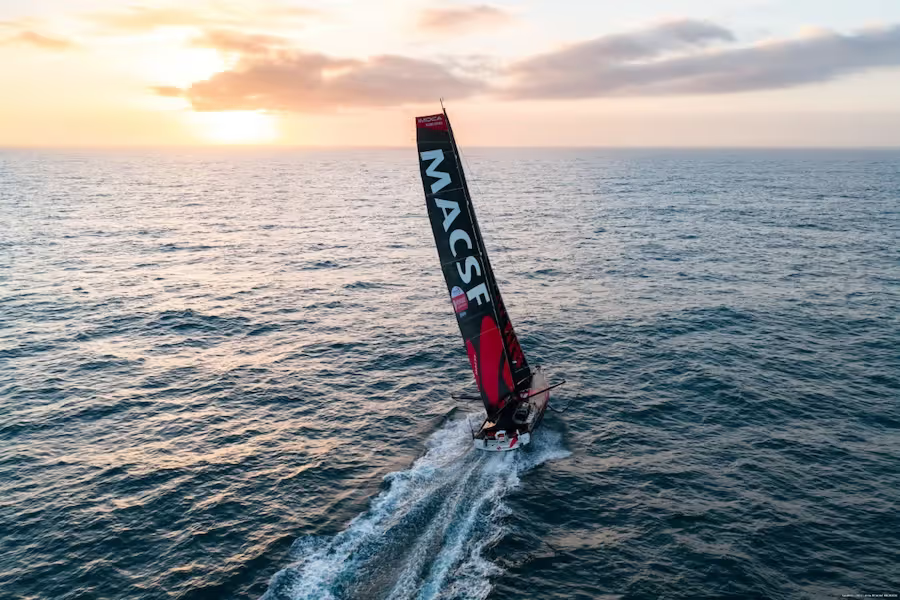
The IMOCA fleet in the Route du Rhum-Destination Guadeloupe was blown wide open on 2 November, and only one skipper caught the move that mattered. Corentin Horeau, sailing MACSF, left his rivals stranded while he sailed into a lead nobody could claw back.
Before the start, most eyes were on the expected duel between Sam Goodchild on Macif Santé Prévoyance and Ambrogio Beccaria on Allagrande Mapei. Sure enough, that pair led the fleet out of the Channel, with Horeau tucked in just 12 miles behind as the fleet gybed south of Ireland.
Then, on day three, everything changed.
"It's dead calm!" Horeau said to camera, headlamp strapped to his forehead, fog pressing in around him. Goodchild and Beccaria had gybed twice to shift roughly 20 miles north, closing in on Sébastien Simon on Groupe Dubreuil-Air Caraïbes, the northernmost boat in the fleet. That left Horeau isolated out front. Nobody realised it yet, but the race had probably already been decided.
MACSF found the trough first. Horeau was slowed like everyone else, but caught the promised north-north-westerly flow and shot south. The others stayed stuck. Goodchild filmed a band of light on the horizon that he needed to reach, but the weather window kept sliding west, out of grasp. Just south of MACSF, Jérémie Beyou on Charal had no better luck, and for more than nine hours the chasing pack sat trapped.
Horeau, meanwhile, was flying at over 20 knots, firing off ten gybes in a row and building a lead of 234 miles, almost unheard of at this stage of a transatlantic race.
Was it luck? More flair than fortune, really. The weather handed MACSF an opening, but Horeau made the call himself, refusing to follow the leaders north and sticking to his own plan. When the gap opened, he pushed hard, aware of the scale of the opportunity, yet still found time between gybes to film himself charting the narrow band of wind he was exploiting. The gybes lasted no more than ninety minutes apiece, tense and exhilarating in equal measure. Picture the adrenaline each time he clicked back to his navigation screen after a manoeuvre, only to find the rest of the IMOCA fleet still parked, the gap still growing.
The run that followed was no easy cruise. Horeau had to hold his nerve, protect the lead without breaking the boat, in thoroughly miserable conditions that battered the entire fleet. MACSF began matching speeds with the Ocean Fifty trimarans. For all his energy, Horeau stayed level-headed rather than boastful.
In a class where routing assistance is banned, he was the one finding the way through, nailing every transition without a single navigational slip. His lead stretched as far as 364 miles in a tropical depression, dipped through the eye, then settled around 200 miles. Only a serious technical failure could have denied Corentin Horeau a famous win on this Route du Rhum-Destination Guadeloupe. It was his first solo IMOCA transatlantic, and he made quite an entrance.