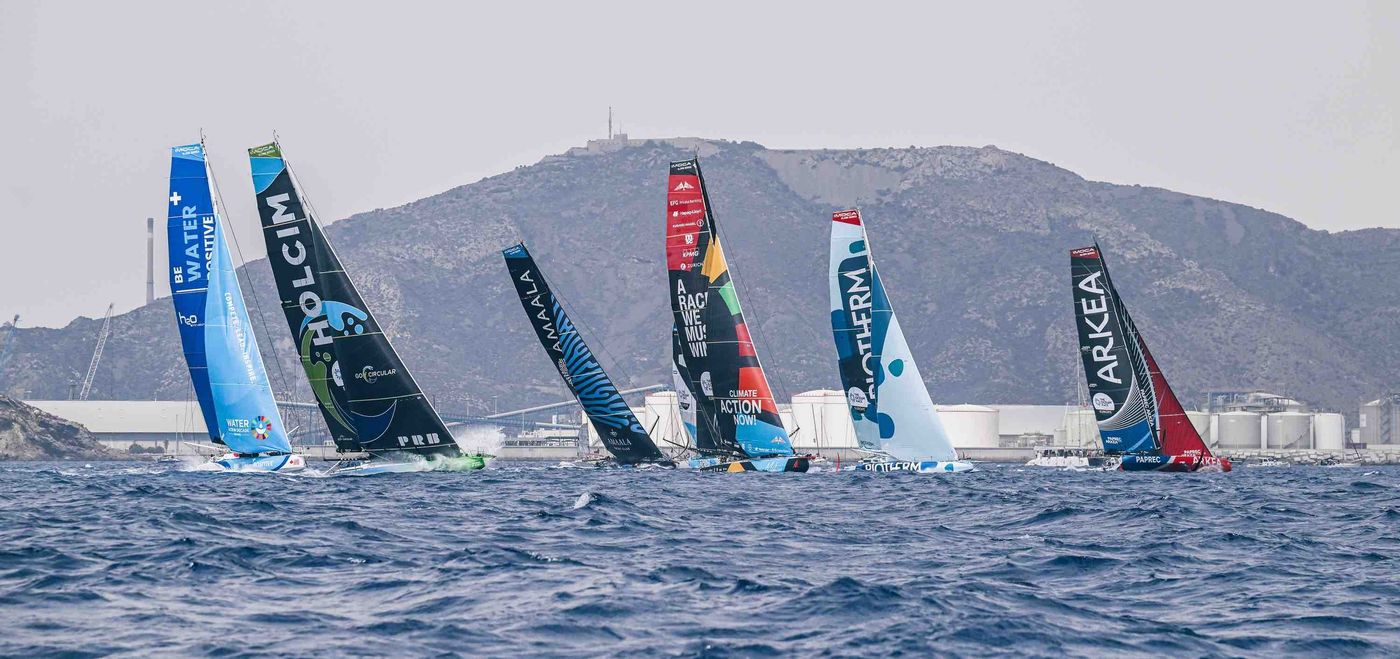
Seven IMOCA 60s departed Cartagena on Tuesday afternoon beneath a cheerful mix of blue sky and patchy cloud, setting out on Leg 3 of The Ocean Race Europe 2025. The 680-nautical mile passage to Nice represents the halfway point of the race, and with 12 to 17 knots of north-easterly breeze filling their sails, the mixed-gender crews drove hard upwind from the moment the start gun fired, targeting the scoring gate at Cabo de Palos.
The stopover in Cartagena lasted four days and marked the ancient port city's first appearance on the race calendar. Speed trials and dockside entertainment kept fans engaged, but once Tuesday came around, the focus shifted decisively back to competition.
A forecast of rare complexity greeted the skippers as they prepared to leave. The Mediterranean course past the Balearics, around Corsica's Giraglia rock, and into the Côte d'Azur is rarely straightforward, and this edition promises to be particularly unpredictable. Most skippers agreed on one thing: the opening night would be manageable enough, but after that, very little was certain.
Biotherm's skipper Paul Meilhat put it plainly. "The first 20 hours seems clear, but then there is a low pressure on the way. We don't really know what will happen but it will change the timings a lot." Routing models are presenting options to the north and south of Mallorca, and the approaching low could either produce a punishing upwind battle or swing conditions around into fast downwind running. Mediterranean racing at its most characteristic.
[embed]https://theoceanrace.s3.amazonaws.com/videos/converted/m188095_250825_SAM_GOODCHILD_BIOTHERM_VNR7_ENG_crop_id_64001_Web-preview_18819201756205603.mp4[/embed]
By evening, the bonus points at Cabo de Palos had been claimed. Biotherm crossed the scoring gate first to collect two points, extending their flawless record in the overall standings. Paprec Arkéa, currently sitting second overall, took one point for second place through the gate. Those points could loom large by the time the fleet reaches Nice. Further back, Holcim-PRB and Allagrande Mapei Racing were engaged in a fierce tussle, while Team Malizia took an early gamble, pushing offshore to the south in search of a different angle on the race.
Meilhat made one significant change to his Biotherm crew for this leg, bringing in Vendée Globe sailor Benjamin Ferré. "We need some refreshment – some new energy – and Benjamin will bring something new and different," he said.
Over on Team Malizia, Boris Herrmann returned to the helm after sitting out Leg 2. The German skipper spoke of "massive uncertainty" ahead and acknowledged the tactical puzzle that racing past Mallorca always presents.
[embed]https://theoceanrace.s3.amazonaws.com/videos/converted/m188180_250826_BORIS_HERRMANN_MALIZIA_VNR7_ENG_crop_id_64001_Web-preview_70948701756216663.mp4[/embed]
For Allagrande Mapei Racing's Italian skipper Ambrogio Beccaria, this stretch of water carries particular personal weight. "I love Mediterranean sailing, I was born here and it is what made me love the sea," he said. "But sometimes it is a difficult relationship and it is hard to understand what she wants." The whole fleet will wrestle with that same tension between familiarity and unpredictability over the days ahead. The Mediterranean offers none of the ocean's endless, consistent fetch, but its compressed systems, shifting headwinds, and dramatic headlands create a form of racing that demands as much gut instinct as it does data.
The leading boats are expected to arrive in Nice around 29 August, though few in the fleet would be prepared to stake much on that estimate. With a low-pressure system in play and routing options still wide open, the leg could unfold in almost any number of ways. As the fleet cleared the Spanish coast and tacked into the evening light, the crews settled in for a first night of demanding upwind work, knowing the real surprises were still to come.