In April 1968, a 20-foot timber hydroplane thundered across the freshwater expanse of Lake Rotoiti near Nelson and became the first boat to crack 100 miles per hour on those waters. That moment has only grown in significance, and Flak Too now stands as one of the great landmarks of New Zealand powerboat history.
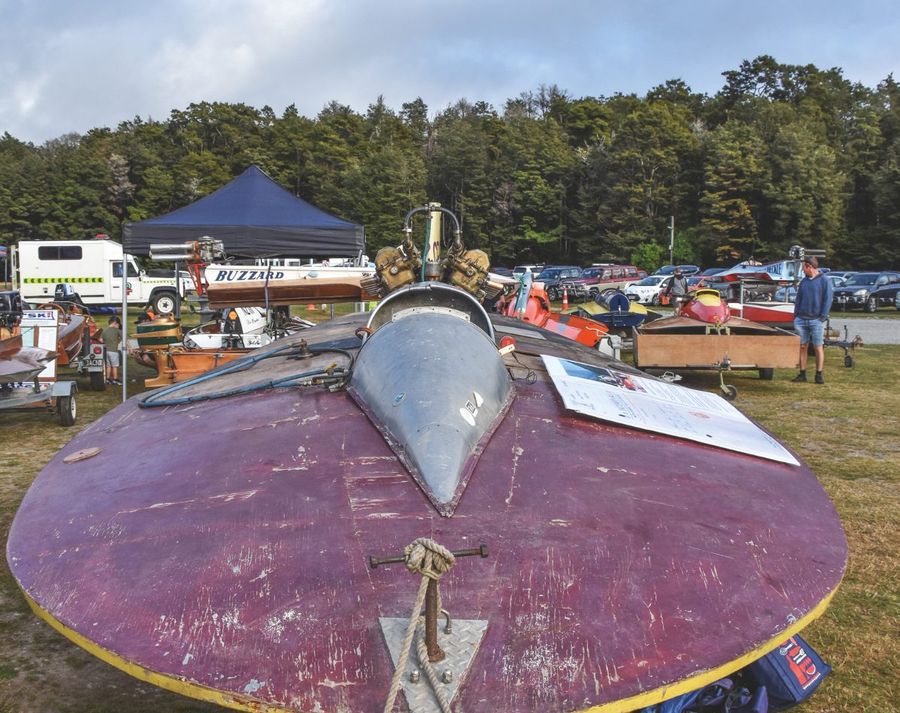
As Lawrence Schäffler explored in an earlier article, Flak Too dates from 1952 and was built in Nelson by Joff Kroening. Her hull follows the classic three-point hydroplane layout, with twin bow sponsons and a single propeller driven from the transom, across 20 feet of timber construction. The designer is believed to have been an American powerboat champion, though his precise identity has never been firmly established.
From her earliest days, Flak Too was inseparable from the story of Lake Rotoiti and the wave of speed boating enthusiasm that swept New Zealand in the years after the Second World War. Performance was chased hard and refinement came later. Hulls were modified in sheds and workshops, engines borrowed freely from whatever industry offered the most grunt, and innovation and risk went hand in hand.
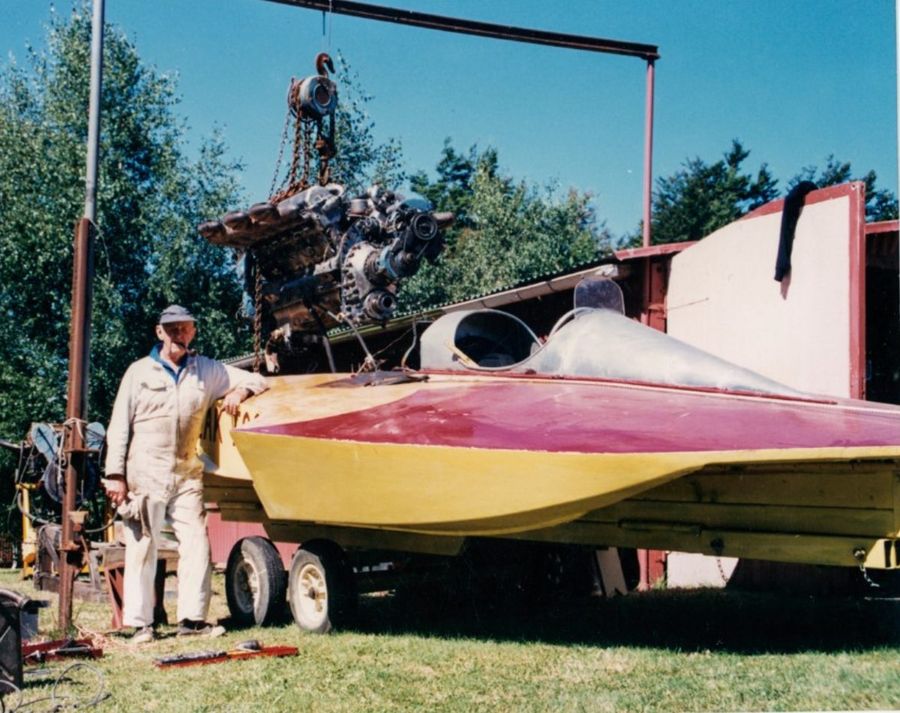
Flak Too lived that reality to the full. Over her competitive life she caught fire three times and sank six times, incidents that were simply part of the landscape when timber hulls were being pushed beyond their limits and high-output engines were being pressed into service from other industries entirely.
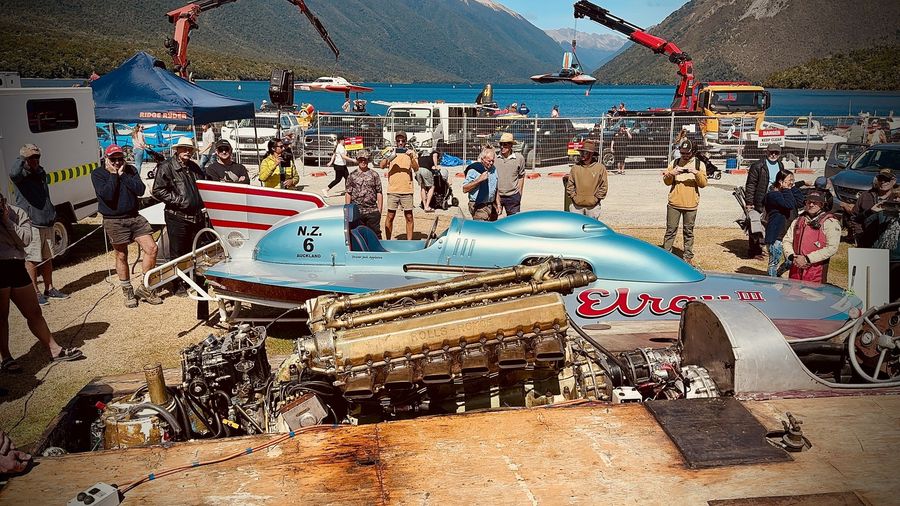
Her original owner, Dick Shuttleworth of Wakefield, ran a local garage and made the relentless pursuit of speed something close to a vocation. He began with a 225 cubic inch flathead Ford V8, then replaced it with a 265 cubic inch Chevrolet V8 in search of more performance. At one point he went further still, experimenting with a Rolls Royce V6 created by halving a V12 Kestrel aircraft engine. The V6 proved less than ideal, and the decisive move came when Shuttleworth fitted a complete 1928 Rolls Royce Kestrel V12, an engine displacing around 22 litres that had originally been developed for military aviation.
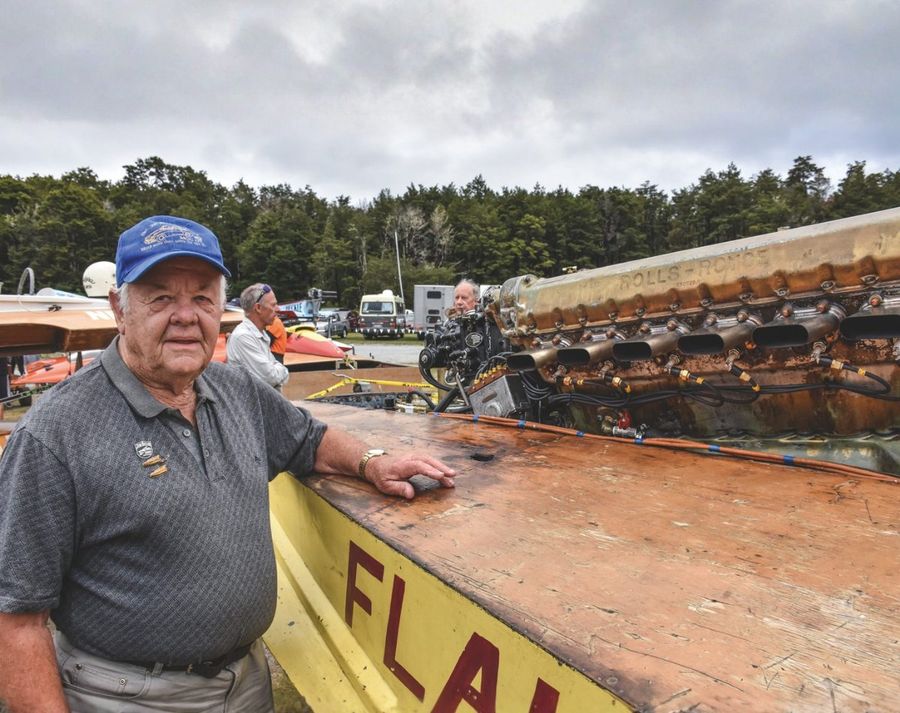
His son Jack Shuttleworth captures that spirit simply: "She was and still is a wonderful vessel. Dad just kept looking for more speed."
The Kestrel delivered somewhere in the region of 750 horsepower in its period configuration. In a lightweight 20-foot hydroplane, that figure was genuinely formidable, and the results followed. Flak Too surpassed 140 miles per hour and claimed the South Island championship at New Brighton. In February 1972 the engine died mid-run on Lake Rotoiti during a 100 mph pass and the boat was swamped by its own wake. She was towed ashore undamaged.
Getting the Kestrel running required ingenuity that matched the engine itself. Standard starter batteries, even those supplied from an attendant launch, simply could not handle the load. The solution was characteristically practical. "The load was usually too much for the starter batteries, which were on an attendant launch, so we hooked up her engine to a chainsaw," Jack Shuttleworth remembers.
The Rolls Royce Kestrel holds a genuine place in aviation history beyond its connection to Flak Too. It was the direct predecessor of the Merlin engines that powered the RAF's Hurricanes, Spitfires, Mosquitos and Lancasters through the Second World War. While later Merlin variants would exceed 2,000 horsepower, the Kestrel laid the engineering foundations, producing between 450 hp and 750 hp depending on the model. There is a further historical wrinkle: in the early 1930s, Kestrel engines were supplied to Germany and fitted to early prototypes of the Messerschmitt Bf 109 and the Stuka dive bomber. Decades on, that same engineering lineage was reverberating across a Nelson lake inside a timber hydroplane.
The survival of Flak Too into the present is the result of determined advocacy by local enthusiasts. The boat had rested in the Nelson region for many years and was at one stage reportedly close to being sold to an Australian syndicate with its eye primarily on the Kestrel engine. Pete Rainey and Glenn Common stepped in to acquire the vessel, keeping both hull and engine on New Zealand soil.
Today, thanks to the work of Nelson engineer Don Walker, the Kestrel runs again. Numerous components have been machined from scratch, among them new cylinder liners, in work that carries the same craftsmanship that defined the boat's competitive years. The hull still requires substantial restoration, but the engine, the beating heart of Flak Too, has been brought back to life.
At both the 2023 and 2024 New Zealand Antique and Classic Boat Show, Flak Too was on display not as a static museum piece but as a direct, physical connection to an important chapter in this country's hydroplane and powerboat story. Her 1968 record on Lake Rotoiti remains a fixed point in that history.
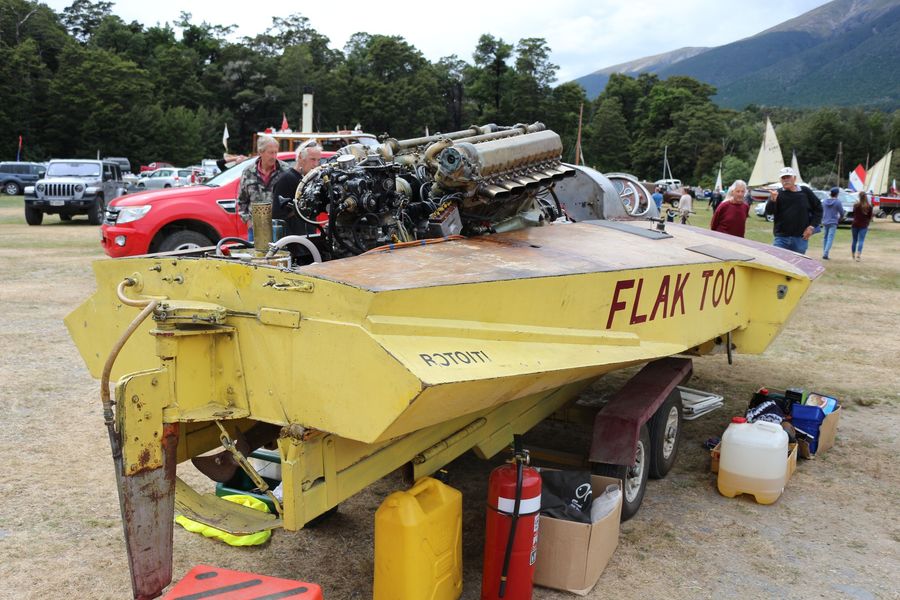
More than seventy years after her launch, Flak Too continues to embody the mechanical ambition and sheer determination that drove early hydroplane racing in Aotearoa. The run she made across Lake Rotoiti at more than 100 miles per hour is still etched into New Zealand's maritime past, a reminder of what bold thinking and hard work could achieve when the only real measure was what the stopwatch said.
The New Zealand Antique and Classic Boat Show is scheduled to be held at Lake Rotoiti, Nelson Lakes, on 7–8 March 2026.