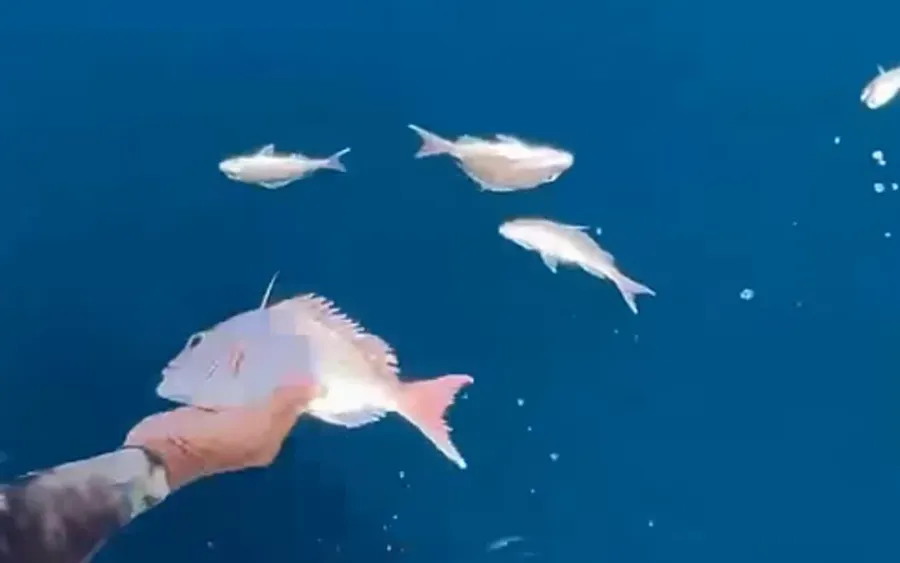
Darren Shields had barely surfaced before he knew what he was looking at. The spearfisher, who captured the scene on video near Great Barrier Island, says it was immediately recognisable, and that it was not the first time he had witnessed something like it.
The footage, which circulated on social media, shows dead fish floating at the surface. Following a complaint, Fisheries NZ confirmed it had identified a vessel operating in the area and launched an investigation.
Shields describes watching fish stocks decline steadily over the years, and believes inaction at critical moments has brought things to this point.
"We never did something when it was time to do something," he said. "We've been allowed to take too much, recreationally and commercially, for too long..."
Both commercial and recreational fishers, he argues, need to operate under tighter restrictions. New Zealand's population keeps growing, more people want to get out on the water and catch a meal, and that pressure has to be accounted for somewhere.
"Take a little bit less, allow for these extra people, get commercial better at what they're doing so they're not bottom trawling," he said.
Shields is particularly critical of bottom trawling, which he sees as causing two distinct harms: destroying seafloor habitat and hauling up undersized fish or species sitting outside the quota management system. He argues that adding more fish to that system is not the answer.
"You don't put it in the quota management system, you stop bottom trawling, so you stop the destruction of the bottom and the catching of undersized fish and fish that aren't in the quota management system," he said.

"You fix the problem, you don't add to the problem."
Fisheries NZ regional manager Andre Espinoza said the agency was examining whether any fisheries offence had taken place. He noted that illegal discarding from commercial vessels is uncommon, partly because many boats carry onboard cameras and partly because vessel movements can be tracked in near real time.
"Illegal discarding of fish from commercial vessels is relatively rare because of the prevalence of on-board cameras on many vessels and because we are able to track the movements of vessels in near real time. However, we do receive complaints from time to time and follow up on each on," Espinoza said.
As part of the investigation, Fisheries NZ indicated it would review the vessel's onboard camera footage, catch reporting records, and GPS tracking data.