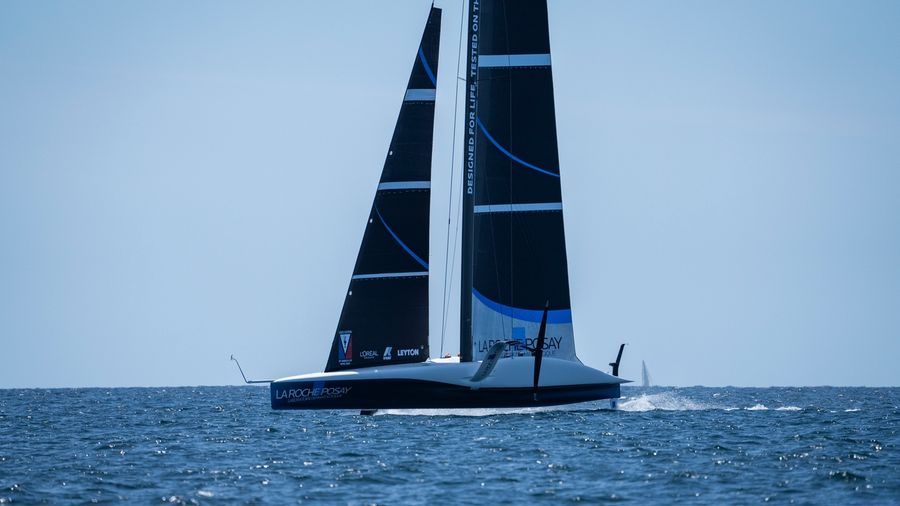
The La Roche-Posay Racing Team took their boat to sea for the first time in French waters, sailing off Lorient in a day that marked a historic point in the campaign.
The day began with a tow out from the team's purpose-built AC75 facility, the harbour atmosphere charged with anticipation as crew and support staff watched conditions carefully before committing. Once the famous port was behind them and open Atlantic water lay ahead, spectator craft moved in to watch. No AC75 had previously sailed in French waters, and nobody present was in any doubt about what they were witnessing.
Quentin Delapierre and Diego Botin were at the controls as the boat, dressed in its azure blue and white livery, made its first moves in the third iteration of the AC75. As a sister-ship to Taihoro, the all-conquering Emirates Team New Zealand boat, La Roche-Posay Racing Team begin their preparations for Naples 2027 from an enviable foundation.
The version three AC75 moves away from earlier generations of the class. The cyclors who powered hydraulic systems on previous boats are gone, replaced by a battery-based arrangement that demands careful energy management from the crew. Six crew pods sit high on the deck's combing arc in a layout broadly consistent with the Kiwi configuration, with trimmers and flight controllers positioned forward, the helms tucked in behind, and a fifth role remaining undefined just aft of the starboard helm position. The port pod furthest aft has been designated the Guest Racer position, a spot set to become highly sought-after once racing begins in Naples.
Jason Saunders and Timothé Lapauw handled trim and controls during this first outing as the team worked through a short upwind leg, a bear-away, and a downwind run. Flight was steady and crew coordination was solid throughout. The session was always intended as a shake-down rather than a performance push, a methodical opportunity to run through the checklist and confirm the boat's many systems were functioning as expected.
Delapierre reflected on the day afterwards. "It was a good setup. Just checking all the hydro settings and the aero systems. Also, first time sailing with sails on an AC75 in France, on water. So yeah, it was pretty special. We had a decent day. All the checks are done, and we're ready for the rest of the week...today, first we had to check all the systems. It was the first time. Also check the sails. We had a bit of upwind, a bear away, a downwind, and after we tried to fine-tune some of the systems before we went back to the harbour."
Before leaving the dock, Delapierre had briefed his sailing crew that their priority for the day was to serve the shore team rather than chase performance. Asked to elaborate, he was candid. "Yeah, it was just because the shore crew and the team worked pretty hard in the last weeks, and it's pretty hard work. Today was honestly just to follow the checklist and see if all the systems are in and in a good shape, and the performance and sailing will come after. It was not a super high-pressure day."
The fuller picture of what unfolded on the water is provided by the on-water recon report compiled by observers who have been tracking the campaign closely.
The team had indicated they planned to sail B1 for the first time on Tuesday 30 June, the opening sailing day of the AC38 campaign. The objective communicated at the dock-out brief was to validate the sail control systems through one upwind and one downwind at approximately 75% of maximum load.
B1 was rolled out of the shed at around 08:15 and taken to a different crane from the one used on D3, where the port and starboard foils and rudder were fitted. The rudder appeared consistent with what had been seen on D3, though it was raked further aft so the elevator leading-edge root sat clear of the hull. Orange marks were visible on the outboard wing tips of both foils, with white marks sitting slightly inboard along the leading edge on the outboard side of each wing tip. The anti-ventilation fences on the foil arm fairings appeared consistent with those observed on D2.
Mast stepping followed a broadly familiar sequence. The forestay was attached and a tensioning process carried out, during which it was detached and reattached while the halyard remained under tension on the hydraulic ram, with mast bend monitored throughout. A crew member was hoisted aloft to remove temporary holding ropes before the hydraulic ram was taken away. B1 entered the water at approximately 09:42, bow facing seaward, consistent with what had previously been observed on D3.
Once alongside the dock, a crew member was sent back up the mast via a hand drill-driven halyard to remove the crane hooks and a temporary spreader piece. The Cunningham hydraulic rams connected to the orange hydraulic lines were then installed to complete the Cunningham system, and the remaining temporary fittings along with the temporary forestay were removed. A thorough dockside validation of the control systems followed, covering mast rotation to both sides, full foil cant cycles, and checks of the mainsheet, traveller, sheeting angle, and mast rotation systems, with several often run simultaneously from laptops on deck. Both mainsail skins, designated MN2-1, were loaded, and two jibs, J3-2 and J4-2, were also on deck.
With Quentin Delapierre on the starboard helm, Diego Botín on port, and Jason Saunders and Timothé Lapauw also aboard, B1 docked out at approximately 11:12 and departed under a short tow to clear the harbour.
The mainsail was hoisted on both sides before the jib went up, and a crew member was sent aloft to carry out checks around the jib hook. After the tow concluded, B1 sailed briefly in displacement mode before lifting onto the foils at approximately 13:02. The boat reached up and bore away to an estimated true wind angle of around 150 degrees on starboard, working through varying modes of roughly plus or minus 10 degrees. Boat speed appeared to be in the region of 30 knots, possibly approaching 40 knots, with a fairly constant ride height, though some pitch movement developed toward the end of the run. A single gybe followed, accompanied by a pronounced touchdown. B1 then struggled to regain stable foiling, with both foils down and significant windward heel before eventually recovering. Ride height and pitch stayed irregular before the boat briefly settled in a bow-down attitude. On a short port segment, raising the windward foil again produced further instability and another touchdown before the foil was lowered once more. B1 then stabilised briefly, headed up, and stopped on the water at approximately 13:14 after around 15 minutes of sailing. Noticeable mast bend remained visible under load while the boat sat stationary.
The technical team boarded to carry out checks while the crew completed team photographs. Once those checks were done the technical team disembarked and B1 appeared set to resume sailing, most likely for an upwind leg, with the chase boat preparing a bow tow. An apparent interruption then followed. The technical team came back aboard and a prolonged wait on the water ensued. Eventually, after the mainsail and jib had been lowered and work had been carried out around the mainsail tack, B1 was bow-towed back to base from approximately 14:37. The reason for the curtailed session could not be confirmed.
B1 docked back in at approximately 15:20. Once alongside, small inspection openings in both inboard foil arm fairings were opened and personnel appeared to inspect the area before applying an unidentified coating or lubricant at several locations. Vibration fairings were also noted on the shrouds and lowers. During end-of-day handling, one foil was observed being pushed down manually rather than through the foil cant system, though whether this was connected to the earlier interruption or simply reflected normal handling could not be determined.
The boat was lifted out at approximately 16:23, with blue markings visible on the foil wings and beneath the foil bulb. The mast was unstepped and rinsed on the pontoon before B1 returned to the shed at approximately 18:08. Shore operations continued normally throughout, though the atmosphere around the team was somewhat subdued following the shortened session, with observers noting the interruption may not have been entirely routine. That, however, remained unconfirmed.