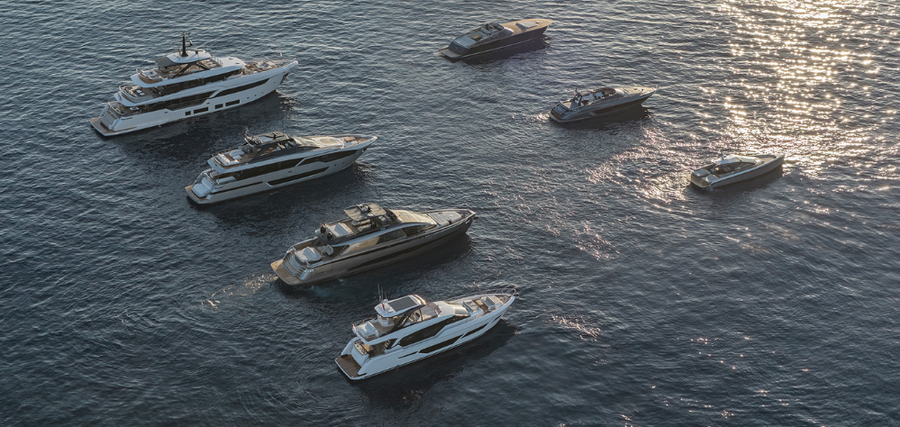
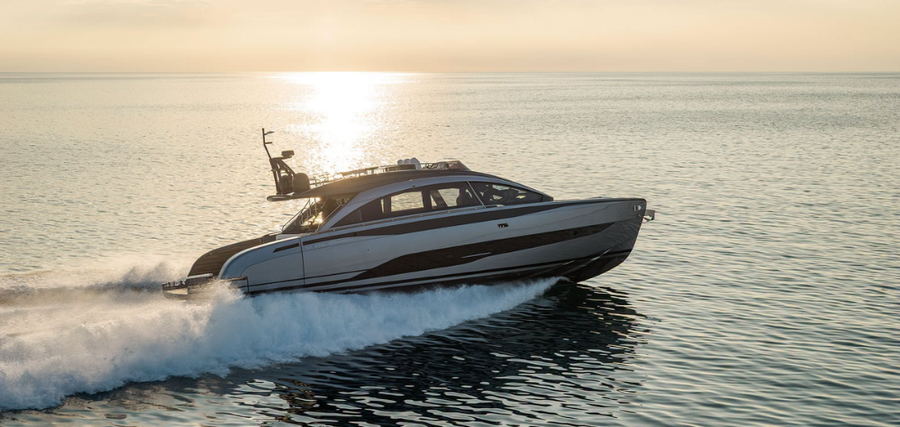
Ferretti Group has brought the Pershing GTX70 to the 2026 Fort Lauderdale International Boat Show, which opened on 28 October and runs until 1 November. The 21.8 metre sport utility yacht, with its triple Volvo Penta IPS propulsion, expansive aft deck and fold-out terraces, is among the models representing the Italian builder in the important American market. Its appearance comes just a day after Ferretti released financial results showing a welcome improvement in third quarter orders, although profitability remains under pressure.
The group, whose brands include Riva, Pershing, Wally and Ferretti Yachts, reported a 6.6% increase in third quarter orders and a 13.6% rise in revenue compared with the same period last year. Across the first nine months of 2026, however, revenue held steady at €888.6 million, adjusted operating earnings fell 7.8% to €130.6 million and net profit dropped 18.2% to €49.9 million.
The results, released on 27 October, prompted Ferretti to cut its full year adjusted operating earnings forecast from €186 million to €197 million to a revised range of €174 million to €185 million. Its revenue forecast remains unchanged at €1.2 billion to €1.24 billion. Chief executive Stassi Anastassov acknowledged the difficulty, saying, “But growth alone is not enough.” The company has invested heavily in expanding production, particularly at Ravenna, while demand for smaller composite yachts is recovering faster than orders for larger, individually commissioned vessels.
Composite yachts lead Ferretti's recovery
Ferretti divides its new yacht business into composite, made-to-measure and Super Yacht divisions. Composite yachts are built around established designs, although buyers can still specify extensive equipment and finishes. Made-to-measure vessels are generally larger and more individually configured, while superyachts involve longer construction programmes.
The strongest growth has come from Ferretti's composite yacht division, where orders rose 28.2% to €357.3 million during the first nine months of 2026. New model introductions and the European boat show season helped drive a particularly strong third quarter, with orders in this division increasing 58.3% compared with the same period last year. Demand for larger, more individually specified yachts has been less encouraging, with made-to-measure orders falling 31.5% to €290.4 million.
The contrast is even sharper in the Super Yacht division, which recorded no new contracts during the nine months, compared with two orders worth €64.2 million a year earlier. There is still a substantial programme of yachts under construction, with €542.3 million in existing orders at the end of September, but fresh contracts have been slower to arrive. Ferretti attributes some of that hesitation to geopolitical uncertainty and longer negotiations with buyers, particularly in the Middle East.
Although the renewed interest in composite yachts has given Ferretti a stronger third quarter, it has not made up for the reduction in larger yacht orders. Across the group, total orders for the first nine months reached €664.9 million, down 13.8% from the corresponding period in 2025, while the total order backlog stood at €1.33 billion, 11% below the previous September.
Why Ferretti's profits are falling
Ferretti's October investor presentation identifies several reasons for weaker profitability, beginning with the changing mix of yachts being sold. Larger, more individually specified vessels have generally contributed more to earnings, so fewer new orders in those divisions affect the balance of the business. Ferretti also reported inefficiencies within subsidiaries that supply its production operations, leading to additional costs and delivery delays, although the company has not identified the affected yards or boat models.
More competitive selling conditions have also reduced margins, while additional customer service commitments, including an extra year of cover under the Ferretti Quality Promise programme, have added to costs. Together with lower use of some fixed production capacity, these factors reduced Ferretti's adjusted operating margin from 16% to 14.7%. Anastassov acknowledged that “Our profitability remains below the level Ferretti Group can and should deliver.”
The company is responding with changes to pricing, product mix, manufacturing efficiency and shipyard utilisation. For buyers, the extended warranty offers a tangible benefit, although Ferretti must absorb the additional cost of supporting each yacht. Management's explanation of the weaker margins does not establish that any particular shipyard is responsible.
Ravenna moves into yacht production
Ferretti's expansion at Ravenna is one of its largest recent industrial projects. The group acquired the former San Vitale shipyard in March 2023, initially securing around 70,000 square metres, before a further land purchase in January 2024 increased the site to approximately 100,000 square metres. The development was intended to ease pressure on existing facilities and provide additional capacity for composite yacht construction.
By November 2025, Ravenna had launched its first new-generation Ferretti Yachts 720, a 22.5 metre flybridge motor yacht destined for the American market. The new model features a four-cabin arrangement, redesigned glazing and a revised relationship between the saloon, galley and wheelhouse. The launch, confirmed by Ferretti in December, marked an important stage in the yard's development as it moved from construction work into regular yacht production.
Investment spending is now easing as major expansion work reaches completion. Ferretti spent €45.5 million on capital projects during the first nine months of 2026, down 29.5% from the same period in 2025, while management reported production capacity use of approximately 80% across much of the group. That figure is not specific to Ravenna, and Ferretti has not disclosed how profitably the new yard is operating.
With the additional manufacturing space now available, Ferretti must match production schedules, skilled workers and suppliers to a changing mix of orders. The recovery in composite yacht demand provides work for facilities such as Ravenna, but the company's wider production network must also accommodate slower new business in its larger yacht divisions.
New leadership at Ferretti
Stassi Anastassov became Ferretti Group chief executive in May 2026, succeeding Alberto Galassi after a contested board election that also prompted shareholder litigation. On 12 October, the Court of Bologna rejected an application for interim relief, although the underlying proceedings remained unresolved.
Anastassov has identified pricing, product mix, manufacturing efficiency and better use of shipyard capacity among his priorities, while also highlighting opportunities in the Americas, Middle East and Super Yacht division. His statement acknowledged the geopolitical uncertainty and longer customer decision-making cycles affecting the business, while stressing the need for management to improve what it can control.
Ferretti continues to develop selected facilities, announcing in October that its Ancona Superyacht Yard had received authorisation to accommodate vessels up to 100 metres, an increase from the previous 90 metre limit. The group is working to improve returns from its expanded production network while maintaining the craftsmanship and individual specification expected across its brands.
How Princess, Beneteau and Sanlorenzo are responding
Other European builders are taking different approaches to changing market conditions, with Princess Yachts demonstrating that improved profitability does not always require higher sales. The Plymouth builder reported 2025 revenue of £321.8 million, down from £378.1 million in 2024, yet adjusted operating earnings increased from £13.4 million to £35.9 million. Princess also returned to an operating profit of £17.6 million after an £8.1 million loss the previous year, supported by manufacturing improvements, cost control and a more disciplined approach to production.
Groupe Beneteau has taken a more drastic approach to declining demand in its American powerboat business, halting production at its long-established Cadillac factory in Michigan during August. The facility, associated with Four Winns boatbuilding since 1975, had seen output fall from 2,313 boats in 2022 to just 474 in 2025. By September, local reporting indicated that nearly 200 workers had been laid off, with approximately 50 retained for maintenance and customer support. As Go Boating reported in June, the French group had announced plans to sell the factory and its Four Winns, Glastron and Scarab Jet brands, whose combined operating losses reached approximately €30 million across 2024 and 2025. Beneteau has promised continued spare parts and after-sales support during the sale process.
Sanlorenzo provides a different picture at the luxury end of the market, reporting €496.4 million in new orders during the first half of 2026, up 18.3%, with an order backlog of approximately €1.03 billion. The Italian builder maintained its full year revenue and earnings forecasts, reflecting a stronger order trend than Ferretti has experienced in its larger yacht divisions.
Although these figures cover different reporting periods and product ranges, they show how differently manufacturers are responding to demand across the boating market. Ferretti's composite yacht business has regained momentum and Ravenna is now producing boats, while its larger yacht divisions still have substantial work on hand despite fewer new contracts. The next set of results will show whether the recovery in orders is beginning to deliver stronger profits.