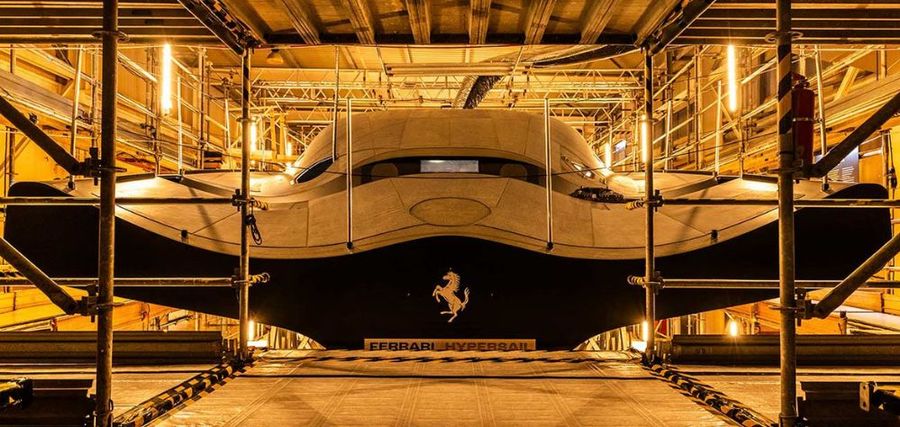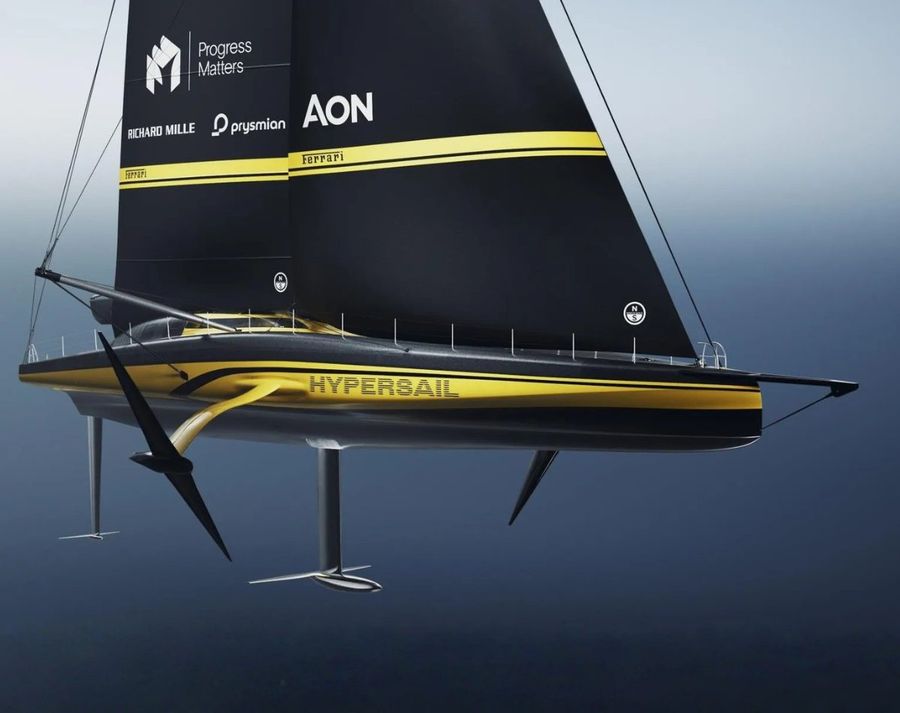
There are racing colours so deeply woven into sport that they need no introduction. Ferrari's palette is among them, and now it is making the crossing from circuit to open ocean. During Milan Design Week, Ferrari Hypersail revealed the livery that will cover its 100-foot foiling ocean monohull, a vessel whose every graphic and tonal decision has been made with the same rigour applied to anything that leaves Maranello.
The project grew from an unlikely convergence of disciplines rather than any straightforward branding exercise. Ferrari's Tech Team, headed by Matteo Lanzavecchia and Marco Guglielmo Ribigini, has been working alongside the Ferrari Design Studio under chief design officer Flavio Manzoni, and with naval architect Guillaume Verdier. Their shared ambition is to build a boat where aerodynamics, hydrodynamics and aesthetics all answer to a single brief. The principle they have set themselves is as simple to state as it is demanding to execute: let performance define the constraints, then let design make those constraints beautiful.
That philosophy reaches into every surface of the vessel. The hull's streamlined form draws from the proportional character of the Monza SP1/SP2, while the coachroof graphics take their architectural reference from the Le Mans-winning 499P Hypercar. Solar panels are flush-integrated into the deck and hull sides, their placement determined only after a thorough study of solar exposure across actual navigation conditions. Finished with grip surfaces and secured by dedicated clip systems, they are walkable, leaving the crew free to move without obstruction.
Lanzavecchia, who holds the title of Head of Vehicle Engineering at Ferrari and Chief Technology Officer of Hypersail, framed what the team is working to achieve: "Hypersail is a vessel unique in scale and technology, engineered to deliver peak performance within an environment as singular and unpredictable as the ocean." The boat foils on a combination of wind, solar and motion-generated energy, with its control systems drawing directly from Ferrari's automotive development programme.
Two colours anchor the livery, and each carries its own history. The hull is finished in Grigio Hypersail, a new shade of grey developed so that the carbon fibre structure beneath can assert itself rather than disappear under pigment. Set against it is Nuovo Giallo Fly, a yellow whose place in the Ferrari story stretches back a considerable way. The colour traces to a suggestion made by Fiamma Breschi, a friend of Enzo Ferrari and the widow of driver Luigi Musso, who raced wearing a yellow helmet. Giallo Fly made its first appearance on the 275 GTB, and on a foiling sailboat the name acquires a fresh layer of meaning: a boat that flies.
Where that yellow wraps the cabin, foils and hull lines, it references the colour separation used on the 512 BB, which Ferrari identifies as the first integrated livery in its history. The Ferrari logo carried on the sail uses the elongated "F" form that has featured across recent programmes, from the 2023/24 F1 car through to the Daytona SP3.
Milan Design Week runs from 22 to 26 April, and throughout that period the project is on display inside the Ferrari Flagship Store in the city. On the main terrace of HIGHLINE Milano, overlooking Piazza del Duomo, a lighthouse sculpture produced by the Ferrari Design Studio marks the occasion.
For Manzoni, the project brought a genuinely unfamiliar kind of challenge. Decades of racing car work had shaped a particular way of approaching design problems, and this boat offered the chance to apply that thinking within constraints drawn not from a circuit but from the open ocean.
Construction continues. Ferrari has, however, already settled exactly how she will look when she flies.