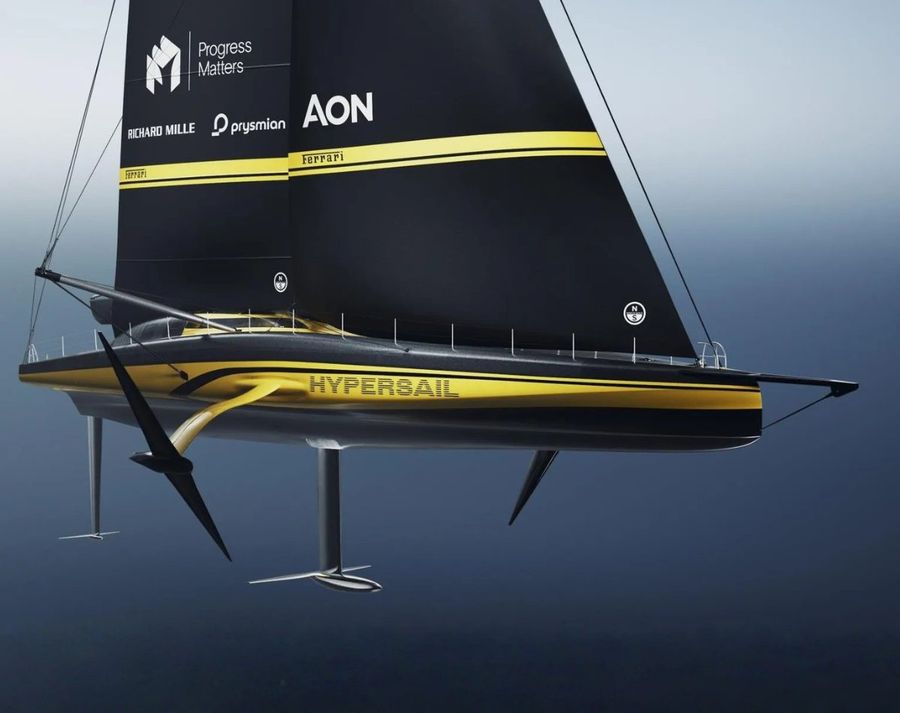
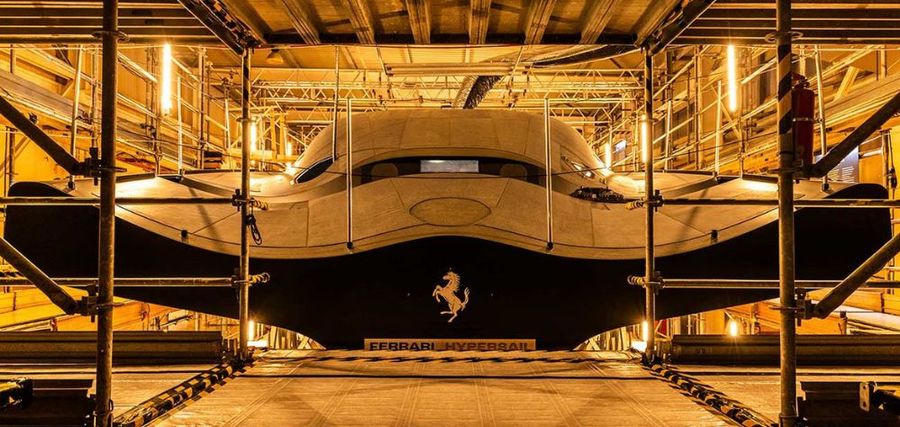
Ferrari has painted the hull of its foiling ocean monohull and shown its foils, keel and rudder for the first time. Sixteen months after the public reveal, the project has a new leader, its first sailors, a base under way in Livorno and a rotating mast built in New Zealand, with first sailing trials scheduled for early 2027.
The hull of Ferrari Hypersail is now fully painted in its grey and yellow livery, and the appendages that are meant to lift 30 metres of carbon monohull clear of the water are sitting in the yard near Pisa. Ferrari announced the milestone on 16 October, after letting groups of journalists through the yard earlier in the week. French offshore racing site Sailorz, which toured the build, reports that the first sailing trials are scheduled for the end of the first quarter of 2027.
It caps a busy few months. Since July, Ferrari has published the boat's energy system, signed an electrification partner, named its first sailors, announced a base and now shown the parts that will make it fly.
Three points of flight
Hypersail is designed to fly on three points of contact. The leeward foil, a T-shaped wing on a curved arm, provides the main lift. A second lifting surface sits on the end of the canting keel and carries its own movable flap, which Ferrari describes as the project's distinctive innovation. The third is the rudder, which also has a flap and makes continuous small corrections to hold the course. If the difference between T and L foils is hazy, our explainer on foil shapes sets out how the AC75 and the F50 go about it.
The parts are big. Sailorz reports a 6.5-metre foil arm, a keel that cants through 35 degrees and a keel wing with a 4.8-metre half-span, with titanium flaps on all the lifting surfaces, a material the team chose for its greater resistance to cavitation. Italian marine news site PressMare, which also visited the yard, describes foil trailing edges less than a millimetre thick and a hull with a maximum beam of almost eight metres.
Keeping all of that in balance is the job of Flight Control, an automated system that measures wind, waves, speed and heel, calculates corrections and moves the appendage surfaces through actuators. Ferrari says the system draws on its electronic and dynamic-control work for road cars. Technical team leader Marco Guglielmo Ribigini told Sailorz, "We adapted our car attitude and roll-control algorithms to develop this flight controller," and said ride height can be regulated up to 1.5 metres between the bottom of the keel and the waterline, close to five metres at deck level. Ferrari's position is that the crew still sails the boat, with the automation taking care of flight trim so the sailors can concentrate on the sea and the strategy.
The hull is built from multiple layers of carbon fibre. Where loads peak, at the foil arms and the mainsheet traveller, Ferrari uses a sandwich of carbon and titanium borrowed from its sports-car work. Sailorz reports the traveller is rated for 40 tonnes. Ferrari says the project has produced more than 20 patents, citing the winch-by-wire system, extended-range wind turbines and the system that integrates the renewable energy sources as working examples.
Power without fuel
For anyone following electric boating, the energy system unveiled in July is the most interesting part of the project. There's no combustion engine aboard. Around 100 square metres of walkable solar panels are spread across the deck and topsides, placed only where Ferrari's simulations of different latitudes and routes showed a worthwhile yield. Removable wind turbines mount at the stern, and Ribigini told Sailorz there are three mounting positions but he expects one or two turbines to be enough. Surplus energy goes into two identical 800V batteries.
The hydraulics are split in two. The big, slow movements, canting the keel and the foil arms, are driven by the 800V rear e-axle from the Ferrari Luce, the company's first electric car. The fast, constant flap movements use two smaller pumps on 48V motors. Across the boat there are four voltage levels between 12V and 800V.
Crew muscle becomes electricity too. Ferrari's winch-by-wire pedestals have no mechanical link to the winches. Grinding turns electric motors taken from the active suspension of the Purosangue and F80, and that power goes into the boat's grid to drive winches or a hydraulic pump. Ferrari says one grinder can handle loads of up to nine tonnes. Yachting World's Matthew Sheahan, who tried the test rig at Maranello, describes the load at the handles staying the same whatever the winch is pulling, with the crew turning at around 100rpm. Ferrari links the approach to the by-wire gearshift of its 12Cilindri Manuale.
Swiss-Swedish electrification group ABB joined as electrification partner in September. Project leader Enrico Voltolini summed up the brief at the time: "It has to be self-sufficient for weeks at a time in the most hostile ocean environments on Earth."
How the project got here
Ferrari unveiled Hypersail at Maranello on 25 June 2025, with Italian offshore sailor Giovanni Soldini as team principal, French naval architect Guillaume Verdier as designer, a 2026 launch in the plan and nine patents filed. The work had started well before that. Matteo Lanzavecchia, the project's chief technical officer, told Sailorz the Pisa shed was bare walls when the team moved in four years ago. Sailorz also points out that the bustle, the slim central hull section running bow to stern, is a concept Verdier developed with Emirates Team New Zealand on the AC75 that won the last America's Cup.
The biggest change came in April 2026. Ferrari announced the end of the first design and construction phase, with component installation, validation and system integration to follow, and said Soldini's involvement had ended, PressMare reported. Voltolini, a naval engineer who sailed two America's Cup campaigns with Luna Rossa, took over as project leader. Speaking in July, he said he remained involved with the Red Bull Italy SailGP Team and that Soldini had brought him into the project in July 2025. Verdier stayed on, as did Glenn Ashby, the Australian multihull sailor best known in New Zealand for his years with Emirates Team New Zealand, who heads the rig and sail design. The same month Ferrari revealed the livery at Milan Design Week, and in May the hull was lifted out of its mould, according to The Foil's project explainer.
The first sailors were named on 21 September. Giulia Conti, a four-time Olympian who won the 2015 49erFX world and European titles and helmed the winning boat in the first Women's America's Cup in 2024, takes charge of flight development, navigation and automation, including simulator and sea trial planning. "My goal is to bring my experience to the Team to ensure that technology does not replace human intuition, but rather empowers the sailors to push the boat to its absolute maximum potential in every situation," she said. Shannon Falcone, a veteran of six America's Cup campaigns and record-setting runs aboard the maxi Comanche, will sail on board and coordinate the shore team, with responsibility for on-water operations and safety procedures.
On 1 October Ferrari announced the project's operational base in Livorno, inside Azimut Yachts' premises, with offices, a gym and workshops for hydraulic, electrical and mechanical components and 3D printing. Ferrari described the announcement as the start of construction on the base. Azimut is also building a custom Fly 72 to work as a tow boat, supporting the hull during the initial flight tests and then monitoring sailing trials.
A New Zealand-built mast
The rig has a strong New Zealand thread. Sailorz reports that the rotating mast, around 35 metres tall, was built by Southern Spars in New Zealand. Ribigini told Sailorz the double-skin mainsail, a concept familiar from the AC75s, delivers significantly more power with a shorter mast, cutting weight and lowering the centre of effort. Sailorz describes a North Sails rig with a maximum sail area of 462 square metres. Southern Spars, which is headquartered in Auckland, listed its involvement in both Hypersail and Gitana 18, the new Ultim trimaran, ahead of last year's Metstrade show. Gitana 18 is also a Verdier design.
What comes next
The boat's next home is Livorno, and the Azimut tow boat is earmarked for its first flight tests. Technical partner North Sails expects Hypersail on the water in the early months of 2027. Ferrari's announcements so far haven't named a race or record target. The Foil has reported the design team's goal of 1,000 nautical miles in 24 hours, which it notes would surpass the 908-mile outright 24-hour record set by the trimaran Banque Populaire V in 2009.
Voltolini has been careful to frame launch day as a starting point. Speaking to PressMare in July, he described Hypersail as a prototype and said, "The launch will not represent the end of the process, but the beginning of the boat's real-world development programme."